
Behind the film
- Year
- 1929
- Director
- Dziga Vertov
- Writers
- Dziga Vertov
- Runtime
- 1h 8m
- Genres
- Documentary, Experimental, Silent
- Production
- All-Ukrainian Photo-Cinema Administration
- Country
- Soviet Union
- Cast
- Mikhail Kaufman
About the film
Contains story spoilers.
Man with a Movie Camera is Dziga Vertov's 1929 silent film about city life and the act of filming it. Its brief opening title cards frame a film experiment; after that, no narrative intertitles explain what people are doing. The camera moves through streets, workplaces and public spaces rather than following a fictional hero. Mikhail Kaufman operates the camera, Elizaveta Svilova edits the footage, and Vertov organizes the day-long portrait. The film also shows the cameraman, the editing table and people entering a cinema, making the crew and audience part of the material on screen. Daily life and filmmaking proceed together.
The city wakes, fills with traffic and work, then turns toward leisure and social events. Trams, cars and pedestrians share the street; workers move between jobs, and public places change as the day advances. Later scenes include marriage, birth and death alongside transport and recreation. These moments do not belong to one family's story. The day structure lets separate parts of urban life sit beside one another, while the rhythm of activity gives the edit a changing pace. The film returns to people at work and in public, then widens to the streets and machines that shape the same environment. The sequence is built from ordinary gestures rather than a single event: a worker begins a shift, a vehicle crosses the frame, and a crowd gathers in a public space. Cutting between those actions turns the city into a shared subject while leaving each person anonymous.
Getting these views required the camera to move with the city. It was attached to motorcycles and trains, putting the apparatus amid the traffic it recorded rather than observing everything from a fixed position. Time-lapse, still imagery and superimposition extended that physical experiment into changes made within the image. The approach also provoked disagreement among Soviet filmmakers. Sergei Eisenstein objected to the emphasis on technique and argued that Vertov's experiments alienated a mass audience. The film's energetic form was therefore a contested choice even among directors committed to developing a new Soviet cinema, rather than an approach everyone around Vertov accepted.
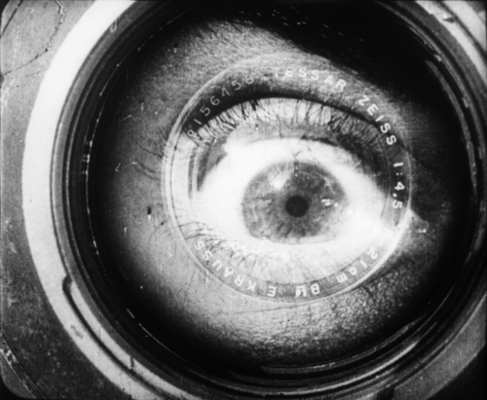
Vertov's cine-eye idea links the camera with a way of seeing beyond ordinary human vision. One composite image places an eye and a camera together. The film also connects the equipment of cinema with machinery used in city work. Film spools, street-cleaning, sewing and hydroelectric power appear in montage passages that make different kinds of labour part of one visual argument. The comparison happens through the cut: a machine in one setting can lead to a mechanism in another, and the viewer is invited to notice the relationship. The film's subject is not only what the camera records, but how editing shapes what those images can mean.
A dissolve can show the city changing without following someone between two places. An empty beach fills with women exercising; swimmers occupy water that had been still. The overlapping images compress a change in activity into the transition itself. Elsewhere, slow motion stretches a woman's turn before she throws a discus. The film gives a brief athletic movement time to be seen in detail, separating the rotation of her body from the ordinary pace of the surrounding day. These passages use different methods to alter time: one brings successive states together, while the other expands a single action.
Other effects make the camera's intervention openly playful. In a stop-motion passage, a camera moves on its own tripod legs, turning equipment normally handled by a person into an animated performer. Moving the object between exposures creates an action that continuous observation could never record. Double exposure produces a different impossibility when the cameraman appears inside a glass of beer. The image combines two views on the same piece of film, changing the apparent relationship of scale between man and glass. These tricks interrupt the expectation that every shot simply preserves whatever stood before the lens.
The audience inside the film completes the chain from street to screen. People enter the cinema, settle into their seats and watch images assembled from the same city the film has been observing. The closing movement returns the viewer to the camera and the act of seeing rather than resolving a fictional character's problem. Its cameraman, editor and audience belong to one connected process: the city is recorded, shaped into a sequence and shown back to a crowd. That structure gives the film an ending without a conventional story climax, bringing its two subjects—urban life and cinema—back together.
Projection speed affects the rhythm of this work as much as the content of individual shots. Copies circulated at inaccurate speeds, changing the pace and accents of the montage and its relation to the original score. A tram passing through the frame or a wheel turning beside a worker can acquire a different urgency when the presentation accelerates or slows it. For a film built around movement, those changes affect how one image answers the next. The city-day structure remains recognisable, but its timing depends on the version being shown, making the conditions of a screening part of the experience.