
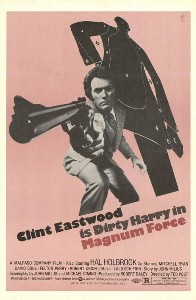
Behind the film
- Year
- 1973
- Director
- Ted Post
- Writers
- John Milius, Michael Cimino
- Runtime
- 2h 2m
- Genres
- Action, Crime thriller
- Production
- Malpaso Productions
- Country
- United States
- Cast
- Clint Eastwood, Hal Holbrook, Mitchell Ryan, David Soul, Felton Perry, Robert Urich, Tim Matheson, Kip Niven
About the film
Contains story spoilers.
Magnum Force opens with crime boss Carmine Ricca escaping conviction, only to be stopped and killed by a motorcycle policeman. Harry Callahan and his partner Early Smith investigate despite Lieutenant Briggs's attempts to restrict their involvement. More killings suggest a patrol officer is choosing victims whom the courts have failed to punish. Harry initially suspects his troubled friend Charlie McCoy, but McCoy is himself murdered after encountering the real killer. A group of rookies, whose accuracy at the firing range has impressed Harry, becomes increasingly suspicious. Their skill is professional; their use of it is something else.
Harry obtains a bullet fired from John Davis's gun and links it to the murders. Briggs instead pushes a raid against Frank Palancio, whose men receive a warning that killers disguised as police are coming. Officer Phil Sweet dies in the resulting shoot-out. Harry then faces an invitation from Davis and the other surviving rookies to join their vigilante campaign. He refuses. A bomb placed in his mailbox is successfully defused, but a second device kills Early before Harry can warn him. The death squad has moved from executing its selected criminals to eliminating policemen who might expose it.
Briggs arrives after Harry reports the bomb and reveals his own involvement by diverting their car journey at gunpoint. Harry escapes him and defeats the remaining motorcycle officers in a waterfront pursuit. Back at the car, Briggs promises to prosecute Harry for their deaths, believing official authority still protects him. Harry has quietly reactivated the mailbox bomb and left it on the seat. Briggs drives away and the explosion kills him. Harry's final remark about knowing one's limitations lands after he has defeated an organisation that treats its own judgment as sufficient reason to kill. His survival closes the pursuit without making his methods gentle.
Ted Post directs Clint Eastwood's return as Harry from a screenplay credited to John Milius and Michael Cimino. The opening credits place the familiar .44 Magnum directly before the audience; Eastwood's voice repeats a variation of the first film's challenge before the weapon fires. Milius described the sequel as the reverse side of Dirty Harry. Having written a policeman who would break the law and even commit murder to get a result, he now placed a death squad of young officers opposite him. The question became where a line could be drawn. That starting point makes the rookies more than replacement villains: they turn a permission already associated with Harry into an organised practice.
Milius also thought Harry remained substantially the same man across the two films. His conception was of someone with few friends, partners who tended to die, and an apartment containing little beyond a bed, old food, service awards and a place to clean his gun. It is a useful account of how the writer imagined the character's narrow life, rather than an inventory that every scene must display. The sequel can challenge Harry through officers who resemble his own dangerous tendencies without rebuilding him as a different hero. Milius's emphasis falls on isolation and personal limits, which gives the confrontation a more uncomfortable basis than a simple contrast between a humane detective and brutal outsiders.
Eastwood approached the same conflict from the position of the returning performer. Speaking to the Hollywood Foreign Press in 1973, he rejected the political label attached to the first film and described Harry as an individual frustrated by his superiors and the courts. For Magnum Force, he identified the danger in an elite police organisation whose members appeared educated, capable and exceptionally proficient with weapons. Harry might have little sympathy for the people they were killing, but he could recognise where that authority would lead. Eastwood's explanation gives the rookies' competence a double purpose: qualities that should recommend them as policemen also make their extremism dangerous. The actor defended the use of physical action in drama while resisting the idea that portraying violence necessarily meant endorsing it. That was his own account of the work, delivered during the period of the films' release.
The production also sits at a specific moment in camera technology. In January 1974, the Museum of Modern Art screened Magnum Force during a programme devoted to Panavision, with company president Robert Gottschalk demonstrating the Panaflex beforehand. The museum identified it as the first feature shot entirely with the new camera. Its announcement described a quiet, lightweight system that could change from a thirty-five-pound studio configuration to a twenty-five-pound handheld one in less than a minute. This was a practical change in the equipment available to filmmakers, allowing one camera system to serve different forms of operation. The museum's decision to present a commercial police sequel in a technology programme records another part of the film's history alongside its argument about vigilantism. The Panaflex connection explains why Magnum Force became a demonstration of new production equipment, without requiring every camera movement in the film to be attributed to that innovation.