
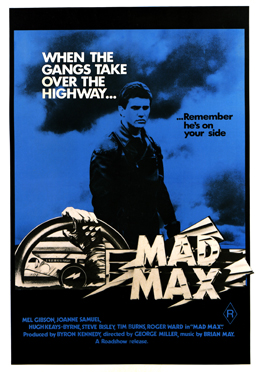
Behind the film
- Year
- 1979
- Director
- George Miller
- Writers
- George Miller, Byron Kennedy
- Runtime
- 1h 28m
- Genres
- Action, Thriller, Vigilante, Dystopian
- Production
- Kennedy Miller Mitchell
- Country
- Australia
- Cast
- Mel Gibson, Steve Bisley, Joanne Samuel, Hugh Keays-Byrne, Roger Ward, Vincent Gil, Paul Johnstone, Reg Evans
About the film
Contains story spoilers, including the ending.
The film opens with Crawford, the Nightrider, stealing a Main Force Patrol car and racing across the flat country with his girlfriend beside him. Goose radios Max from the road as the patrol tries to contain the pursuit. Max Rockatansky waits ahead and forces the Nightrider into a collision with a wrecked vehicle; the escape ends in a violent crash. Max removes his sunglasses and studies the road, introduced through the calm precision of a driver who can read speed and distance as well as danger. Engines, radio voices, abrupt cuts and long exposed roads establish the film’s approach to action: the vehicles and landscape carry information as directly as dialogue.
The Nightrider’s death brings the Toecutter’s gang into open conflict with the patrol. The bikers arrive in a small town, where their swagger turns into intimidation and sexual violence against a young couple. Max and Goose respond, and Johnny the Boy is taken into custody after the gang’s rampage. Yet the law has little authority beyond the road: the court releases Johnny, and the gang can treat arrest as another temporary inconvenience. Max’s supervisor, Fifi, understands the force is losing its grip but still tries to keep his officers from becoming the same kind of predators they chase. Max is the more controlled of the two patrolmen, while Goose is sociable and reckless; together they make a last, imperfect picture of ordinary comradeship inside an institution that cannot guarantee justice.
The gang turns its retaliation toward Goose. They tamper with his motorcycle, causing a high-speed crash. Goose survives and borrows a truck to bring his damaged motorcycle back. Johnny attacks the truck, causing a second crash, and Toecutter pressures him to set the wreck alight with Goose inside. Max goes to the hospital and sees Goose’s badly burned body, a sight that makes the cost of the patrol’s work impossible to treat as another roadside incident. He tells Fifi he wants to resign. Fifi asks him to take a few weeks away first, hoping distance will let him decide without the road’s pressures. Max leaves with Jessie and their infant son, Sprog, for a holiday, trying to trade the patrol’s daily violence for an ordinary family life.
The family’s trip brings them into contact with the gang again. After Jessie resists the bikers’ harassment, they pursue her and Max through the countryside. At a farm, May Swaisey helps Jessie and the child hide, then confronts the men with a shotgun. She buys Jessie time to reach the car, and the family drives away, but their vehicle soon breaks down. The gang catches Jessie and Sprog on the road. The film does not show the attack directly; a small shoe left on the ground becomes the evidence of what happened to the child. The road that had given the patrol and the bikers room to move now stretches between Jessie and any possible help.
At the hospital, the doctors tell Max that Sprog arrived dead and that Jessie has suffered multiple severe injuries. One doctor calls her salvageable and tells a colleague to reassure her husband that she will be all right. The film leaves her outcome unresolved; she has not died in the story. Max nevertheless leaves the hospital in shock. He returns to the patrol garage, puts on his black leather uniform and takes the specially prepared V8 Interceptor. His movement from the hospital to the car marks a decision to pursue revenge rather than resume patrol duty. Towns, courts, police stations and family homes still exist in Miller’s world, but institutions have lost much of their power to protect people from the gang.
Max follows the gang along the highways and picks off its members in a series of violent confrontations. He uses the Interceptor’s speed and the patrolman’s knowledge of the roads to outmaneuver the bikers, while their own appetite for risk repeatedly becomes a weakness. The pursuit is not framed as a return to official duty: Max has removed himself from the force and no longer tries to arrest the men or hand them to a court. Toecutter’s authority over his followers cannot protect him from the same roads he has used to terrorize others. His death comes in a head-on collision with a truck, a reversal that ends the gang leader’s command in the open landscape that had seemed to belong to him.
The final pursuit leaves Johnny the Boy as the last man Max confronts. After a crash, Max handcuffs Johnny’s ankle to the wreckage and gives him a hacksaw. He explains the choice with cold precision: cutting through the handcuff metal will take about ten minutes, while sawing through Johnny’s ankle will take about five. Max drives away, and an explosion follows. The film does not return to official justice; Max has made the gang member face the same brutal arithmetic that has shaped his own life. George Miller described the film as an experiment in visual storytelling, and its edits, engines and long road views keep the action tied to the bodies and machines at risk.