
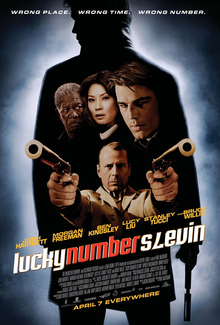
Behind the film
- Year
- 2006
- Director
- Paul McGuigan
- Writers
- Jason Smilovic
- Runtime
- 1h 49m
- Genres
- Crime thriller, Neo-noir, Comedy thriller, Drama
- Country
- Canada, United Kingdom, Germany, United States
- Cast
- Josh Hartnett, Morgan Freeman, Ben Kingsley, Lucy Liu, Stanley Tucci, Bruce Willis, Mykelti Williamson, Corey Stoll
About the film
Contains story spoilers.
Slevin Kelevra appears to arrive in New York at precisely the wrong time. Staying in Nick Fisher's apartment, he finds his friend absent and meets Lindsey, the neighbor who is curious about the disappearance. Henchmen take him to a crime lord known as the Boss, who treats him as Nick and demands repayment of a gambling debt. The alternative is to murder the son of the Rabbi, the Boss's rival, in retaliation for the killing of his own son. Another abduction brings Slevin before the Rabbi, who also believes he is Nick and wants money. Detective Brikowski watches the developing conflict, while the assassin Goodkat is involved with both bosses. Slevin accepts the assassination assignment. When he enters the intended victim's apartment, his apparent helplessness gives way to coordinated action: he and Goodkat are working together, and the supposed mistaken identity has brought them where they wanted to be.
The explanation reverses the meaning of Slevin's predicament. Nick was selected because he owed money to both bosses; the man Goodkat killed at the beginning was the real Nick, rather than an unrelated victim. Slevin has already murdered the Boss's son to help set the two criminal organizations against each other. He is also the surviving child from Goodkat's earlier account of a family destroyed after a disastrous horse-racing bet. The Boss and the Rabbi were responsible for his parents' deaths, and the assassin assigned to kill the boy spared him. Their adult partnership is the mechanism of his revenge. Slevin kills both bosses and later kills Brikowski, who murdered his mother. Lindsey seems to become another casualty when Goodkat shoots her, but Slevin has warned her and helped stage her death. The apparent innocent caught between established killers has been directing the trap from inside it. The horse's name supplied his alias.
Jason Smilovic described a substantial change between his first idea and the finished screenplay. He initially imagined a man subjected to impossible bad luck, writing a short draft in only a few days in 1997. Rereading it, he found a mismatch between the calamities and the man's responses. A friend's story about a gambler borrowing heavily to wager on a fixed race supplied the beginnings of the family history. The new backstory gave the outwardly unlucky figure something concealed beneath his circumstances. Smilovic's account also explains why casting Hartnett mattered to him: he wanted someone whose approachable appearance could coexist with a darker quality. For the Rabbi, Kingsley's contrasting screen associations as Gandhi and Meyer Lansky suggested a model for the character's combination of religious and criminal identities. The script then spent years moving through development before financing and casting came together. These were choices about the information an audience receives from a face or a role, as well as about the events eventually disclosed in the story.
McGuigan's account of working with the actors emphasizes the duration of a performance. In his Tufts Daily interview, he explained that he liked to watch whole scenes unfold, sometimes allowing a lengthy dialogue exchange to run from beginning to end. Seeing the complete scene helped him find its rhythm and notice details that a succession of isolated fragments might obscure. He likened the experience to watching a staged play. Hartnett's light touch and willingness to challenge ideas appealed to him, while Liu's energy and quirks could emerge during the longer takes. Music was another question of leaving room for the spoken performance. McGuigan said he did not want lyrics constantly competing with the distinctive dialogue and therefore favored a score over a succession of songs. Composer J. Ralph's long friendship with Smilovic was useful because he already understood the material. The director's description connects the length of takes and the musical approach through a shared concern: allowing the words and the actors' timing to remain audible and legible.
The rival bosses' apartments make their standoff visible, although the production achieved the two interiors with one Montreal set. According to the production notes, Freeman's scenes were shot first; after the confrontation between the two men, François Seguin's team redressed the space for the Rabbi. The exteriors likewise began with one New York building. Visual effects supervisor Eric Robertson described combining the actors' separately photographed close-ups, exterior plates, skyline photography and digital extensions into a movement across the street from one boss to the other. The design of the interiors avoids a single obvious period through patterned wallpaper, glass, mirrors, unusual fixtures and dark wood. Odette Gadoury's costumes carry related patterns into the frame, while Slevin's softer, slightly eccentric clothing supports his apparently unthreatening presence. McGuigan also credited Peter Sova with lighting broad areas of the set so that the camera could move freely. The result joins the story's opposed positions to a carefully manufactured geography: two isolated men seem to occupy facing strongholds, even when the rooms, building and moving viewpoint have been assembled from shared spaces and separate elements.
At Sundance, Hartnett and Liu described the freedom McGuigan gave them within Smilovic's defined roles. Hartnett recalled being able to explore the script because the entire set was lit, and Liu said the director encouraged her to push further. McGuigan credited the screenplay with attracting the cast in the first place. Those recollections locate the performances in a combination of preparation and permission: the characters and dialogue offered a firm starting point, while the actors had room to test how they would play them.