
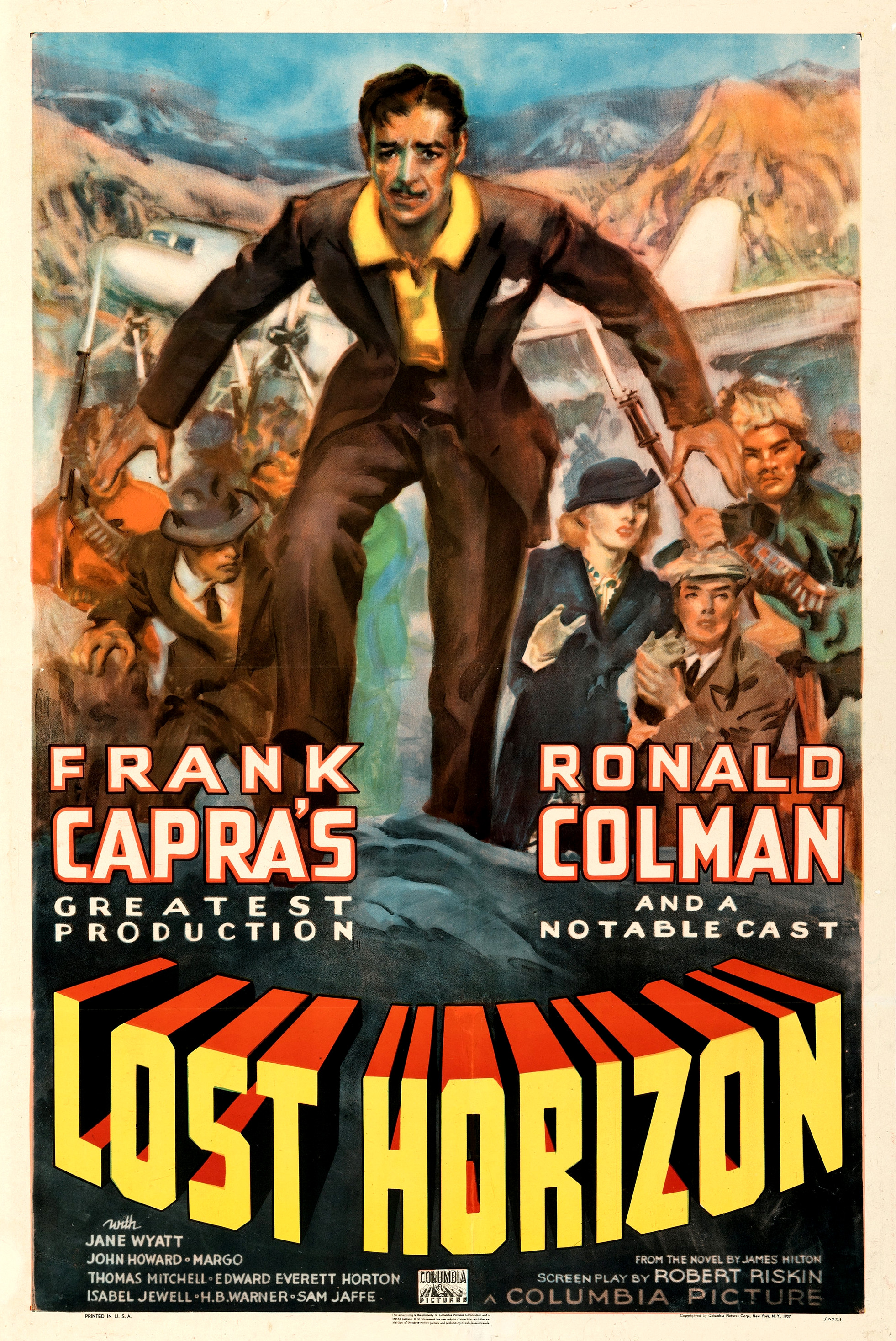
Behind the film
- Year
- 1937
- Director
- Frank Capra, Andrew Marton
- Writers
- Robert Riskin, James Hilton
- Genres
- Fantasy, Drama, Science fiction
- Production
- Columbia Pictures
- Country
- United States
- Cast
- Ronald Colman, Jane Wyatt, Sam Jaffe, John Howard, H. B. Warner, Edward Everett Horton, Thomas Mitchell, Margo
About the film
Contains story spoilers.
Robert Conway, his brother George, Lovett, Barnard and Gloria flee revolutionary China aboard a plane that is hijacked and crashes in the mountains. Chang leads them to Shangri-La. Sondra arranged Conway's arrival after reading his books, and the High Lama, the centuries-old Father Perrault, chooses him to lead the community before dying. Most of the passengers settle happily. George wants to leave with Maria, who disputes the lamas' account of her age and captivity. Conway joins them for his brother's sake. Beyond the valley, Maria rapidly ages and dies; George also dies. Conway survives, loses his memory and later recovers it while being escorted home. He escapes to search for Shangri-La. Gainsford eventually abandons his pursuit and reports Conway's travels to friends in London, while Conway climbs towards the mountain pass.
Shangri-La is a fictional Himalayan refuge, imagined as a place apart from the violence surrounding Conway's journey. The Library of Congress places Capra's romantic fantasy in the Depression, when an American audience facing hardship could find an escape in the idea of a private utopia. The distant valley offers shelter as the outside world approaches war. Giving that imagined refuge a physical form required a large construction effort in California. TCM's production history describes sixty-five sets and more than seven hundred props, with Shangri-La built at Columbia's Burbank ranch. The mountains created a different practical problem. Snow scenes and aircraft interiors were photographed in a cold-storage warehouse containing real snow and ice. The temperatures made equipment freeze, stiffen and break. Recreating the Himalayas in Los Angeles extended the schedule, and Capra's repeated takes and camera angles added to the amount of material: the production exposed more than a million feet of film. The snowbound journey depended on working in cold conditions as well as constructing the valley beyond it.
The landscape also helped determine the film's black-and-white photography. In Kevin Lewis's CineMontage article, Frank Capra Jr. explained that his father wanted the scale available in existing footage of avalanches and high mountains. Little suitable colour footage was available, and he did not want to mix colour with black-and-white images. Capra Jr. also described Shangri-La as a place where art and beauty could be kept safe for the future. Building the film continued in the cutting room. Capra and editor Gene Havlick restructured the opening after the preview, removing about twenty minutes. Further shortening ordered by Columbia without Capra's knowledge became part of his dispute with the studio; who performed that recutting remained unclear. His son recalled that Capra spent considerable time working with his editors and regarded their contribution as a remaking of the picture. Later reissues and television versions shortened it again, leaving a substantially reduced film in circulation.
Dimitri Tiomkin's music gives Shangri-La a recurring choral theme. A love-theme sheet-music edition carried lyrics by Gus Kahn, but those words were not sung in the film. Instead, a wordless choir accompanies the opening credits, the entrance to Shangri-La and the closing credits. The same melody therefore belongs both to a published song and to the valley's musical identity on screen. Tiomkin recalled unusual freedom over the score: he wrote, orchestrated and recorded it before Capra and the studio executives heard any of the music. That freedom existed alongside a partnership arranged by the director. Capra proposed Max Steiner as musical director and conductor when Columbia president Harry Cohn was uneasy about entrusting such a large production to Tiomkin, who had relatively little experience with dramatic features. Steiner conducted the score, while Tiomkin composed it.
The last glimpse of Conway changed during the film's early life. Richard Raskin's account distinguishes three endings. Riskin's screenplay sent Conway over a snowy hill towards a warm light on the horizon. Another filmed ending showed Sondra noticing him from the mountain pass, calling and waving as he waved back. The revised ending uses a shorter sequence: Conway crosses a glacier, looks up from his ice axe, and sees the familiar archway with the lamasery beyond it. A close view shows him smiling before the closing bells. These images stop before an extended reunion with Sondra. Raskin reads the point-of-view sequence as Conway succeeding in his search, while discussing Robert Gitt's and Leland Poague's more ambiguous readings. Hilton's novel leaves the question of finding Shangri-La unanswered. The different endings change how directly the film offers an answer, from a distant light to a greeting or the sight of the pass itself.
The film's later reconstruction had to contend with missing images as well as earlier cuts. Robert Gitt recalled beginning Lost Horizon during his third year at the American Film Institute and described it as his first important restoration. He contrasted a truncated version of ninety-something minutes with a film originally running 132 minutes. Sony describes nearly thirteen years spent tracking down lost footage. Where sound survived without its matching picture, the reconstruction used still photographs. Further recovery remained possible: Sony preservationist Rita Belda's account of the 2017 restoration describes a European 16mm print containing another minute of Conway's meeting with the High Lama, material previously represented by stills. Digital repair reduced dirt, scratches and unsteadiness, but the recovered images remained softer than the 35mm material around them. That scene's recovery restored more of the conversation with Perrault, without making the surviving picture uniform. The film's repeated shortening and the deterioration or loss of prints explain why reconstruction involves both finding scenes and repairing the material that carries them.