
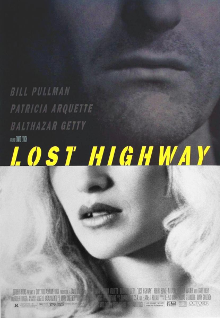
Behind the film
- Year
- 1997
- Director
- David Lynch
- Writers
- David Lynch, Barry Gifford
- Runtime
- 2h 15m
- Genres
- Neo-noir, Mystery, Thriller, Film noir
- Production
- Ciby 2000
- Country
- United States, France
- Cast
- Bill Pullman, Patricia Arquette, Balthazar Getty, Robert Loggia, Jack Nance, Richard Pryor, Robert Blake, Michael Massee
About the film
Contains story spoilers.
Lost Highway opens with Fred Madison, a Los Angeles jazz saxophonist, hearing a message through his home intercom: “Dick Laurent is dead.” He cannot see who spoke. Fred and his wife Renee then begin finding anonymous videotapes outside their house. The first shows the building from the street; another moves through the home and records them asleep. At a party hosted by Renee’s friend Andy, Fred meets a pale man who says he is standing inside Fred’s house at that moment. The Mystery Man hands Fred a phone; when Fred calls home, the same man answers there while still facing him at the party. A later tape shows Renee’s mutilated body and Fred kneeling nearby. The film never stages the killing as a clear, conventional flashback. Fred watches the recording, screams, and is convicted of her murder.
On death row, Fred suffers headaches and visions of a desert cabin and a figure he recognizes as the pale, unnerving Mystery Man. One night, guards find someone else in his cell: Pete Dayton, a young mechanic with no known connection to the Madison case. The prison authorities investigate and release Pete to his parents, while detectives remain convinced he is tied to Fred. Pete has no memory of the change. His parents avoid explaining what happened during his absence, and he returns to work under the watch of both the police and his worried girlfriend Sheila. The film presents this change as an event without a practical explanation, leaving the viewer to follow its consequences rather than wait for a reveal that makes it ordinary.
At the garage, Pete’s skill draws the attention of Mr. Eddy, a wealthy customer who insists that Pete alone service his car. During a drive, another motorist follows too closely. Mr. Eddy forces him off the road, beats him, and lectures him about safe distance as if the violence were a reasonable lesson. He later returns with Alice, his blonde mistress, played by the same actor as Renee. Pete and Alice begin an affair, meeting secretly while Mr. Eddy remains dangerous and Sheila notices Pete pulling away. Alice says she fears being caught and wants to escape. Her story links Andy, a pornographer she knows, to an opportunity for money and a way out.
The plan is to steal valuables from Andy’s house. Alice recounts how she met Mr. Eddy, describing a night when she was forced into a sexualized performance at gunpoint. The film does not provide an independent account that settles every detail of her story. Pete enters Andy’s home during the burglary and encounters Andy there; the two men struggle, and Andy falls headfirst against a glass table and dies. Pete then sees a pornographic film featuring Alice and finds a photograph of Andy, Mr. Eddy, Alice and a dark-haired woman who resembles Renee. The image destabilizes the distinction between the two women, but it does not supply a plain answer about how they are connected.
Pete and Alice take the stolen goods toward a remote desert cabin, intending to sell them to a fence who is not there. They have sex outside by the car’s headlights. When Pete says he wants Alice, she tells him he will never have her and walks inside; she disappears from view. In a flash of light, Pete becomes Fred. The Mystery Man waits in the cabin with a video camera and tells Fred that the woman was Renee, not Alice. Fred escapes and drives to the Lost Highway Hotel, where he watches Renee with Mr. Eddy, whose other name is Dick Laurent. He takes Laurent at gunpoint, puts him in a car trunk and drives him into the desert.
The Mystery Man appears again and gives Fred a knife. Fred cuts Laurent’s throat; the Mystery Man shows the dying man a video and then shoots him. The sequence joins the events of the two apparent lives without explaining whether Pete’s story is a disguise, a dream, or something else. Fred returns to his house, presses the intercom, and repeats the opening message: “Dick Laurent is dead.” Detectives are waiting at the gate. Fred runs to his car and speeds away as they pursue him. During the chase, his face begins to distort, recalling the transformation in the prison cell. The film cuts back to the dark road before that change completes, leaving Fred’s fate unresolved and the opening message in a loop.
The shift into Pete’s life changes how the story feels without making him a simple escape from Fred. The first half is marked by dark interiors, surveillance images and Fred’s guarded silences; Pete works in daylight, surrounded by family and coworkers who want him to return to normal. Yet the two parts carry details across the break. Pete reacts with a headache when a saxophone plays on the garage radio, and Mr. Eddy’s car, Alice’s face and Andy’s photograph bring the earlier unease into his everyday surroundings. Sheila senses a change she cannot name, while Pete cannot account for his absences or his attraction to Alice. These concrete repetitions make the connection felt before the desert cabin joins the identities directly.