
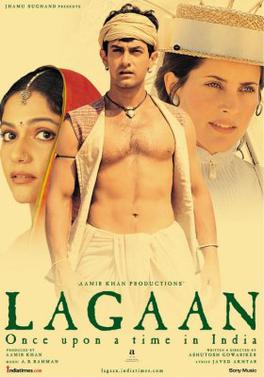
Behind the film
- Year
- 2001
- Director
- Ashutosh Gowariker
- Writers
- Ashutosh Gowariker, Kumar Dave, Sanjay Dayma, K. P. Saxena
- Runtime
- 3h 44m
- Genres
- Musical, Drama, Romance
- Production
- Aamir Khan Productions
- Country
- India
- Cast
- Aamir Khan, Gracy Singh, Rachel Shelley, Paul Blackthorne, Kulbhushan Kharbanda, Rajendra Gupta, Raghubir Yadav, Rajesh Vivek
About the film
Contains story spoilers.
Lagaan opens in 1893 around Champaner, a farming village facing a second failed monsoon and an unpaid land tax. The people ask their local ruler for relief, but Captain Andrew Russell, the British officer overseeing the cantonment, has the authority to raise the demand. He doubles it while the fields remain dry. At a military exhibition, Bhuvan watches the officers play cricket and compares their unfamiliar game to the village children’s stick-and-ball pastime. Russell hears the comparison as an insult. When the villagers again plead for mercy, he turns that irritation into a wager: if Champaner defeats his eleven in a three-day cricket match, the province will owe no tax for three years; if it loses, the tax will be tripled. Bhuvan accepts before the frightened crowd can stop him, placing more than his own harvest at risk.
The promise leaves Bhuvan with a problem that cannot be solved by courage alone. Cricket is a British sport with rules the villagers do not know, and most of the men see Russell’s offer as a trap rather than an opportunity. Bhuvan moves from household to household, trying to assemble a side from people with other work, loyalties and grievances. Gauri, the village doctor’s daughter, believes in him and helps keep the effort from collapsing into argument; his widowed mother Yashodamai also supports his resolve. Their romantic bond is complicated by Lakha, a woodcutter who wants Gauri and resents Bhuvan. Russell’s sister Elizabeth approaches Bhuvan after the wager and offers to teach the villagers the game. Her lessons give the team access to cricket’s basic vocabulary, while her growing affection for Bhuvan creates an awkward connection between the village and the household whose captain has threatened it.
The team takes shape around skills that initially seem unrelated to cricket. Deva Singh has encountered the sport while serving in the British army; Bhura’s work with chickens has made him an alert fielder; Bagha, a temple drummer who cannot speak, can strike the ball with force. Ismail, a Muslim potter, joins with the villagers from different communities, while Guran’s strange predictions unsettle and amuse the group. The most divisive choice is Kachra, a Dalit man whom the village treats as untouchable and whose hand is withered. Bhuvan sees that the arm can impart unusual spin, but the other players object to touching or sharing food with him. Bhuvan stands by his selection and forces the team to confront the exclusion it has treated as ordinary. Kachra’s inclusion changes the side’s cricket and its internal terms of membership, though it does not erase the tensions around him.
Training mixes practical lessons and musical sequences. Elizabeth teaches the villagers to bat, bowl and field, while they turn everyday strengths into a working combination. Lakha secretly offers Russell help in return for a chance to damage Bhuvan’s prospects with Gauri. Elizabeth must teach a group with no shared experience of cricket to read one another’s movement and respond as a unit. The contrast between formal cantonment life and communal village gatherings keeps the romantic triangle in view: Gauri’s attachment to Bhuvan is public, while Elizabeth’s feelings remain private.
The match begins before villagers and British officers. The British bat first and build a large total as the inexperienced villagers struggle to judge the ball; Lakha’s failures in the field compound the damage. When Elizabeth reveals his betrayal, anger threatens to break the team apart. Bhuvan stops the villagers from attacking Lakha and gives him a chance to make amends. The British then bowl aggressively. Several villagers are hurt, and Ismail continues with a runner. Each dismissal shifts the crowd’s hopes, while Russell grows increasingly volatile as the underdogs keep the match alive.
Across the three days, the villagers find ways to answer the British advantages. Kachra’s spin troubles the batters, fielders cover ground, and Bhuvan holds together players who have been injured or shaken. Lakha returns and tries to repair the harm he caused. On the final day the villagers chase the British total; wickets fall until Kachra, the last batter, joins Bhuvan. Kachra appears to be dismissed on the last ball, but a no-ball gives the villagers another delivery. Bhuvan takes the strike and hits it, but Russell catches the ball beyond the boundary. The catch does not count as a dismissal, and the shot earns six runs. The villagers win by one run, cancelling the province’s tax for three years.
Rain arrives over the parched fields after the victory. Bhuvan and Gauri marry; Elizabeth returns to England without declaring her feelings, and Russell is sent away from Champaner. The match is fictional, not a documented historical event, and the story’s simple opposition between a benevolent local ruler and a brutal British officer compresses a more complicated colonial system. Within that fable, cricket gives the villagers a public arena in which coordination and nerve answer the power that set the wager.