
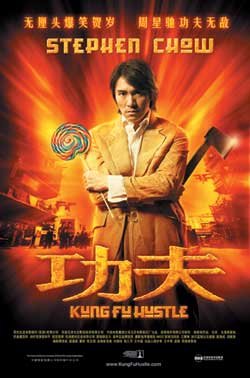
Behind the film
- Year
- 2004
- Director
- Stephen Chow
- Writers
- Stephen Chow, Kan-Cheung Tsang, Chan Man-Keung, Lola Huo Xin
- Runtime
- 98 minutes
- Genres
- Action comedy, Parody, Martial arts
- Production
- Star Overseas, China Film Group Corporation
- Country
- People's Republic of China, Hong Kong
- Cast
- Stephen Chow, Danny Chan, Lam Suet, Xing Yu, Yuen Wah, Bruce Leung
About the film
Contains story spoilers, including the ending.
Kung Fu Hustle puts Sing's ambition to become a gangster against the hidden strength of Pigsty Alley. He and Bone impersonate Axe Gang members, drawing the real gang into a neighbourhood defended by Coolie, Tailor and Donut. Hired musicians defeat those masters, but the Landlady and Landlord reveal their own powers. Sing frees the Beast for the gang, then turns against him. The Beast's beating releases Sing's extraordinary ability, and he defeats the assassin with Buddhist Palm. Sing and Bone eventually open a candy shop, where Fong finds him again. Their reunion recalls his childhood attempt to protect her from bullies, the humiliation that persuaded him goodness was useless. His final choice returns him to that earlier impulse. The power he wanted for gang membership instead lets him stop the man he helped release.
Pigsty Alley's crowded homes came from Stephen Chow's memories of the Hong Kong neighbourhood where he grew up. He recalled discovering that an apparently ordinary neighbour was a martial-arts master, a surprise that gave the community's concealed talents a personal starting point. Production designer Oliver Wong described the buildings as a southern Chinese style later copied in Hong Kong. The four-storey set was built at Chedun, outside Shanghai, with advertisements copied from old photographs. Shops and cramped homes give the fights a place occupied by people with daily business to attend to. Wong contrasted that Chinese neighbourhood with the Western-influenced decoration of the Axe Gang's casino. Costume designer Shirley Chan also followed Sing's changing loyalties: his early clothing is borrowed or stolen, gang membership brings suits, and his later appearance is Chinese and elegant. His clothes change as he moves between the people he wants to impress and the person he becomes. The neighbourhood and casino make those choices visible before the final confrontation settles them.
Chow described building Kung Fu Hustle from its characters, expanding the story outwards from the people he wanted to portray. He also explained the ordinary residents' power as a warning against judging people by their appearance. The Landlord and Landlady can look like familiar neighbourhood figures while holding abilities outsiders cannot see. Familiar Western comedy sits alongside that Chinese martial-arts story: Chow acknowledged The Shining and the cartoon-like chase when asked about those references. He wanted to bring Chinese sentiments to Western audiences without replacing the material he knew. The difficulty lay in combining the film's different kinds of action into a continuous experience. Some fights depend on martial-arts performance, while the musicians' attack requires extensive computer imagery. Chow singled out Yuen Woo-ping's willingness to consider unusual ideas as essential to that sequence. An action director who looked like an old-fashioned master could still embrace the improbable idea of a musical instrument becoming a weapon. Their collaboration therefore involved deciding how the contrasting fights could belong to the same story.
In his Cannes interview, Chow linked the film's speed and surreal movement to animated films he watched as a child. He said he had deliberately emphasised visual action over dialogue to help Kung Fu Hustle reach a wider audience. Its starting point also included an old black-and-white Cantonese kung fu film from the 1960s and the Hong Kong martial-arts cinema he knew. He chose Yuen for his ability rather than to repeat The Matrix or Crouching Tiger, Hidden Dragon. Their discussions concerned taking older fighting styles and adapting them with computer imagery. Chow described those decisions as a matter of testing how far an idea could go, rather than following a fixed rule about what effects should do. The physical work still demanded preparation: he began training a year before filming and spoke of the energy needed to act, direct and carry responsibility for the script. He also acknowledged that rehearsal could not remove the danger of working high above the ground on wires. The exaggerated movement remained tied to performers doing demanding work.
Visual effects producer Tommy Tom described Centro's involvement beginning four months before shooting, with discussions, concept artwork and animation tests. The crew stayed involved on set so that Chow could film the material needed for later effects, while still introducing new ideas during production. The snake gag combined real animals with computer-created snakes wherever they touched Sing. Clips and rope gave Chow something physical to pull against; the effects artists replaced those objects and studied snake movement and skin to build the final animals. Tom said three artists spent nearly two months on the sequence. Other problems arrived after filming. Chow asked for frogs to be added to the passage where Sing searches for the Beast, leaving the team to match them to handheld footage with few useful tracking features. Tom also described an entirely computer-created view of the casino breaking apart under the Lion's Roar. Those examples range from a small comic addition to the destruction of a large space, each extending something a character does.