
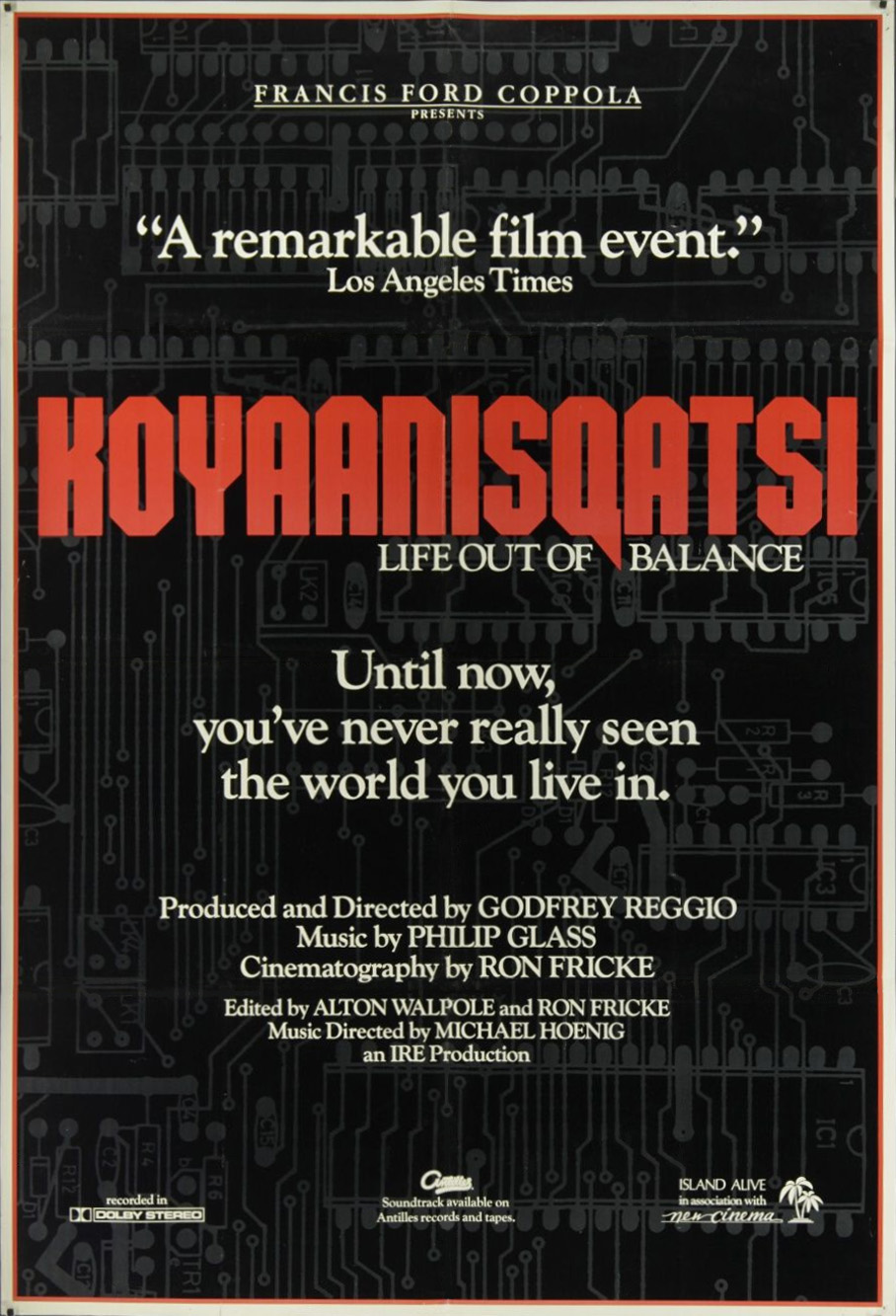
Behind the film
- Year
- 1982
- Director
- Godfrey Reggio
- Writers
- Ron Fricke, Michael Hoenig, Godfrey Reggio, Alton Walpole
- Genres
- Documentary
- Country
- United States
About the film
Discusses the film's closing images.
Koyaanisqatsi follows changes in landscape, movement and human activity through images and Philip Glass's music. Godfrey Reggio directed it, with Ron Fricke responsible for cinematography and sharing the editing with Alton Walpole. Natural environments give way to extraction, buildings and accelerating traffic. The film makes those environments its subject, allowing the viewer to follow differences in scale and pace without a central character explaining them.
The early rocket imagery leads into aerial views of the American Southwest and moving clouds. Industrial activity then interrupts the landscapes, followed by the concentrated motion of city streets and highways. Time-lapse compresses that activity into currents that are difficult to perceive at ordinary speed. Near the conclusion, a rocket rises and breaks apart, with falling fragments extending its destruction. The final title definitions include life out of balance and a condition that calls for a different way of living.
Reggio described his method as poetic cinema, built through discovery and collaboration. He wanted sensation and emotion to reach the audience before logical explanation. That choice removes the familiar route through a main character's decisions: a building or a mass of moving people can hold the screen without becoming the setting for someone's private problem. Reggio said the audience must supply the story and characters themselves. His description helps explain why the images do not come with a single voice telling the viewer what each one means. The movement between nature and constructed environments can suggest connections while leaving room to experience the sequence differently. Reggio also resisted the label experimental, preferring to describe the work as an experience. He was interested in what image and music could do to perception, and in using the large screen to give those encounters a scale that a small display could not reproduce.
The choice of Glass began before Reggio was ready to shoot. A friend helped him listen to contemporary composers, and Glass's North Star struck him as having the structure the film would need. Reggio wanted music with its own voice, capable of working beside the images rather than simply pointing out their content. Glass initially declined to compose for the project. Reggio eventually arranged a screening of footage at Anthology Film Archives and played the same material against different music, including North Star. He recalled Glass responding to the relationship between his sound and the images and agreeing to begin. The finished film's musical partnership thus grew from an encounter with actual footage. Reggio's account also makes clear that a speechless film still required planning: he prepared a paper describing its dramatic shape so that the composer could respond to the feeling and direction he wanted. The crew initially questioned his choice, suggesting established classical composers instead. Reggio wanted an original collaborator whose music could be written in response to this film. He also considered Terry Riley, whose music he found spiritual, but chose Glass because its stronger sense of form suited the film he imagined.
In discussing the collaboration years later, Reggio emphasised Glass's wish to understand the images he was composing for. The composer visited locations when his schedule allowed, and watched selected footage with the director. Reggio would describe the dramatic shape of a scene and see what Glass responded to, giving the music a relationship to material gathered by the crew. That process left the composer an active participant in the film's development. Reggio linked Koyaanisqatsi's score to his own long familiarity with the Dies Irae, the chant associated with the dead, and to Glass's musical education. The presence of voices in the score belongs within that musical design even though the film has no spoken commentary. Music can bring a human presence into the stream of images without supplying a conversational narrator or assigning names and motives to the people passing through the frame.
The title came from Reggio's conversations about how the Hopi language could describe the society he wanted to film. He named David Monongya, James Kuchanga and Michael Owatewama among the people whose perspective helped him, and the scholar Ekkehart Malotki as a collaborator on the word. Reggio said he explained his intentions and was offered koyaanisqatsi as a fitting term. He treated its several definitions as a way of bringing the audience toward a different understanding of familiar life. He also stressed that his films were not accounts of the Hopi way of living. The title supplies a perspective on the industrial world depicted in the footage. Reggio described wanting many images to approach the force of that one word. Delaying its explanation gives the landscapes and urban rhythms time to establish their own relationships before the final definitions offer language for what the viewer has encountered. Reggio recalled the possibility of a trilogy emerging during the first project through Glass, rather than arriving as a fully formed plan before Koyaanisqatsi began.