
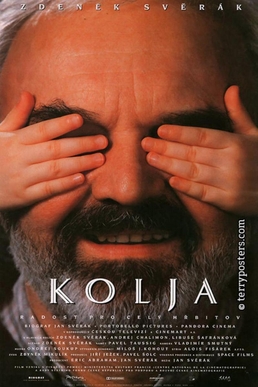
Behind the film
- Year
- 1996
- Director
- Jan Svěrák
- Writers
- Zdeněk Svěrák
- Genres
- Drama, Comedy
- Production
- Biograf Jan Svěrák, Portobello Pictures
- Country
- Czech Republic, France, United Kingdom
- Cast
- Zdeněk Svěrák, Libuše Šafránková, Andrei Chalimon, Ondřej Vetchý, Nela Boudová, Stella Zázvorková, Marek Daniel, Pavel Vondruška
About the film
Contains story spoilers, including the ending.
František Louka has organised his life around keeping other people at a comfortable distance. In Kolya, Jan Svěrák's 1996 film, the former Philharmonic cellist earns his living playing funerals in Prague during the final years of Communist rule. He needs money for his mother's house and his own upkeep, and a car would make travelling between jobs easier. A paid marriage to a Russian woman seems to offer a practical answer. For forty thousand crowns, he can settle debts and buy a Trabant without making the emotional commitments of an ordinary marriage. His new wife leaves for Germany, however, and the paperwork brings State Security into his life. It also leaves him with five-year-old Kolya, who speaks Russian and has no reason to feel at home with this reluctant guardian. Louka's carefully protected freedom now means very little to a frightened child who needs someone to stay.
Louka's adjustment reaches into the small demands of a child's evening. When Kolya cannot sleep, Louka calls a woman who teaches Russian and asks her to read him a story over the telephone. The arrangement borrows someone else's language skills to offer comfort he cannot yet provide himself. Later, when she is unavailable, he has to attempt a story on his own. During Kolya's illness, the doctor's instruction to give antibiotics every four hours puts care on a schedule, and Klára stays through the night to help. She remarks that she had not imagined Louka worrying so much about another person's child. He admits the change surprises him too.
The two initially struggle with each other's languages, including similar words that do not mean the same thing in Czech and Russian. Louka also faces the possibility of imprisonment over the marriage, while the boy could be sent to a Soviet children's home. The Velvet Revolution changes the political circumstances around them, but the personal resolution still requires a goodbye. Kolya's mother returns and takes him with her. Louka cannot keep the child whose presence has changed his life. The closing passage returns him to the Czech Philharmonic, playing Smetana's Má Vlast under Rafael Kubelík in 1990, with his pregnant girlfriend Klára watching. Music, once reduced to the work that kept him solvent, again connects him with a wider public life.
Zdeněk Svěrák wrote the screenplay and plays Louka, while his son Jan directs. Jan described the story as a combination of invention and experiences that had happened to other people. His father created the musician and joined that character to two real stories: a man who married for money, and a Russian boy who spent a year living with a Czech man. Jan said his central interest was the change in a selfish adult who avoids responsibility and suddenly has to care for a child. Politics could not be removed from these people's lives, but he wanted the man's transformation to remain the centre of the film.
That interest in an adult changing depended on finding the right child. Jan recalled a search lasting about a year, with the production looking in Moscow because Kolya had to speak Russian. The eventual choice was Andrej Chalimon. His usual good humour made the early scenes of unhappiness more difficult to film, particularly when Louka and Kolya have only just met. Jan described taking advantage of children's spontaneity in early takes: repeating a scene could tire and irritate a young performer, even when repetition helped an adult actor improve.
The Czech and Russian dialogue mattered enough that Jan resisted suggestions to make the film in English. He explained that many jokes relied on the differences between the two languages. Louka and Kolya's difficulty communicating therefore belongs to the film's humour as well as its account of friendship. There was a commercial obstacle too. Jan recalled Czech distributors fearing that audiences would avoid a film about a Russian child and asking him to change the title, which they thought might make it sound like a Russian production. The title keeps the boy at the centre despite those concerns. After Kolya won the Academy Award for best foreign-language film, Jan returned to crowds in Prague and joked that his reception resembled a cosmonaut coming home. He also spoke about the small Czech-speaking market and cheap cinema tickets, which made filmmaking difficult to sustain. The international success brought attention to a film whose local languages had initially been treated as a barrier to reaching people abroad.
Cinematographer Vladimír Smutný later identified Kolya as a personal turning point. Looking back on his earlier work under Communism, he described images that stressed the ugliness of the surrounding world through handheld camerawork and mixed colours. During the 1990s he began moving away from randomness and the destruction of the image. He placed Kolya within that change, while acknowledging that it may already have started with The Gentle Barbarian. His recollection locates the film in a change of artistic direction as well as a change of political era.