
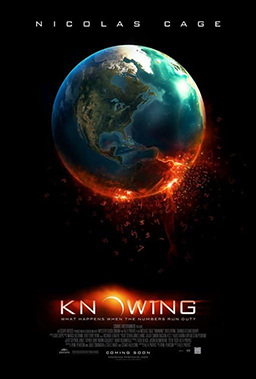
Behind the film
- Year
- 2009
- Director
- Alex Proyas
- Writers
- Ryne Douglas Pearson, Stuart Hazeldine, Alex Proyas
- Runtime
- 2h 1m
- Genres
- Science fiction, Disaster, Action, Mystery
- Production
- Saturn Films, Escape Artists
- Country
- United States, United Kingdom
- Cast
- Nicolas Cage, Rose Byrne, Chandler Canterbury, Lara Robinson, Ben Mendelsohn, Alethea McGrath, Adrienne Pickering, Liam Hemsworth
About the film
Contains story spoilers.
Knowing begins in 1959 at an elementary-school ceremony in Lexington, Massachusetts. Students are asked to imagine the future and put their work into a time capsule that will be opened fifty years later. Most draw pictures; Lucinda Embry fills a sheet with columns of numbers. She hears whispers as she writes, and her teacher takes the paper before she can finish. Lucinda scratches the remaining digits into a closet door with her fingernails. The film then moves to 2009, when the capsule is opened and its contents are handed to current students. The old paper goes to Caleb Koestler, whose widowed father John teaches astrophysics at MIT.
John initially treats the paper as a child’s strange exercise, until a sequence catches his attention: a date followed by a number he connects to the September 11 attacks and their death toll. He works through the rest and finds that the strings combine dates, fatalities and locations associated with major disasters across the half-century since Lucinda wrote them. His discovery unsettles the distinction he has taught between chance and a universe governed by a larger order. The list is not only a record of past catastrophes; its final entries point forward. John sees three events that have not yet happened and realises that interpreting the numbers may give him a chance to intervene. Before the capsule is opened, he has been explaining randomness to his students as a way to describe a world without a designed purpose. That certainty has already been tested by the death of his wife, and by Caleb's questions about whether people continue after death. Now John has evidence he cannot fit neatly into his classroom answer, though a pattern alone does not tell him whether he has uncovered fate, a message, or a coincidence he wants to believe in.
The first prediction John can test arrives almost immediately. While driving to collect Caleb, he encounters a passenger plane crash on a highway and tries to help people among the wreckage. The event matches one of Lucinda’s remaining entries, including the number of people killed. That terrible confirmation turns John’s investigation into an urgent problem, but it does not give John a clear method to prevent what comes next. His colleague Phil Beckman warns that people can impose patterns on numbers, and John’s grief after his wife’s death makes the certainty he seeks especially difficult to separate from fear. Caleb, meanwhile, starts hearing the same whispers that seem to have guided Lucinda, and strangers in dark clothes leave him smooth black stones. The plane sequence also changes the scale of the story. John is no longer simply trying to explain a historical code to himself; he is standing among people who have just died and wondering whether a warning can matter if he cannot turn it into a useful action.
John searches for Lucinda’s family and finds her daughter Diana Wayland and granddaughter Abby in New York. Diana is wary of his claims, while Abby shares Caleb’s ability to hear the voices. The adults’ argument over whether the paper predicts or merely resembles events is interrupted by the next disaster: a subway train derails, killing passengers in the crowded station. The spectacle makes the remaining predictions harder to dismiss, but Diana still wants to protect Abby by keeping her away from John’s escalating investigation. John needs the girls’ connection to Lucinda to understand what the warnings mean; Diana needs him to accept that knowing a date does not automatically let anyone control it.
Their trail leads to Lucinda’s abandoned mobile home, where the family finds a religious image of a fiery sun and the message Lucinda left behind. The final marks on the page are not a count but the letters “EE,” which John reads as “Everyone Else.” He realises the numbers describe more than isolated accidents. At the same time, the whispers, the black stones and the strangers who watch the children point toward a presence outside the ordinary human world. Abby colours the sun in the engraving, prompting John to investigate at the MIT observatory. He identifies the last threat as an enormous solar flare, timed to the final date on the sheet. His attempt to turn the prophecy into a survival plan becomes a race to protect Caleb and Abby as heat and panic spread.
Diana wants to shelter in nearby caves, but John realises that they cannot protect anyone from the flare. He retrieves the closet door Lucinda scratched in 1959 and identifies the remaining numbers as coordinates, giving him one last destination to investigate. The whispering beings take Caleb and Abby away, and Diana dies while trying to follow them. John reaches the children at the mobile home and learns that the beings intend to carry selected children away from Earth. Caleb does not want to leave without his father, but John tells him to go with Abby and says goodbye. Unable to join them because he never heard the voices, John returns to Boston and reconciles with his estranged father before the predicted catastrophe arrives. The flare burns through the planet, killing the people who remain. The film then shows Caleb and Abby in a grassy landscape on another world, running toward a large white tree. Its ending carries the disaster to its full conclusion while leaving John’s final choice with his family as the last human-scale moment.