
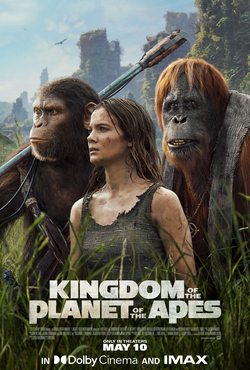
Behind the film
- Year
- 2024
- Director
- Wes Ball
- Writers
- Josh Friedman
- Genres
- Science fiction action, Adventure, Post-apocalyptic, Science fiction
- Production
- 20th Century Studios, Chernin Entertainment
- Country
- United States
- Cast
- Owen Teague, Freya Allan, Kevin Durand, Peter Macon, William H. Macy
About the film
Contains story spoilers, including the ending.
Kingdom of the Planet of the Apes opens with Caesar's funeral before moving many generations into a world shaped by his legacy. Noa, played by Owen Teague, belongs to a peaceful clan that raises eagles. He seeks his father's approval and tests his own courage, with little knowledge of the wider ape societies beyond home. That security ends when soldiers from Proximus Caesar's kingdom attack and take the clan captive. The ruler has adopted Caesar's name while twisting his words to justify domination over other apes. Wes Ball's 2024 film places this new chapter roughly three hundred years after the previous trilogy, when ape civilizations have developed and most surviving humans live without speech.
A broken eagle egg helps set the disaster in motion. After a human scavenger inadvertently damages the egg he has collected for a ceremony, Noa goes looking for a replacement and encounters raiders. They follow his horse back to the village, where Sylva kills his father and leaves Noa for dead. Noa survives and sets out to find the abducted clan. He meets Raka, an orangutan who preserves a different understanding of Caesar's teachings, and the human who has been following him. Raka offers her food and protection. Their assumption that she cannot speak proves wrong: she is Mae, and she knows where the prisoners have been taken. Raka is swept away while saving her during an ambush at a bridge, leaving Noa and Mae to be captured.
The captives are taken to a coastal settlement built around an old human vault. Proximus wants the technology inside and has forced other clans to work on its doors. Noa finds his own people there, while Mae's knowledge offers a way into the structure that the king has been unable to open. She recruits Noa and his friends to help reach a hidden entrance, with explosives placed at the barriers holding back the sea. Inside, the apes encounter weapons and evidence of humanity's former dominance. Mae retrieves the object she came for: a key for satellite communications. Their cooperation gives her access, but it does not mean that she has shared the whole purpose of her mission.
When Proximus confronts them at the vault, Mae sets off the explosives, letting the sea flood the structure with Noa and the others still inside. The apes escape upward, and Noa subsequently faces Proximus at the cliff. His clan's relationship with its eagles becomes the means of defeating the ruler: their call summons the birds, which drive him over the edge. Noa and Mae then return to their separate communities. She delivers the recovered key to humans at a satellite facility, enabling contact with another human settlement. Her claim that the object would help humans speak again is fulfilled through communication across distance. The rescue has freed Noa's people, but Mae's willingness to endanger them has damaged the trust on which their alliance depended. The ending leaves coexistence as a question, while revealing that organised human society has survived beyond the world Noa knew.
Ball found that the effects changed the way he directed dialogue and quieter encounters. Speaking at the Directors Guild of America, he explained that some of his usual elaborate camera movements distracted from the reality of the digital apes. He reshot certain material with a simpler camera position, giving the performances room to carry the scene. A still frame could make the work more convincing than an additional flourish. The decision mattered because Weta's task was to turn the actors' recorded behaviour into living characters. Keeping attention on their faces and interactions allowed the technology to serve an ordinary dramatic exchange, even when every visible ape was created digitally.
Weta's capture equipment combined marked suits with cameras recording the actors' faces. Visual effects supervisor Erik Winquist and animation supervisor Paul Story described updated suits with markers embedded to reduce snagging during outdoor work. Two stacked facial cameras supplied depth information, helping the artists retain small movements around the lips and eyes. The captured performance still needed translation into an ape's different anatomy. Motion editors mapped the body movement to each character and adjusted limb proportions before animation and facial work were brought together. The team deliberately gave these apes somewhat longer legs, preserving the actors' position within the photographed frame and helping with horse-riding poses. Story described the revised facial process as giving animators more time to refine emotion and lip synchronisation against the original acting. The digital figure was therefore built through several passes, with the recorded performance remaining a reference throughout.
Filming the actors in real Australian locations gave the production actual light and surroundings to work against. Winquist told TheWrap that the team also photographed clean versions of scenes without the ape performers, providing backgrounds from which the actors did not have to be removed. The material could then be recombined during post-production. Story explained that reconstructed backgrounds allowed camera work as well as performances to be joined across takes, expanding the editor's choices. The finished interaction could preserve a preferred piece of acting while using a different photographed view of the environment. This flexibility depended on collecting the required versions during the shoot.
Ball also described sound as essential to making the invented creatures seem present. In his Post Magazine interview, he discussed the need for effects that felt natural and organic while still supporting the scale of the action. Ai-Ling Lee handled sound design and mixing. The visual material carried its own complications: old anamorphic lenses introduced optical characteristics that the effects had to match, and the production used a look based on an older Agfa film reference. The apes needed to belong to that photographed image, including its imperfections.