
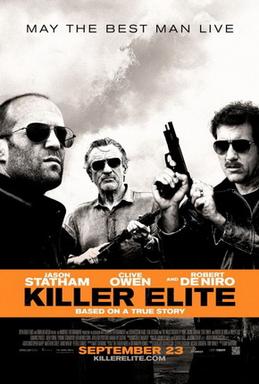
Behind the film
- Year
- 2011
- Director
- Gary McKendry
- Writers
- Gary McKendry
- Runtime
- 1h 56m
- Genres
- Vigilante, Action, Drama
- Country
- Australia, United States, United Kingdom
- Cast
- Yvonne Strahovski, Clive Owen, Jason Statham, Dominic Purcell, Robert De Niro, Adewale Akinnuoye-Agbaje, Aden Young, Ben Mendelsohn
About the film
Contains story spoilers.
Killer Elite begins with Danny Bryce killing a man in front of his child and abandoning mercenary work. Hunter's captivity draws him back: Sheikh Amr demands confessions and apparently accidental deaths from three former SAS soldiers. Speaking to ComingSoon around the film's 2011 release, Gary McKendry described Danny and his pursuer Spike Logan as essentially the same man, seen from different positions. What interested him was the difficulty of choosing a good side. Jason Statham's Danny considers killing a job he wants to leave; Clive Owen's Logan treats his military identity as something he cannot shed. McKendry connected Logan's resentment to the experience of men trained to regard themselves as exceptional, then deprived of the uniform and purpose that sustained them. His account gives their clashes a personal cause beyond the immediate question of who completes a contract.
That weariness also shaped McKendry's visual intentions. He named The French Connection and Three Days of the Condor among the older thrillers he loved, with their rough handheld images and men who seemed used up. Restrictions on what the camera could show led him to tighter, more intimate framing. He also disliked the title and the confusion with Sam Peckinpah's unrelated film. His later personal account sounds less satisfied. McKendry recalls writing a stripped-down thriller with Matt Sherring, built around dark loyalties and moral uncertainty, then seeing it become a full-scale action film during production. He remembers the change from The Feather Men to Killer Elite as part of that experience. The lesson he takes into subsequent shoots is to ask the producers at the outset whether everyone shares the same conception of the film.
The physical production required a different kind of coordination. In Post, McKendry explained that financing collapsed twice before Australian backing shifted much of the shoot to Melbourne. The crew had to combine foregrounds and backgrounds filmed in different countries while keeping the early-1980s setting intact. Iloura's early involvement let him reconsider his existing storyboards frame by frame, deciding what needed a real location and what could be added later. Editor John Gilbert joined those planning discussions and worked on the set, checking chase pacing as well as continuity across footage shot out of order. McKendry counted more than 700 effects shots, roughly 95 percent handled by Iloura. For the rooftop pursuit, three units filmed practical stunts fourteen floors above Melbourne; matching London backgrounds would complete the setting. Sound had a connecting job too. He wanted restrained music and small details that could give way to much larger bursts of violence. Rather than assigning each country an obvious musical cue, or filling the film with period songs, he wanted the sound to carry the thriller across its changing locations.
The production notes describe a more personal use of those locations. Danny's possible future in Australia called for wet greenery and flowers, found in the Yarra Valley, where Anne's home and Danny's house were filmed. McKendry associated London with a purple bruise and the desert with white bone. Hair and makeup designer Paul Pattison developed individual, understated looks for twenty-seven cast members. These soldiers' tastes belonged to the early 1970s, with Slade and Sweet, rather than the flamboyant styles commonly used to signal the 1980s. Anne's scenes offered a different working rhythm: two cameras allowed Yvonne Strahovski and Statham room to improvise. Strahovski described Anne gradually connecting Danny's strange calls and telegrams. Owen, meanwhile, recalled spending hours daily over several weeks preparing for a sustained fight with Statham. The notes stress the intention to keep the performers visible during the action.
Adewale Akinnuoye-Agbaje's handler works through other people's exertions. In his Blackfilm interview with Wilson Morales, the actor described a man who sets politicians against mercenaries and mercenaries against one another, collecting payment while they take the risks. Money governs his loyalties; whether he is helping Danny stays uncertain. The part appealed because it moved him away from the physically threatening roles with which he was associated. He could direct the conflict without doing most of its fighting. Akinnuoye-Agbaje also recalled filming a longer encounter with Robert De Niro that included Statham at one stage; the finished edit contained less. For him, working opposite De Niro meant settling firmly into the character and meeting a partner whose technique raised his own expectations. Although he and Owen had appeared in two films together, he said they first met at a London screening of Killer Elite. Their shared billing had not meant shared scenes.
The fictional conspiracy eventually outgrows Amr's revenge. Danny frees Hunter, then receives another assignment against the story's version of Ranulph Fiennes. He only wounds the author and photographs an apparent death. A government operative reveals an oil bargain involving Britain and Amr's son Bakhait. Logan kills the operative, then Amr, and receives payment from Bakhait. Danny and Hunter intercept Logan, take expenses and leave him the remaining money to begin again. Danny reunites with Anne.