
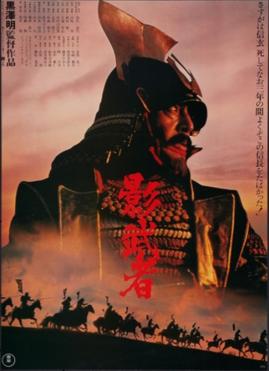
Behind the film
- Year
- 1980
- Director
- Akira Kurosawa
- Writers
- Akira Kurosawa
- Runtime
- 2h 59m
- Genres
- Drama, War
- Country
- Japan
- Cast
- Tatsuya Nakadai, Kaori Momoi, Takashi Shimura, Tsutomu Yamazaki, Jinpachi Nezu, Hideji Ōtaki, Daisuke Ryū, Mitsuko Baishō
About the film
Contains story spoilers.
Nobukado recruits the thief as Shingen's double. A sniper wounds Shingen, who orders his death concealed for three years. The thief discovers his body, leaves, then returns to serve. He convinces the household and inspires soldiers, but falling from Shingen's horse exposes his missing scars. Expelled, he follows Katsuyori's army to Nagashino. Oda gunfire defeats the Takeda. The thief charges with a spear and is shot. He reaches for the fallen banner in a river, dies and drifts away.
Akira Kurosawa found the idea while researching the Sengoku period for an adaptation of King Lear. In his conversation with Tony Rayns, the director described Nagashino as an unresolved historical question that he wanted to approach through a single man's experience. Choosing a petty thief as Shingen's double gave him a way into the larger conflict without trying to tell it entirely through military leaders. Kurosawa imagined Shingen's personality having such a hold over the impostor that the man began to become him. He extended that interpretation to the Takeda commanders, seeing their deaths as an expression of their devotion to Shingen. This was Kurosawa's reading of the battle. He said the stories of the lord, the double and the clan developed from those characters rather than a predetermined structure. The sniper was also a deliberate choice among differing accounts of Shingen's death, including accounts of illness.
The film's images developed during a long wait for the money to make them. Peter Grilli describes Kurosawa spending nearly four years turning imagined scenes into full-scale paintings while funding remained uncertain. Precise sketches and detailed storyboards had already been part of his working method: collaborators helped write the scripts, while he translated their scenes into pictures himself. For Kagemusha, the delay stretched that visual preparation far beyond the usual gap between a sketch and a filmed scene. Grilli also connects the project to Kurosawa's earlier interest in multiple identities and the different faces a historical figure might present in different situations. The paintings gave the director a place to stage the drama in his imagination before actors could enact it.
Tatsuya Nakadai's later account recalls a different initial plan for the two central roles. Shintaro Katsu would play the thief, while Katsu's brother, Tomisaburo Wakayama, would play Shingen. When Wakayama declined, Katsu was to take both parts. Nakadai remembered advising Katsu that working with Kurosawa meant following the director's instructions, even for an actor accustomed to directing himself. He also recalled Katsu missing rehearsals and script supervisor Teruyo Nogami asking him about the absences. Nakadai associated that disagreement over preparation with the eventual breakdown between actor and director.
Speaking during production in 1979, Nakadai described shooting six major scenes for Kagemusha. He singled out the opening encounter between Shingen, the thief and Nobukado, three similar-looking men brought together before the title. He also mentioned Shingen's drinking party with his concubines at the Takeda residence. Having taken over from Katsu, Nakadai wanted the performance to belong to him. He said that once filming began, Katsu's image disappeared and he sought something he alone could bring to the roles.
The shoot brought back Ishiro Honda as chief assistant director. Kurosawa credited him with advice on effects, supplementary filming and communication with the crew, as well as help teaching the actors. Honda's presence let Kurosawa concentrate on other work. Conditions could still interrupt the production: a typhoon stopped filming, and Nakadai was hospitalized after falling from a horse. The crowded compositions placed activity in foreground, middle distance and background, requiring the film's people and horses to occupy several planes within a single frame. Neil McGlone's production account puts the Nagashino reconstruction at two months within a nine-month shooting schedule, with more than five thousand extras employed. The battle required a substantial share of the filming period, gathering thousands of performers for the Takeda army's final assault against Nobunaga's forces. Kurosawa also described a limit to reproducing the period's clothing. He aimed to suggest sixteenth-century costumes, but said their exact colors could not be recreated because historical fabrics used natural dyes rather than the chemical dyes available to the production.
Optical technician Takeshi Miyanishi later recalled a separate attempt to increase the number of horses on screen. Kurosawa asked him to turn thirty photographed horses into an apparent hundred to a hundred and fifty. Of ten shots, Miyanishi found only three steady enough for compositing, so he reused and reframed parts of those images. His method combined filmed horses with hand-drawn masks. Kurosawa initially responded favorably, Miyanishi said, but repeated screenings revealed the same horse on both sides of the frame and the director rejected the result. Miyanishi linked the difficulty to Kurosawa's preference for telephoto photography. He would have preferred a 50mm or 70mm lens to the longer lens and more distant camera position Kurosawa favored.