
Behind the film
- Year
- 2001
- Director
- Iain Softley
- Writers
- Charles Leavitt, Gene Brewer
- Runtime
- 2h 0m
- Genres
- Science fiction, Drama
- Production
- Intermedia
- Country
- Germany, United States, United Kingdom
- Cast
- Kevin Spacey, Jeff Bridges, Mary McCormack, Alfre Woodard, Celia Weston, Brian Howe, David Patrick Kelly, Peter Gerety
About the film
Contains story spoilers.
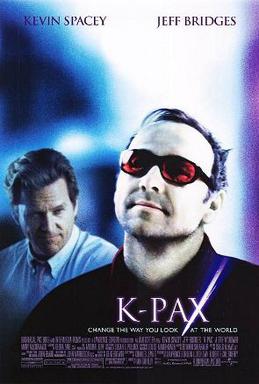
Prot's appearance after a disturbance at Grand Central Station begins a mystery about his identity. He says that he has come from K-PAX, a distant world whose star system he can describe in unexpected detail. Dr. Mark Powell initially approaches the claim with skepticism, then finds himself increasingly fascinated by the patient. Scientists also struggle to account for the information Prot gives them. Prot insists that his stay has an end date, giving the investigation a deadline. Kevin Spacey plays the stranger and Jeff Bridges the psychiatrist in Iain Softley's 2001 film, which places the effort to explain Prot alongside the effect that meeting him has on the people nearby.
Within the institute, Prot gains the confidence of other patients, who take his extraterrestrial account seriously. His promise that he can bring one person with him gives them a reason to imagine leaving their present lives behind. Powell sees the announced July departure as a possible clue to an earlier traumatic event and uses hypnosis to investigate. The inquiry leads toward Robert Porter, a man whose wife and child were murdered and who subsequently attempted suicide. That history offers Powell a human explanation for the stranger's behavior, but learning it does not settle every question raised by Prot's arrival or knowledge. Powell investigates a past life while the patients believe in their present companion.
Powell confronts Prot with a photograph of Robert Porter, only to receive an answer that asks him to care for Robert rather than straightforwardly admitting the identity. At the predicted departure time, the monitoring camera turns to static. Powell then finds the man in a catatonic state, while the other patients say that Prot has gone. Bess, who had asked to accompany him, is also missing and is not found again. Powell continues caring for Porter and tells him about the changes in patients whom Prot encouraged. These events leave a distinction between the evidence of Porter's tragedy and the explanations attached to Prot. The ending presents an unresponsive man, an unexplained disappearance and continuing belief without demonstrating that only one account can be true.
Softley considered the coexistence of possible explanations central to the film. He wanted the human and extraterrestrial readings to receive equal weight, allowing an audience's perspective to affect the conclusion it drew. That concern also shaped his interest in Spacey's performance: the director saw playfulness and an unreadable quality that could suggest sincerity, teasing or a darker intention without requiring an immediate choice between them. Softley described Spacey and Bridges as prepared but collaborative, with Bridges refining an interpretation through takes while Spacey often offered alternatives. The visual treatment had to support those performances without overwhelming the exchanges. Softley pointed to choices in format, lighting and a progression of color, and identified the hypnosis passage as a particular challenge because it holds two people talking on screen for an extended time. His stated attraction to the script included its mixture of realism, mystery and humor, together with a willingness to face grief and death without treating the lighter elements as a reason to dismiss them.
Composer Edward Shearmur began exploring the music before the whole film was finished. In his account of the process, early footage of the house, the murder flashback and the movement into the river focused his discussions with Softley on the emotional center of the story. The shape of that sequence emerged early, but much of the subsequent work concerned sound: finding the right use of the vocalist Melissa and refining the electronic material. Demos made after reading the script helped start a conversation even though that initial music did not survive into the film. Shearmur also changed the density of his writing. He began with a more chromatic, intricate approach and moved toward a more open language in response to a quality he perceived in Spacey's performance. The score's development therefore involved both responding to an actor and solving the sound of a specific traumatic passage. An early compositional idea could establish the discussion without becoming the final cue heard with the images.
A separate Shearmur interview explains why the score also needed restraint. He and Softley already had a working relationship from The Wings of the Dove and wanted to explore electronics, testing sounds while trying to keep the music minimal. An overtly emotional treatment could tell viewers too quickly whether to regard Prot as human or alien. Shearmur described texture as a stronger source of cohesion here than a large network of melodies, contrasting the approach with scores that readily accepted more explicit thematic writing. He even felt that more experimentation might have led him to replace some piano passages with sounds that suggested less definite associations. Those decisions gave the uncertainty a musical form: the score could accompany a scene and connect its atmosphere to the rest of the film while withholding the kind of emphatic emotional instruction that would resolve its central question on the audience's behalf.