
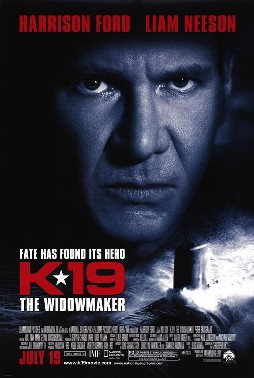
Behind the film
- Year
- 2002
- Director
- Kathryn Bigelow
- Writers
- Christopher Kyle
- Runtime
- 2h 12m
- Genres
- Thriller, Drama, Disaster, Historical
- Production
- National Geographic Society, Intermedia, Regency Enterprises
- Country
- Canada, United Kingdom, Germany, United States, Russia
- Cast
- Liam Neeson, Harrison Ford, Peter Sarsgaard, Joss Ackland, Christian Camargo, Shaun Benson, John Shrapnel, Donald Sumpter
About the film
Contains story spoilers, including the ending.
Kathryn Bigelow's K-19: The Widowmaker follows a Soviet submarine crew into a crisis during the Cold War. Harrison Ford plays Captain Alexei Vostrikov, who takes command of the vessel in 1961, while Liam Neeson plays Mikhail Polenin, the captain displaced into a subordinate role. The crew's attachment to Polenin makes the handover more than a change of rank. Vostrikov insists on discipline and the demands of the mission; Polenin is more immediately concerned with the men who must carry it out. The 2002 film turns that conflict toward a disaster within the boat itself, where obedience and responsibility become increasingly difficult to reconcile.
When a failure in the reactor's cooling system threatens the submarine, sailors must enter the compartment to make improvised repairs. Their work exposes them to radiation, and the men returning from the first attempt show those who follow what the task will cost. The film gives that danger a human scale through the crew's faces, hesitation and physical suffering. Its immediate suspense comes from an escalating technical emergency, but each attempted solution requires another decision about the people who must perform it. Preventing a wider catastrophe may depend on accepting injuries that cannot be undone once the machinery is under control.
Polenin refuses to support the officers who try to remove Vostrikov, and the two commanders cooperate through the last attempt to save the submarine. The young reactor officer Radtchenko returns to the damaged compartment and helps avert a meltdown, at terrible personal cost. When a Soviet rescue vessel arrives, Vostrikov evacuates his men against orders. A later tribunal clears him, with Polenin speaking in his defense, although his submarine command career is over. The closing cemetery reunion brings the survivors together years afterward. Vostrikov honors the dead among men who understand their sacrifice, while the public recognition he sought for them has been refused.
Bigelow and cinematographer Jeff Cronenweth kept the interior sets close to the submarine's actual scale. Their commentary describes a promise to avoid camera positions that could not physically exist inside the boat, with limited exceptions for obvious effects transitions. Low ceilings, crowded equipment and narrow passages forced bodies and cameras to negotiate the same space. The restriction made claustrophobia a practical condition of staging. Keeping the camera mobile within those limits required planning how a scene could move between people without pretending the compartment was larger than it was. The machinery around the actors became part of every movement.
The production assembled its Soviet setting across several locations. Moscow supplied Russian material, Lake Winnipeg stood in for Arctic ice, and Toronto housed the submarine interiors. Halifax's shipyards and harbor represented the naval base and supported the ocean work. Costume designer Marit Allen also oversaw more than four hundred uniforms, with different outfits needed for formal appearances and shipboard labor. Russian workers made the garments to reproduce period fabric and construction. These details link the large military spectacle to the repeated activities of the crew. The same men who appear in ceremonial dress must later work in confined compartments, where the appearance of institutional order gives way to an immediate struggle with damaged equipment.
Ford described Vostrikov as a character who was not meant to be sympathetic at first. His interest lay in the difficult choices the captain faces and the possibility that decent behavior can emerge under extreme pressure. Bigelow likewise described the film as a character piece, acknowledging that the historical events had been altered for drama. Her meetings with survivors involved suspicion about how an American production would portray Soviet experience, while Ford recalled finding different accounts from men who had occupied separate compartments. Their interviews locate the project between a specific military history and a dramatic structure built around personalities whose understanding of the crisis remains partial.
Bigelow's account of development begins with a documentary about the incident and her decision to pursue the story in 1996. The arrival of another submarine production, U-571, delayed the project, leaving time for further research. She also had to decide how an international cast would represent Soviet sailors in English. The resulting accents were deliberately invented, intended to give actors from different countries a shared vocal setting. In her description of the cramped sets, advance planning created room for fluidity rather than dictating every finished gesture. That combination of preparation and adjustment connects the long development process to the practical demands of shooting a large cast inside a restricted environment.
The research did not eliminate disagreement about the dramatization. Before release, reactor supervisor Yuri Yerastov and other surviving sailors objected to an early script's depiction of their competence and conduct. They challenged material involving drunkenness and conflict among the officers, saying it misrepresented their experience. Their objections concerned a script while filming was under way, so they do not establish the content of every scene in the finished film. They do establish that the people whose actions inspired the story contested how those actions were being reshaped for the screen.