
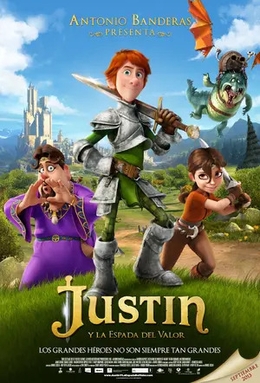
Behind the film
- Year
- 2013
- Director
- Manuel Sicilia
- Writers
- Matthew Jacobs, Manuel Sicilia
- Genres
- Fantasy, Children's, Adventure, Animated
- Country
- Spain
About the film
Contains story spoilers, including the ending.
Justin and the Knights of Valour follows a boy whose chosen profession has been outlawed. In Manuel Sicilia's animated adventure, the kingdom is run by bureaucrats, and its knights have been sent away. Justin wants to follow his grandfather into their ranks. His father Reginald, an adviser to the Queen, expects him to become a lawyer instead. Leaving home brings Justin into contact with the barmaid Talia, an eccentric would-be wizard and three mentors who teach him the skills of knighthood. The disagreement at home has consequences beyond choosing a career: the kingdom will need someone who can defend it when a threat arrives. Justin's teachers prepare him for that responsibility while his father has been preparing him for a place in the administration.
The threat is Sir Heraclio, the exiled knight who killed Justin's grandfather and stole his sword. Justin trains at the Tower of Wisdom, where a test with an alligator disguised as a dragon nearly kills him. Back home, he abandons his dream until Talia brings news that Lara, the girl he admired, has been kidnapped. His father finally accepts his decision to attempt a rescue. Justin and Talia face Heraclio's forces together, with Blucher arriving to help. Justin recovers his grandfather's sword and sends Heraclio over a waterfall to his death. The Queen knights Justin and agrees with Reginald to restore the knights. Justin returns Lara's dirty sock, the token she gave him before his journey, rather than proposing to her. He invites Talia on further adventures, and she kisses him. His teachers place his statue beside his grandfather's and reveal a hall for future knights.
Reginald's fear became more important as Sicilia developed the story. Speaking to the Spanish film academy's magazine, the director explained that early versions belonged entirely to Justin's point of view. His father functioned as an opponent in a story about rebellion and finding an identity. During the long development, Sicilia became a father himself and began thinking about the terror of a child leaving home to risk his life. He rewrote with that other side of the argument in mind. The setting also rests on a change that interested him: a medieval world of castles, abbeys and sword fights is losing its magic and becoming modern. The original project was called Goleor: The Scales and the Sword. Kandor had postponed making it until the studio could achieve the film Sicilia wanted. He described the unlikely ambition of making internationally distributed animation in Granada as something he recognised in his slight young hero's determination to become a knight. That connection concerns the director's own experience of pursuing the project, as well as the family dispute he had reconsidered while writing it.
The Broken Eagle Inn gives this changing kingdom a particular address. Sicilia told RTVE that it had once been a legendary meeting place for knights but had become a fast-food restaurant. That transformation was already present in the first screenplay. Inma Cuesta, who voices Talia in Spanish, described her as a brave fighter who encourages Justin rather than waiting to be rescued. Cuesta had to raise the pitch of her own deeper voice to make the character sound younger. Antonio Banderas described his impostor knight, called Sir Antoine in the Spanish version, as someone whose own romantic dream had failed and curdled into frustration. He saw the character as a source of comedy. Banderas also produced the film, but said he took the acting role Sicilia offered him. His account distinguishes the comparatively straightforward voice work from the much harder production around it.
Sicilia's account of the animation describes how that production gave Justin a world to move through. He told Peques y Más that the work took about three and a half years, with much of the animation, lighting, rendering and compositing concentrated in the last eighteen months. Technical directors supplied tools for the artists, while riggers prepared character models for animation. Other staff repaired problems in animated models or combined the layers of the finished images. Kandor tracked fourteen million files associated with the film and developed its own methods for hair, vegetation and crowds. The studio also brought stereo previews into early stages of production. Its collaboration with the University of Granada had a direct place on screen: students on the animation master's course animated secondary characters appearing in the background. Sicilia described that course as using the same tools and working methods as the studio, allowing students to contribute to an actual production rather than learn a separate classroom process.
The kingdom's castle takes inspiration from the Alcázar of Segovia. Sicilia told HobbyConsolas that he wanted the story's basic motivations to be understandable internationally while keeping a recognisably European medieval flavour. More than a hundred characters and forty settings were created for the film. Its English-language production brought together voices including Freddie Highmore, Saoirse Ronan and Julie Walters. Timeless Films joined Kandor as a partner and acquired worldwide distribution rights outside Spain. The screenplay was written by Sicilia and Matthew Jacobs from Sicilia's original idea. The English cast and Cuesta's Spanish performance belong to different voice versions of the same adventure.