
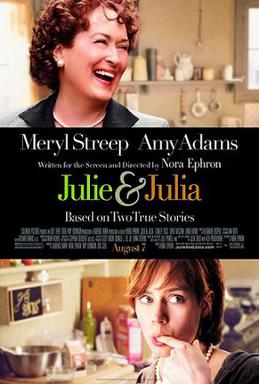
Behind the film
- Year
- 2009
- Director
- Nora Ephron
- Writers
- Nora Ephron, Julie Powell, Julia Child, Alex Prud'homme
- Runtime
- 2h 3m
- Genres
- Biographical, Comedy drama, Romantic comedy, Drama
- Production
- Columbia Pictures
- Country
- United States
- Cast
- Meryl Streep, Amy Adams, Stanley Tucci, Chris Messina, Mary Lynn Rajskub, Jane Lynch, Vanessa Ferlito, Casey Wilson
About the film
Contains story spoilers.
Julie & Julia moves between two women who are separated by decades but connected by a cookbook. In 1950s Paris, Julia Child arrives with her diplomat husband Paul and looks for something absorbing to do. In 2002 Queens, Julie Powell is a frustrated state employee who answers calls from people affected by the September 11 attacks and the plans to rebuild the World Trade Center site. Nora Ephron’s film gives each woman an ordinary starting point: Julia is restless in a new city, while Julie feels her life is not becoming the writing career she imagined. Cooking becomes a practical route into a larger question of what work can make a life feel chosen.
Julia first tries hat-making and other diversions, but French food catches her attention. She enrolls at Le Cordon Bleu, where the male students and the school’s director regard her as an outsider. Rather than retreat, Julia practises the techniques and proves she can keep pace. She also meets Simone Beck and Louisette Bertholle, who are developing a French cookbook for American readers. Julia joins the project and brings energy, organization and persistence to it. The film presents her not as an instant expert but as someone who learns by repetition, tasting and correcting. Her physical delight in food makes the lessons feel social as well as technical, and Paul’s steady companionship gives her room to pursue them.
The book becomes a long collaboration rather than a quick triumph. Julia and her co-authors test recipes, revise instructions and try to make French methods usable for people cooking in American kitchens. Paul’s diplomatic postings repeatedly disrupt their routine, and the film shows the couple adapting to new homes while Julia keeps returning to the manuscript. A publisher rejects the book as too long and complicated, forcing Julia and Simca to reconsider its shape. Their work survives that refusal: Alfred A. Knopf eventually accepts it. The film cuts between this extended process and Julie’s compressed one-year challenge, linking two kinds of persistence without pretending that writing a cookbook and following one are equivalent achievements.
Julie’s project begins with a clear rule: cook every recipe in Child’s Mastering the Art of French Cooking during one year and write about it online. Her husband Eric supports the idea, and the routine gives her a daily task beyond the call centre. The small Queens kitchen becomes a recurring stage for spilled ingredients, difficult techniques and meals shared with friends. Recipes that demand unusual equipment or long preparation turn the schedule into a test of patience. Julie’s blog finds readers, which changes the private challenge into a public performance. She now has to keep cooking while turning each success and mishap into something worth reporting, and the project’s neat deadline begins to shape her relationships as much as her meals.
As Julie’s audience grows, the work starts to crowd out the people who helped make it possible. She becomes absorbed in the blog and its readers, and an argument with Eric brings their marriage into the foreground. He leaves for a short time; Julie recognizes that the project has become a way to claim attention as well as to find purpose. The conflict is intimate rather than a dramatic career crisis, grounded in the question of how much of a shared life can be organized around one person’s ambition. Meanwhile, Julia’s story carries a different pressure. Paul is questioned during the McCarthy era and reassigned, while the cookbook continues to demand attention. Both plots ask what support looks like when a partner’s work takes over daily life.
The film does not make Julie’s achievement depend on Julia’s approval. A New York Times food writer visits and reports on the blog, bringing Julie attention from journalists, agents and publishers. Then Julie hears that Child was critical of the project, a painful complication for someone who has treated the older woman as a source of encouragement. Julie remains grateful for the cookbook even while absorbing that disappointment. The film closes their stories with separate acts of recognition: Julie and Eric visit a reconstruction of Julia’s kitchen at the Smithsonian, while Julia receives the first printed copy of her own book at home with Paul. The parallel ending offers connection through work and influence, not a meeting between the women.
Ephron uses the alternating structure to create a rhythm between Paris and Queens, old-world culinary training and the improvised demands of a small modern kitchen. Food is both action and texture: Julia’s lessons bring technique into the frame, while Julie’s cooking supplies the visible evidence of each deadline. The film’s warm comic tone comes from the contrast between Julia’s buoyant appetite and Julie’s increasingly public self-discipline, with Paul and Eric giving each story a domestic counterweight. Julia’s practice produces a mountain of chopped onions, making the repetitive work behind her new cooking skills visibly part of the comedy. Their work proceeds on different timescales: Julia revises a manuscript over years, while Julie turns its instructions into a daily cooking practice with a fixed end date.