
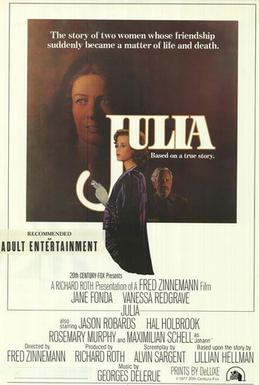
Behind the film
- Year
- 1977
- Director
- Fred Zinnemann
- Writers
- Alvin Sargent, Lillian Hellman
- Runtime
- 1h 58m
- Genres
- Drama, Biographical
- Production
- 20th Century Studios
- Country
- United States, United Kingdom
- Cast
- Jane Fonda, Vanessa Redgrave, Jason Robards, Hal Holbrook, Rosemary Murphy, Maximilian Schell, Meryl Streep, John Glover
About the film
Contains story spoilers, including the ending.
Julia follows Lillian Hellman's memories of a friend who refuses the comfortable life her wealthy family offers. Jane Fonda plays Lillian, with Vanessa Redgrave as Julia and Jason Robards as Dashiell Hammett, the writer sharing Lillian's life. The story comes from Hellman's Pentimento, and the memoir became the subject of a dispute. Hellman maintained that she had taken part in the mission. Muriel Gardiner, an American who had worked against Nazism in Vienna, said she had never known Hellman and believed her own history had been borrowed. That dispute sits behind a film which begins and ends with Lillian alone in a fishing boat. The friendship reaches us through her recollection, including the gaps left by someone she could no longer question.
Lillian is struggling with her writing while Julia studies medicine in Europe. When fascists attack the university in Vienna, Julia is badly injured. Later, an approach in Paris asks Lillian to carry money into Germany for her friend. The journey turns ordinary travel arrangements into sources of fear: luggage, fellow passengers and a hat carrying concealed money all matter. In Berlin, Lillian finally meets Julia in a café and sees that she has lost a leg. Julia tells her about a daughter living with a family in Alsace and asks Lillian to care for the child if anything happens to her. The successful delivery does not keep Julia safe. She is killed in Frankfurt, and Lillian's attempt to find the daughter fails. Back in America, her attempt to contact Julia's family ends at the door. Lillian's final remembrance returns to the fishing boat and the people who have disappeared from her life. The mission has an end, but the child's whereabouts remain beyond her reach.
For Zinnemann, Lillian's fear was the way into the story. He told El País that her attempt to emulate Julia had fascinated him, including her inability to become the person she admired. His interest in the rise of Nazism also came from memories of Vienna, where he had seen its early appeal and the danger of dismissing Hitler. He and Alvin Sargent worked together on the screenplay for four months before taking it to Hellman. Their treatment made Hammett and Julia the two people whose support and example mattered most to Lillian.
The café meeting also posed a very practical problem for editor Walter Murch. Zinnemann disliked cutting into close-ups too early, so Murch wanted to save the largest views of Fonda and Redgrave for the scene's most charged moments. Yet the actresses' hands did not always match from one shot to the next. The script supervisor warned him after the daily screenings that continuity would be difficult. A close-up could have hidden an awkward change, but using one simply to escape a mismatch would spend an image he wanted to hold back. Murch recalled finding a way through the material without abandoning that restraint. His account puts the editing decisions at the table itself: where the hands are, when a face fills the screen, and how long the wider view can carry a conversation. The suspense has to stay with the two women rather than draw attention to the joins between their takes.
Redgrave remembered another kind of cutting before the same scene was filmed. The night before the shoot, Zinnemann asked both actresses to shorten their own dialogue as much as they could. They each removed lines from their own part, rather than trimming the other woman's speech. Redgrave welcomed the request because it allowed the encounter to carry things that did not need to be said aloud. The café scene was therefore being pared down before Murch ever assembled the shots. Less dialogue left more of the meeting to the actresses' presence and responses.
Getting Redgrave into the film had required its own conversation. Casting director Juliet Taylor recalled that Zinnemann worried about working with both her and Fonda while the actresses were so politically active. Taylor thought passing over Redgrave would be a mistake and contacted the producer, angering the director by going around him. He eventually met Redgrave while she was appearing in a play and warmed to her. Taylor also cast Meryl Streep in her first film role, Anne Marie. Streep had arrived from Yale and was already attracting attention in New York theatre. Taylor remembered being fortunate to secure her when other people also wanted her in films.
The film moves back and forth between girlhood memories, Lillian's writing life and the courier journey of 1937. Julia can be absent for long stretches even while Lillian's thoughts keep returning to her. Hammett occupies another part of that remembered life, away from the hurried Berlin meeting. The train ride concentrates the story into a task with immediate risks, while the flashbacks reach across years of attachment. At the café, the two women have very little time together. Their conversation has to fit both a delivery and a farewell into that brief space.