
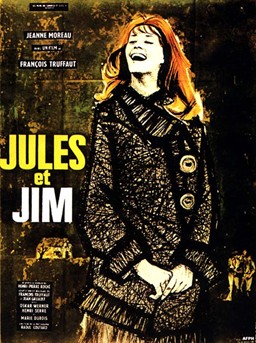
Behind the film
- Year
- 1962
- Director
- François Truffaut
- Writers
- Jean Gruault, Henri-Pierre Roché, François Truffaut
- Runtime
- 1h 45m
- Genres
- Romance, Drama, Buddy
- Country
- France
- Cast
- Jeanne Moreau, Oskar Werner, Henri Serre, Marie Dubois, Sabine Haudepin, Serge Rezvani, Michel Subor, Jean-Louis Richard
About the film
Contains story spoilers.
Jules and Jim begins in Paris in 1912, where Jules, a shy Austrian writer, befriends Jim, a more outgoing Frenchman. They share an appetite for art, conversation and women, and the film treats their companionship as its first love story. They attend a slide show and become fascinated by a smiling statue of a goddess; the image gives them a shared ideal before either knows what it will mean. When they travel to see the sculpture, the trip extends their friendship beyond the cafés and streets where it began. François Truffaut’s narration introduces their world quickly, moving across years and experiences with a lightness that makes the coming change feel possible rather than planned.
The two men meet Catherine, who seems to carry the statue’s smile into ordinary life. She is neither a passive prize nor a stable answer to their fantasy: she changes mood, challenges expectations and makes their friendship newly difficult. Jules becomes her partner, while Jim remains drawn to her and continues seeing Gilberte. The three nevertheless share a seaside holiday, and Catherine’s quickness and playfulness give their arrangement an energy neither man could create alone. In one sequence she disguises herself with a moustache and races the men across a bridge. Such moments present her as an active participant in the trio, while also showing the men interpreting her through the beautiful image they had already chosen to follow.
A missed café meeting alters their future. Catherine asks Jim to see her, but arrives late and finds he has left; she soon marries Jules and moves with him to Austria. The First World War places the friends in opposing armies, where each fears that he may have to kill the other. The film compresses this separation with narration, images and abrupt transitions rather than turning the war into a conventional battle adventure. When Jim visits after the conflict, Jules and Catherine have a daughter, Sabine, and live in a chalet. Their marriage is strained by Catherine’s affairs and absences. Jules tells Jim how much he fears losing her, while Catherine confides that she misses her earlier freedom and tries to draw Jim back into her life.
Jules responds to the crisis with an unusual offer: he gives Jim permission to marry Catherine so she will remain near him. For a time they live together with Sabine, sharing a household that seems to answer Jules’s fear and Catherine’s restlessness. It cannot settle the triangle. Jim and Catherine want a child but cannot conceive one, and Jim returns to Paris. Letters briefly renew the possibility of a reunion when Catherine believes she is pregnant, but she suffers a miscarriage. The trio’s arrangement has depended on everyone accepting a different version of love, and the loss exposes how fragile that compromise was. Jules still wants the friendship and proximity; Jim wants Catherine but is wary of being governed by her; Catherine refuses to remain within a settled role.
Later, Jim encounters Jules and Catherine back in France. Catherine tries to win him over again, but he tells her that he intends to marry Gilberte. She pulls a gun on him; he wrestles it away and escapes. Their next meeting comes in a cinema during a newsreel of Nazi book burnings, a public image that brings the history outside the trio into their private story. They meet afterward at an outdoor café. Catherine asks Jim to ride with her and tells Jules to watch them. She drives the car from a ruined bridge into the river, killing herself and Jim. Jules is left to attend their burial, with Catherine’s wish to have her ashes scattered in the wind still unfulfilled. The close leaves him with memory and Sabine, not a repaired friendship.
The film’s form keeps its emotional shifts unusually immediate. Voice-over, fast cutting and ellipses compress years, while freezes, still images, wipes and newsreel footage call attention to the act of telling. The result can feel playful even when the characters are facing separation, because the camera moves with the speed of their impulses rather than the weight of a formal period drama. Raoul Coutard’s photography and Georges Delerue’s score help give the friendship a buoyant surface that the later years gradually darken. Catherine’s song, Le Tourbillon de la Vie, becomes a small performance within the story: she sings of life’s whirl while Jules and Jim listen, and its melody returns in memory after the trio’s life together is over.
Truffaut adapted Henri-Pierre Roché’s semi-autobiographical novel. Jules’s loyalty keeps him near Catherine even after their marriage has changed, while Jim returns to Gilberte when the shared household cannot give him the future he wants. Catherine’s refusal to accept that separation brings their experiment to its fatal end. The open arrangement has given the friends temporary closeness, but it has not dissolved jealousy or their different expectations. Jules alone survives to arrange the burial of the two people around whom his adult life has revolved.