
Behind the film
- Year
- 2008
- Director
- Eric Brevig
- Writers
- Mark Levin, Jennifer Flackett
- Runtime
- 1h 32m
- Genres
- Science fiction, Fantasy, Adventure, Action
- Production
- New Line Cinema, Walden Media
- Country
- United States
- Cast
- Brendan Fraser, Josh Hutcherson, Anita Briem, Seth Meyers
About the film
Contains story spoilers, including the ending.
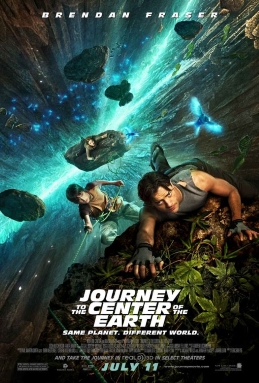
Journey to the Center of the Earth sends a small group into a world far larger than anything they are equipped to handle. Brendan Fraser plays Trevor Anderson, with Josh Hutcherson as his nephew Sean and Anita Briem as the guide who accompanies them. Eric Brevig directed this 2008 adventure, which takes its starting point from Jules Verne and turns the descent into a modern journey. Discovery quickly gives way to the practical problem of getting back. The companions have to move through unfamiliar surroundings and survive creatures that make their expedition increasingly dangerous. Its compact central group keeps the adventure focused on people who can argue, help each other and react differently to the same extraordinary sight, even as the landscape keeps expanding around them.
The search begins with Max, Trevor's missing brother and Sean's father, whose notes lead them towards Iceland. A storm traps Trevor, Sean and Hannah in a cave, and their route deeper underground eventually brings them to Max's former refuge. They find his body and learn from his journal that the temperature is rising, giving their own escape a deadline. An underground ocean, predatory fish and a dinosaur stand between them and the surface. Trevor ultimately ignites magnesium in a wall to release water into a geyser, sending the group out through Mount Vesuvius in Italy. Sean's collected diamonds help pay for the damage they cause on arrival and support the laboratory back home. Trevor and Hannah have also become a couple. A later gift of a book about Atlantis leaves Sean with the suggestion of another expedition, while the glowing bird he brought out escapes into the open air.
The novel exists inside the film, which gives the adaptation a playful way to use its source. Trevor can compare what he finds with a story he has read, rather than occupying the role of one of Verne's nineteenth-century explorers. Brevig wanted the characters' ordinary reactions to make that impossible situation approachable. Fraser's physical comedy and capacity for a more vulnerable performance were both part of the casting, since Trevor begins with a life that is going badly and finds new attachments during the expedition. Before filming, the director rehearsed with the three leads for two weeks in an empty space marked out to represent the future sets. They worked through scenes and character problems there. Establishing how the group related to each other gave the actors something settled to carry into days dominated by technical equipment and effects work.
Most of that underground world was built in Montreal. Brevig filmed the Icelandic mountain exteriors on location, then used soundstages and local surroundings for the rest of the journey. Four stages housed underground sets that had to be dismantled and rebuilt as shooting moved between them. Hannah's house and the Italian farm at the end were also filmed in a Montreal park. The schedule made this an exercise in coordinating changing spaces: one set needed to be ready while another was being taken apart. The modern setting helped keep the journey moving too. Brevig chose to retain the novel's spirit and major wonders while dropping the long travel that would no longer seem extraordinary to a contemporary audience. The underground ocean and prehistoric creatures remain, but reaching Iceland becomes the beginning of the adventure rather than a lengthy achievement in itself.
The mixture of physical sets and computer imagery was designed around what the actors could touch. Brevig wanted uneven ground under their feet and real surfaces immediately around them, even when the distant view would be added later. Those built pieces also supplied the effects artists with photographed textures and lighting to extend, helping the small practical space and the larger invented environment fit together. Stereo photography made that matching particularly demanding. A flat-image trick could fail once the viewer's two eyes were given different information about distance. Brevig could check the results during production on a large projection screen, judging depth at a scale closer to the eventual cinema image. That let the team assess a shot before removing the set. The work joined a very small acting ensemble to landscapes that were being constructed through several different kinds of image-making.
Depth was part of the composition from the start. Brevig used stereo cameras developed from the system associated with James Cameron and Vince Pace, treating the space between foreground and background as something to arrange deliberately. A 3D shot can direct attention through distance as well as across the screen, which suits a story about people encountering enormous hidden spaces. It also creates a practical limit: repeatedly forcing the eyes to adjust can become tiring. Brevig discussed that problem while the film was being made, recognising that the audience's physical comfort affected how the adventure would play. The attraction of the format consequently involved both surprise and restraint, with the camera deciding how far a new world should seem to extend around its visitors.