
Behind the film
- Year
- 2013
- Director
- Joshua Michael Stern
- Runtime
- 2h 2m
- Genres
- Biographical, Drama
- Country
- United States
- Cast
- Ashton Kutcher, Josh Gad, Dermot Mulroney, Matthew Modine, J. K. Simmons, Lukas Haas, Victor Rasuk, Ron Eldard
About the film
Contains story spoilers, including the ending.
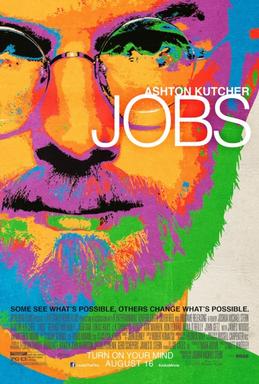
Jobs follows the creation of Apple through a partnership that is already uneven before the company exists. Ashton Kutcher plays Steve Jobs and Josh Gad plays Steve Wozniak in Joshua Michael Stern's 2013 drama, written by Matt Whiteley. The young Jobs leaves Reed College but continues attending classes, including calligraphy, then travels to India with Daniel Kottke. Back in California, his work at Atari brings Wozniak into a game-development assignment. Jobs keeps an unfair share of the payment. When he sees the home computer Wozniak has built, he recognises a product they could sell. The pair establish Apple and bring a small team into Jobs's parents' garage. Store owner Paul Terrell's interest offers a first commercial opening, though his disappointment with a bare motherboard shows how far Jobs's promises run ahead of what the team has delivered. The film makes the early business a mixture of engineering, persuasion and personal favours.
Mike Markkula's investment helps the company grow, and the Apple II gives the partners a public success. Growth also brings distance between Jobs and people who knew him before Apple. He recruits John Sculley as chief executive, but struggles within a company that no longer simply follows his wishes. Removed from the Lisa project, he takes control of the Macintosh group and pushes aside its original leader. The Macintosh launch does not protect him from the boardroom conflict, and Sculley forces him out. Years later, Jobs runs NeXT and has a family life that includes Lisa, the daughter he once refused to acknowledge. Apple's purchase of NeXT brings him back as a consultant. He regains control, removes former opponents and takes an interest in Jonathan Ive's design work. The story reaches his renewed direction for Apple and the Think Different campaign. His return restores his power inside the company after the earlier rejection.
The people hurt along the way keep that comeback from being a simple account of perseverance. Chrisann Brennan's pregnancy meets Jobs's refusal to accept paternity, while some of Apple's early workers are excluded from the stock that would reward their part in its beginnings. Stern discussed both choices when explaining the difficult behaviour Kutcher had to play. The actor needed to understand how this Jobs justified himself, even when those justifications would not satisfy the people around him. Stern also described the young man's frustration in trying to explain products and ideas for which a familiar vocabulary did not yet exist. That is the tension the film puts beside his treatment of others: someone pushing towards a product he can imagine can also refuse to hear the needs directly in front of him. The biographical material is shaped into dramatic conversations, so these encounters are the film's portrayal rather than a transcript of private events.
Stern narrowed the story around Jobs and the business becoming inseparable. He recalled a screenplay of roughly two hundred pages, far more material than could fit into the finished film. Decisions about what to leave outside the frame were therefore central. Bill Gates is heard on a telephone rather than given a separate story, and the wider competition in computing is often felt through arguments inside Apple's offices. Stern used a conversation about IBM as an example: he wanted the concern to enter through what it meant to people in the boardroom. He was following the experience of the man building the company, rather than trying to dramatise every industry event around him. That choice makes relationships at work carry much of the historical movement. A change in a product team or a board's loyalties becomes a change in Jobs's own position.
Kutcher's preparation included extensive study of Jobs's mannerisms and distinctive walk before his first meeting with Stern. The director remembered being surprised by how much work had already happened. They continued to discuss individual scenes throughout the shoot, with Kutcher calling late at night to ask what they might have missed or what could be improved. Stern linked that sustained attention to the film's interest in obsession. The physical resemblance was a beginning, but the performance also had to account for someone whose determination could be exciting and difficult to live around. Stern acknowledged his own uncertainty over casting a performer strongly associated with comedy. He felt that curiosity and scepticism about the choice could give the audience a reason to look more closely at the portrayal.
Gad and Kutcher approached the early partnership as mutually beneficial. In Gad's description, Wozniak supplies the technological imagination while Jobs sees how the inventions might be brought to a wider public. Gad compared the pairing cautiously to Lennon and McCartney, emphasising the usefulness of their differences without trying to assign a matching share of credit. Stern also wanted the scenes to give an impression of what Wozniak meant to Jobs and what was lost when he left. For the director, the absence of one obvious incident explaining Jobs's personality was part of the challenge. He chose to build the portrait through moments of work and contact with other people. The company survives changes in that circle, but the early garage partnership cannot simply be recovered by returning to Apple.