
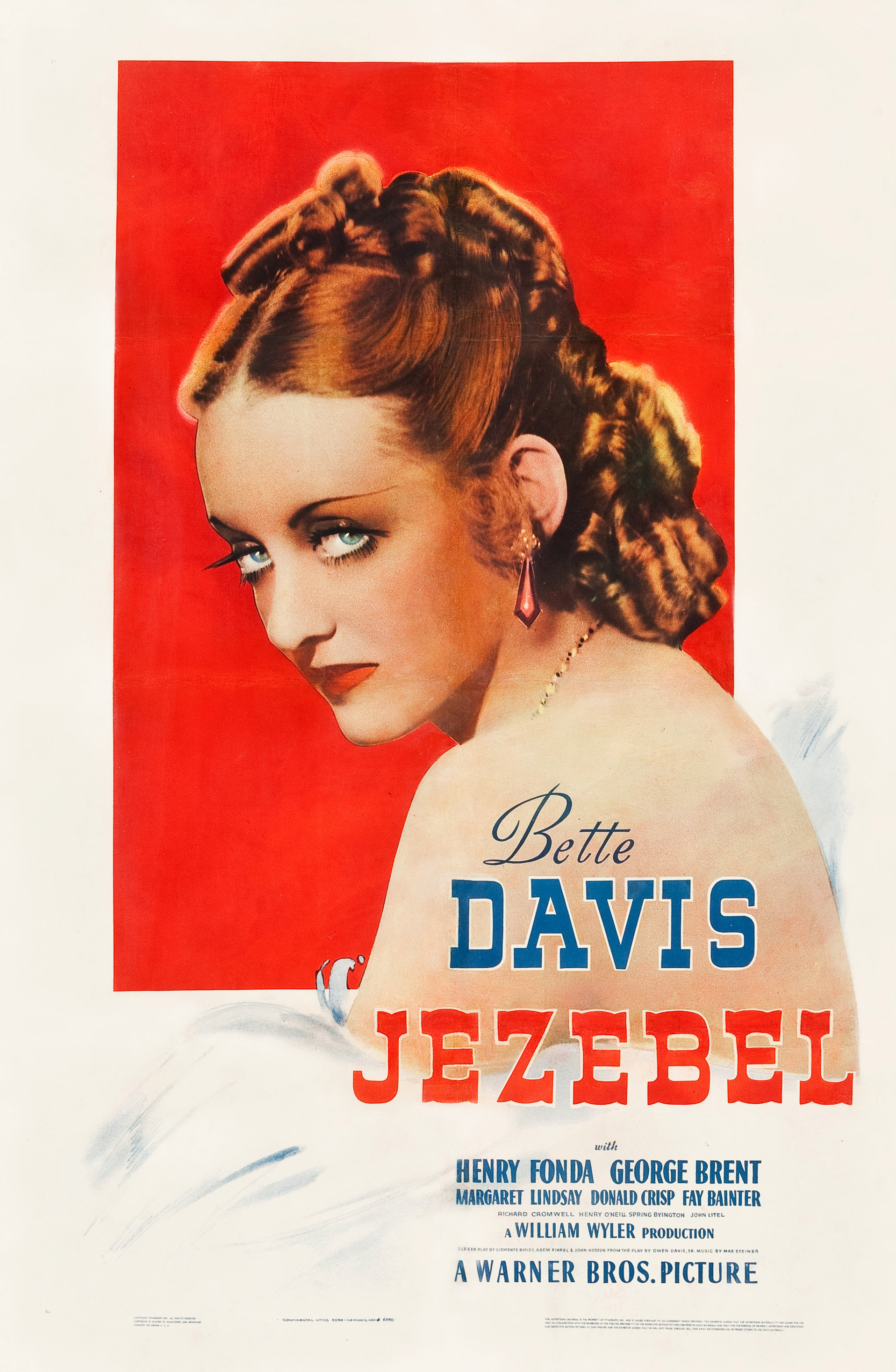
Behind the film
- Year
- 1938
- Director
- William Wyler
- Writers
- John Huston, Abem Finkel, Owen Davis
- Genres
- Romance, Drama
- Production
- Warner Bros. Entertainment, Warner Bros. Pictures
- Country
- United States
- Cast
- Bette Davis, Henry Fonda, George Brent, Margaret Lindsay, Donald Crisp, Fay Bainter, Henry O'Neill, Spring Byington
About the film
Contains story spoilers.
Jezebel follows Julie Marsden, played by Bette Davis, and her struggle with her equally stubborn fiancé, Preston Dillard, played by Henry Fonda. Their engagement ends after she wears red to a ball where unmarried women are expected to wear white. Julie is already accustomed to attracting disapproval. She arrives at her own party in riding clothes and takes the initiative in her romance with Pres, refusing the quiet, obedient role expected of her. The Olympus Ball makes her defiance public. At Madame Poulard's dress shop, Julie rejects a white crinoline when she sees the red gown. The garment carries an additional insult: it is intended for a woman outside respectable society. Julie chooses it to provoke the banker she expects to marry, turning an argument between the couple into a challenge to the people around them.
At the ball, Julie regrets her choice, but Pres makes her dance before breaking their engagement. He leaves for the North. When he returns, Julie asks forgiveness and discovers that he has married Amy Bradford. Yellow fever drives Julie and Aunt Belle to their plantation. A dinner argument leads to a duel in which Pres's brother Ted kills Buck Cantrell. Pres falls ill. With Gros Bat's help, Julie crosses the fever line to reach him. Amy follows, insisting on nursing her husband, but Julie persuades her that she is unprepared for the quarantine. Julie accompanies Pres to the leper colony, riding beside him into the night.
The fever changes what it means for Julie to break a rule. Her earlier choice of dress humiliated Pres; crossing into the sealed city brings her to his sickbed. Taïna Tuhkunen's study of Jezebel draws attention to both transgressions and questions whether the last journey settles Julie's character into a simple image of selfless virtue. The film places this personal crisis within a city whose confidence persists as disease approaches. At dinner, Buck insists that the cotton trade will keep New Orleans prosperous, even with fever threatening it. Pres, meanwhile, complains that the city is being left behind. These arguments belong to the film's characters and their competing visions of the place they inhabit.
Wyler had seen Owen Davis's stage play before Warner Bros. asked him to direct its adaptation. Although the play had closed after thirty-two Broadway performances, he thought its love story could work on screen. He wanted to bring in action that the stage version merely described and make use of its settings and costumes. That expansion is especially clear at the Olympus Ball. Ernest Haller's camera moves behind pillars and between the ceiling and dance floor, taking in the room around Julie. Her confidence collapses in the expanse of space. The film also repeats settings and situations: formal dinners, parties in Julie's honour and visits to the hotel bar. Her red dress at the ball is answered by a white dress at Halcyon. Elsewhere, the camera can remain still. When Pres breaks the engagement, Julie's face and eyes follow him as he leaves. Gabriel Miller's account of Wyler's direction points to this reliance on small movements within the frame, alongside long takes and carefully arranged scenes.
The work behind those controlled gestures could be exhausting. Frank Miller's production account describes Davis's frustration when Wyler kept repeating a dress-shop scene without giving her the reassurance she wanted. Watching the rushes changed her response: she could see that the later takes were better. Wyler also pressed her to reduce nervous movements of her head and hips. When the studio considered replacing him with William Dieterle, Davis argued for keeping him and offered to work longer hours. The final confrontation between Amy and Julie required another practical decision. Wyler placed Margaret Lindsay higher on a staircase than Davis so that Amy would appear dominant. Davis later remembered an inserted close-up of Amy's wedding ring on the banister, but Miller notes that the shot does not appear in the finished film.
Davis later looked back on Jezebel as the point when her career began to take shape. Speaking to Margaret Hinxman in an interview published in the winter of 1971–72, she credited Hal Wallis with finding it for her. She also recalled David O. Selznick's anger over its arrival before Gone with the Wind. Her comparison of the two films concerned their scale and appearance: she felt that Gone with the Wind would have benefited from black-and-white photography and a smaller, more intimate treatment. Jezebel itself was photographed in black and white by Ernest Haller, with costumes by Orry-Kelly and music by Max Steiner. Davis's comments place that visual choice alongside her preference for subjects suited to monochrome, rather than treating colour as an automatic improvement. Around Julie, the cast gives the conflict familiar faces: George Brent plays Buck, Fay Bainter is Aunt Belle, and Margaret Lindsay plays Amy. Eddie Anderson appears as Gros Bat, while Theresa Harris plays Zette, within the household surrounding Julie.