
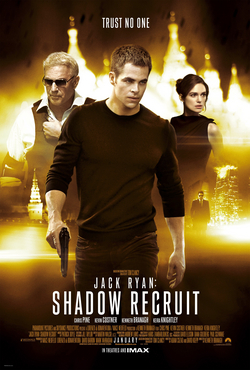
Behind the film
- Year
- 2014
- Director
- Kenneth Branagh
- Writers
- David Koepp, Anthony Peckham, Steven Zaillian
- Genres
- Thriller, Action, Spy, Techno-thriller
- Production
- Paramount Pictures, Skydance Media
- Country
- United States
- Cast
- Chris Pine, Kevin Costner, Keira Knightley, David Paymer, Kenneth Branagh, Nonso Anozie, Colm Feore, Karen David
About the film
Contains story spoilers, including the ending.
Jack Ryan: Shadow Recruit starts its hero's intelligence career with a problem he can see in financial records. Chris Pine plays Ryan, with Kevin Costner as CIA handler Thomas Harper and Keira Knightley as Cathy Muller. The 2014 film takes him from his response to the 9/11 attacks through Marine service, a serious injury and recruitment into financial intelligence. Hidden Russian accounts eventually send him to Moscow, where his position as an auditor offers access to businessman Viktor Cherevin. The investigation becomes dangerous before Ryan can settle into the job. Cathy follows him because his secrecy makes her suspect an affair, and learning that he works for the CIA changes the reason for his evasions. She is then drawn into helping the operation herself.
Ryan explains the suspected attack to Harper through the behaviour of the dollar. Cherevin's organisation has committed heavily to American currency despite conditions that should be weakening it. Ryan believes that a terrorist attack and a coordinated sale will trigger a wider collapse, with other investors rushing to abandon the dollar. He needs access to Cherevin's computer system to discover the timing. His specialised knowledge gives him something the agency cannot easily replace, but it does not make field work familiar. After killing a man who attacks him in his hotel, he struggles to remember the meeting arrangements his emergency contact gives him. The film repeatedly places an analyst's ability to recognise a pattern beside the immediate fear of being caught or killed.
The search eventually leads back to New York and Cherevin's son Aleksandr, a sleeper operative preparing the attack. Ryan stops the bomb from destroying its intended target, driving the vehicle carrying it into the East River and escaping before the explosion. Cherevin is killed by his own side after the plan fails. The ending brings Ryan and Harper to a meeting with the President. Harper coaches the younger man to answer clearly and avoid offering more information than he is asked for. Ryan's visible excitement survives the advice. The recruit who began by noticing something wrong in a set of accounts has reached the White House, with his analytical work having pulled him into the physical task of preventing the attack.
Kenneth Branagh directs the film and plays Cherevin. He described the villain as a mixture of people the filmmakers met, including men with military backgrounds and prison experience, rather than a portrait of one identifiable oligarch. For Branagh, starting the film with 9/11 required seriousness about its politics. He framed Ryan as someone who loves his country without wanting it to dominate the world, and who has reservations about the organisation he serves. That gave the character a question to carry beyond simply finding the villain: how can a person retain his principles while working inside this kind of institution? Branagh also arrived after years of screenplay development and described his directing job as gathering and guiding the ideas of the many people already involved. The film's new beginning for Ryan came with a substantial history of work behind it.
Branagh wanted to bring Tom Clancy's character into a contemporary world, and the production's travel helped establish its pace. He recalled arriving in Moscow from New York, scouting a location and then finding himself on a hotel roof with Pine as daylight ran out. With several pages of dialogue to cover, the question became whether they could do the scene in one take. The brief Moscow visit influenced how they approached British locations standing in for the city, including Liverpool, Manchester and parts of London. Branagh said they carried the same urgency back with them. This was also a film in which he had to perform while directing. His account of the shoot places its breathless movement in the practical decisions of a working day, from the available light to the time left for a scene.
Cherevin's Moscow office combined a Pinewood set with photographed views of the city. Visual-effects supervisor Matt Johnson wanted the work to feel as though a camera had captured it, without distracting from the actors. The office's glass walls, polished floors and other reflective surfaces made the background part of more than the view through a window. The effects team added reflections of buildings and sky so that the interior and its surroundings belonged together. Johnson and visual-effects photographer Aviv Yaron gathered high-resolution stills for panoramas and moving footage from Moscow rooftops. Those photographic materials supplied the world outside the studio set. The room could suggest Cherevin's place above the financial district while the actors worked in a controlled environment. Its reflections helped connect the two spaces, carrying the city into the surfaces around the conversation.
The film was shot on anamorphic 35mm, with Haris Zambarloukos as cinematographer. Colourist Rob Pizzey first watched an assembly with Zambarloukos and Branagh at Pinewood, then made a preview grade to help the edit. He recalled that the initial transfers did not always match in colour. Their discussions concentrated on natural skin tones, visible eyes and faces that stood out without looking forced. Pizzey spent several weeks with the cinematographer on the final grade, establishing each scene's mood before refining smaller details. Fast cutting and moving actors made work on the eyes harder, so tracking helped keep those adjustments attached to the face. Branagh then gave his notes before delivery. The finishing work kept attention on people who are often moving quickly through the film's offices, streets and confrontations.