
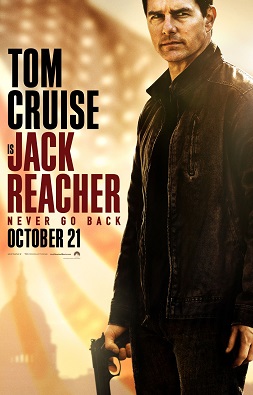
Behind the film
- Year
- 2016
- Director
- Edward Zwick
- Writers
- Richard Wenk, Edward Zwick, Marshall Herskovitz
- Runtime
- 1h 58m
- Genres
- Action, Thriller, Crime
- Production
- Paramount Pictures, Skydance Media, Huahua Media
- Country
- United States
- Cast
- Tom Cruise, Cobie Smulders, Danika Yarosh, Patrick Heusinger, Aldis Hodge
About the film
Contains story spoilers, including the ending.
Jack Reacher: Never Go Back brings Tom Cruise's former military policeman back to an institution that now treats him as a suspect. Cobie Smulders plays Major Susan Turner, accused of espionage after two soldiers are killed in Afghanistan. Reacher breaks her out of detention, and they protect teenage Samantha while following the conspiracy to New Orleans. Military contractor Parasource has been selling weapons to insurgents and smuggling opium. Evidence in a shipment exposes its chief, General Harkness, while Reacher defeats the pursuing mercenary known as the Hunter on a rooftop. Turner regains her command. Samantha's suggestion that Reacher is her father falls apart when he meets her mother without recognizing her. He leaves, but Samantha's farewell text reaches him on the road. The 2016 film ends with a connection he can carry into his wandering life, even after the supposed family tie disappears.
Director Edward Zwick saw the series as something close to an anthology: Reacher could enter a new place and meet a new group of people each time. That gave Zwick room to change the character's circumstances rather than reproduce the first film. Making the journey required New Orleans to stand in for Oklahoma and Washington as well as itself. Set decoration, location choices and extensions helped distinguish those places. Zwick, Cruise and cinematographer Oliver Wood also chose to shoot on film, looking toward the texture of thrillers such as Bullitt and Two Days of the Condor. Digital work supported that approach even where it was intended to pass unnoticed. Zwick described wire removal, set extensions and image adjustments among the effects. Rooftop action could involve safety equipment that would later disappear from the image. The intended physical style depended on practical performance and digital finishing working together. His account of nearly two hundred effects shots makes that distinction clear: a film can avoid conspicuous spectacle while still requiring a considerable amount of image work after photography.
Stunt coordinator Wade Eastwood built the fights around what Reacher wanted at a particular moment. He described the action as earthy and brutal, with each encounter needing a reason in the story. A fight could communicate a character's purpose as well as stop someone from pursuing him. Eastwood considered that harder than simply arranging an elaborate chase. He had worked with Cruise before and described an actor who continually pushed both himself and the surrounding crew to improve a scene. Maintaining the necessary skill involved repeated preparation in fighting, driving and riding. That did not remove disagreement: Eastwood recalled arguments when Cruise wanted to perform something requiring a specialist's lifetime of experience. The coordinator had to judge the action while the star pressed for more involvement. Working with Zwick also involved informal discussions of ideas, sometimes sitting together on the floor. Eastwood connected the director's interest in character and emotion to the different circumstances facing Reacher here. The choreography was developed within that broader argument about what kind of man the fighting should reveal.
Zwick's account of the kitchen fight describes a process that remained flexible after rehearsal. Eastwood's team developed the choreography, then worked through it with the director and Cruise. Changes could continue during shooting when a different move worked better. The sequence used wider master shots and additional coverage, allowing the edit to punctuate action that the performers were actually carrying out. Repeating those moves all day meant kicks, bruises and physical fatigue, so the number of takes mattered. Zwick estimated at least a day and a half of filming for under five minutes of screen time. The duration of a fight in the finished film conceals the repetitions needed to photograph it from several useful positions.
Patrick Heusinger approached the Hunter as a possible version of Reacher stripped of his moral restraints. He described a mercenary dedicated to completing an assignment, with no comparable loyalty to the country's institutions. That was his interpretation for the performance, including ideas about a possible military past, rather than a complete biography supplied by the story. It gave the pursuit a specific opposition: two men capable of violence, with very different reasons for using it. Lee Child, whose novel supplied the film's starting point, identified a smaller invention that pleased him. Reacher uses an IHOP saltshaker to break a car window in a scene the filmmakers created. Child felt that the improvised weapon suited his character so closely that he wished he had written it himself. His response separates fidelity to a personality from copying every incident in a novel. The saltshaker beat belongs to the screen adaptation, even though the author recognized Reacher's habits in it.
Henry Jackman recorded the score at the Newman Scoring Stage, with Nick Glennie-Smith conducting a sixty-piece Hollywood Studio Symphony. Stephen Coleman led orchestration, Alex Belcher contributed additional music and Dan Pinder served as music editor. Zwick described temp tracks as one way to communicate with a composer, alongside conversation and discussion of tempo or musical phrases. The recording joined that preparation to the orchestra's performance, with Zwick and film editor Billy Weber attending during post-production. Music work proceeded alongside the continuing assembly of the picture.