
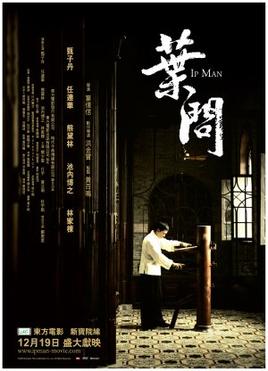
Behind the film
- Year
- 2008
- Director
- Wilson Yip
- Writers
- Edmond Wong, Chan Tai Lee
- Runtime
- 1h 46m
- Genres
- Action, Biographical, Martial arts, Historical
- Production
- Orange Sky Golden Harvest, Mandarin Films Distribution
- Country
- Hong Kong
- Cast
- Donnie Yen, Simon Yam, Lynn Hung, Gordon Lam, Louis Fan, Xing Yu, Chen Zhihui, Hiroyuki Ikeuchi
About the film
Contains story spoilers.
Ip Man opens in Foshan, a city where martial arts schools sit close together and a good reputation can bring a challenger to the door. Ip Man, played by Donnie Yen, is already a skilled Wing Chun master, wealthy enough to live in a large house and content to spend time with his wife Cheung Wing-sing and their young son. He does not chase fame. When a visiting master named Liao asks for a match, Ip invites him to dinner first, then beats him in a private bout and asks him to keep quiet about the result so Liao will not lose face. The scene establishes a fighter who treats restraint as part of his skill.
That easy rhythm is interrupted by Jin, a brash newcomer who arrives with a group of northern fighters and tries to establish himself on Foshan’s martial arts street. Ip initially stays outside the dispute, even as Jin’s crew humiliates local schools. The film uses these early challenges to show a community where fighting is sport, status and neighbourhood politics at once. Ip’s friend Zhou Qingquan, who runs a cotton mill, sees the town’s martial artists as a source of solidarity; Ip’s wife, by contrast, would rather he spend less time accepting challenges. Their household arguments give the opening bouts a domestic cost. Ip can treat a fight as harmless fun, but Wing-sing has to live with the consequences when that hobby crowds out family life.
The Japanese invasion changes what a fight means. Soldiers take Ip’s house for their headquarters, and the family is forced into a cramped, damaged apartment. Ip looks for work at a coal mine to feed them, joining other men whose former standing no longer protects them. The film’s colour and atmosphere turn markedly duller as occupied Foshan replaces the earlier world of polished rooms and friendly visitors. At the mine, Ip reconnects with Lin, a restaurant owner and martial artist whose younger brother, Sha Dan Yuan, had left town after their public humiliation. Their reunion is complicated by shame and survival: Lin needs work and food, while Ip wants to understand what became of his friend Zhou and the other people from before the occupation.
General Miura, the Japanese officer in charge, stages arena bouts where Chinese fighters can earn a sack of rice. Lin enters the arena to fight Miura and does not return, prompting Ip to investigate. He arrives in time to see Master Liu, the man he defeated in a friendly match before the invasion, lose a bout against three fighters. When Liu tries to collect the rice earned in an earlier victory, Colonel Sato shoots him. Ip understands that Lin has also been killed. He challenges ten Japanese fighters at once and beats them in a burst of close-range Wing Chun strikes. The sequence makes the arena’s stakes specific: hunger draws men into a contest whose rules the occupiers control, and the killings turn Ip’s restraint into public defiance.
The story is a highly dramatized account of a real martial artist, not a documentary biography. Its most consequential wartime confrontations, including the duel with Miura, were invented to heighten the drama; the film compresses years of history into a single popular-hero narrative. That shaping is visible in the way Ip’s personal restraint gradually gives way to confrontation. The Japanese occupation is not a background decoration: it takes his home, forces him into dangerous work, and turns the town’s martial arts culture into a contest over dignity. But the film also narrows a complex war into a handful of antagonists and set pieces, so its emotional focus stays with Ip’s choices rather than the wider history of the occupation.
Miura wants Ip to train his troops and later arranges a public match, hoping a victory will break Chinese morale. Ip refuses to teach the occupiers and accepts the challenge on his own terms. Before the duel, he has to face the costs of his absence from home and the danger that his family will pay for his defiance. The final contest against Miura is built around contrast: Miura’s forceful karate attacks meet Ip’s compact, precise Wing Chun, which keeps its hands close and turns defence into a rapid counterattack. Ip wins, but the victory does not end the occupation. Sato, Miura’s subordinate, shoots him in front of the crowd. Li Zhao wrestles the pistol from Sato and shoots him with his own gun; in the confusion, Zhou pulls Ip away, and Ip escapes with his family toward Hong Kong.
The immediate story ends with Ip’s escape from Foshan. A closing montage and captions then summarize his later life in Hong Kong, where he spreads Wing Chun and teaches students, including Bruce Lee. That ending moves from the crowded public square to the future of a teaching practice that occupation could not erase. Sammo Hung’s choreography keeps the fights readable by letting each opponent’s approach register before Ip answers it. Early Foshan bouts leave room for manners and comic timing; later fights carry the pressure of hunger and public humiliation. Ip’s control remains central, but the story makes clear that restraint alone cannot protect everyone around him.