
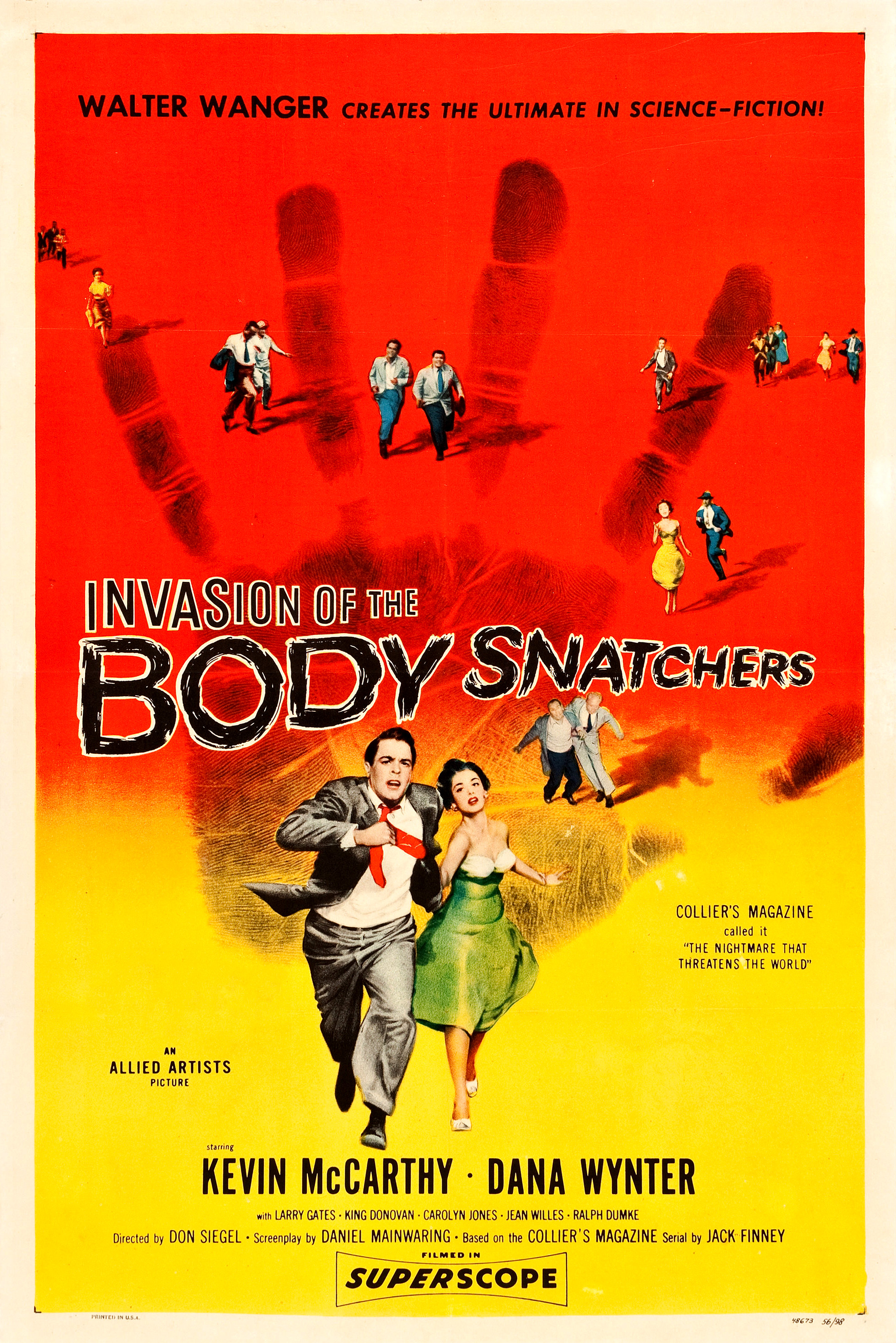
Behind the film
- Year
- 1956
- Director
- Don Siegel
- Writers
- Daniel Mainwaring
- Runtime
- 80 minutes
- Genres
- Science fiction, Horror, Monster, Science fiction horror
- Production
- Monogram Pictures
- Country
- United States
- Cast
- Kevin McCarthy, Dana Wynter, Larry Gates, King Donovan, Carolyn Jones
About the film
Contains story spoilers, including the ending.
Invasion of the Body Snatchers takes place in Santa Mira, a California town whose familiar faces have become difficult to trust. Dr Miles Bennell, played by Kevin McCarthy, returns from a medical conference to find patients insisting that their relatives are impostors. They recognise a person's appearance, but something is missing from the relationship. Dana Wynter plays Becky Driscoll, a former girlfriend back after a divorce. Their relationship resumes as Miles discovers why his neighbours seem changed. Plant-like pods produce exact physical copies of people and replace them during sleep. The doubles can pass for the people they have displaced, yet they lack the emotion that made those people recognisable to someone who loved them.
The first tangible warning comes at Jack and Teddy Belicec's house, where an unfinished human body lies on a billiard table. Its resemblance to Jack grows harder to dismiss when it develops the same injury as his hand. Miles also finds a duplicate forming beneath Becky's home. The evidence keeps disappearing before others can examine it, while patients who feared their relatives suddenly withdraw their complaints. Four pods in Miles's greenhouse finally expose the process directly. Attempts to telephone outside help fail, and escape becomes urgent as Miles discovers that people around him, including his nurse Sally, have already been replaced.
Miles and Becky see pods being distributed for other towns. Their transformed friends promise a painless existence without love, but the couple flee. They try to pass as doubles until Becky's frightened reaction exposes them. After hiding in a tunnel, Miles returns from investigating music to find Becky changed. Alone, he reaches the highway and tries to warn drivers. The released film returns to the hospital where he has been telling his story: a crashed truck's cargo of pods finally persuades the doctors to summon outside help.
That hospital conclusion differs from both the earlier film ending and Jack Finney's source novel. In the darker climax intended before the framing material was added, Miles's warning to traffic leaves the invasion spreading beyond Santa Mira. Finney's novel instead has the pods abandon Earth for another planet, with federal authorities taking control of the remaining duplicates. Film historian Robert Sklar describes those departures in his account of the adaptation. The distinctions matter because each leaves a different prospect for resistance: an ignored warning, a warning finally taken seriously, or an invasion whose organisms have chosen to leave. The 1956 theatrical ending offers a chance of intervention without showing the threat defeated.
Santa Mira's streets were largely filmed in Sierra Madre, with other locations around Los Angeles supplying the couple's escape route. Production designer Ted Haworth matched studio interiors to those locations, while the greenhouse was built where the bursting pods could be controlled. The staircase chase used a small camera dolly running along the handrails; the hiding place in the tunnel included a trench covered by planks. Rob Nixon's production account records these practical solutions alongside the cast's memories. Wynter recalled the discomfort of being enclosed while a mould was made for her duplicate. Those actor-shaped forms appear beneath foam when the pods open. The freeway warning was staged on a cross-bridge with stunt drivers. Siegel later recalled McCarthy's exhaustion and the danger of working among the cars at dawn. Wynter also described a shoot whose pace left the actors responsible for preparing their actions before stepping in front of the camera, with little rest between chase takes.
The greenhouse makes the replacement process visible inside a confined, cage-like space. Its crowded framing and slanting camera angles give the characters little room around the bodies forming beside them. The WJEC film-study notes draw attention to those angles and to the close views of Miles reacting to the pods. His face also becomes central to the highway warning, when his appeal reaches beyond the drivers towards the audience. The camera's movement there follows his panic, while views from above diminish him among the traffic. The notes also identify the close exchange after Miles kisses Becky: the discovery depends on intimacy with someone whose appearance has barely changed. Sirens accompany the chase and the hospital setting, linking sounds associated with rescue to a pursuit in which official authority has already become suspect.
The emotionless doubles have supported conflicting political readings. Mark Salisbury records interpretations involving communism, anti-communist persecution and pressure to conform, as well as Siegel's resistance to a political explanation of his purpose. Kevin Hagopian's film notes place the production beside the Hollywood blacklist and read its central threat as a loss of individuality. He connects that reading to screenwriter Daniel Mainwaring's interest in hypocrisy and to producer Walter Wanger's earlier work with Siegel on Riot in Cell Block 11. These accounts do not establish a single political key to the story. Hagopian also describes the decision to use the human replicas and pods sparingly rather than turn the invasion into a display of monsters. The strangers Miles fears remain his neighbours, speaking reasonably while asking him to surrender the feelings that make Becky matter to him.