
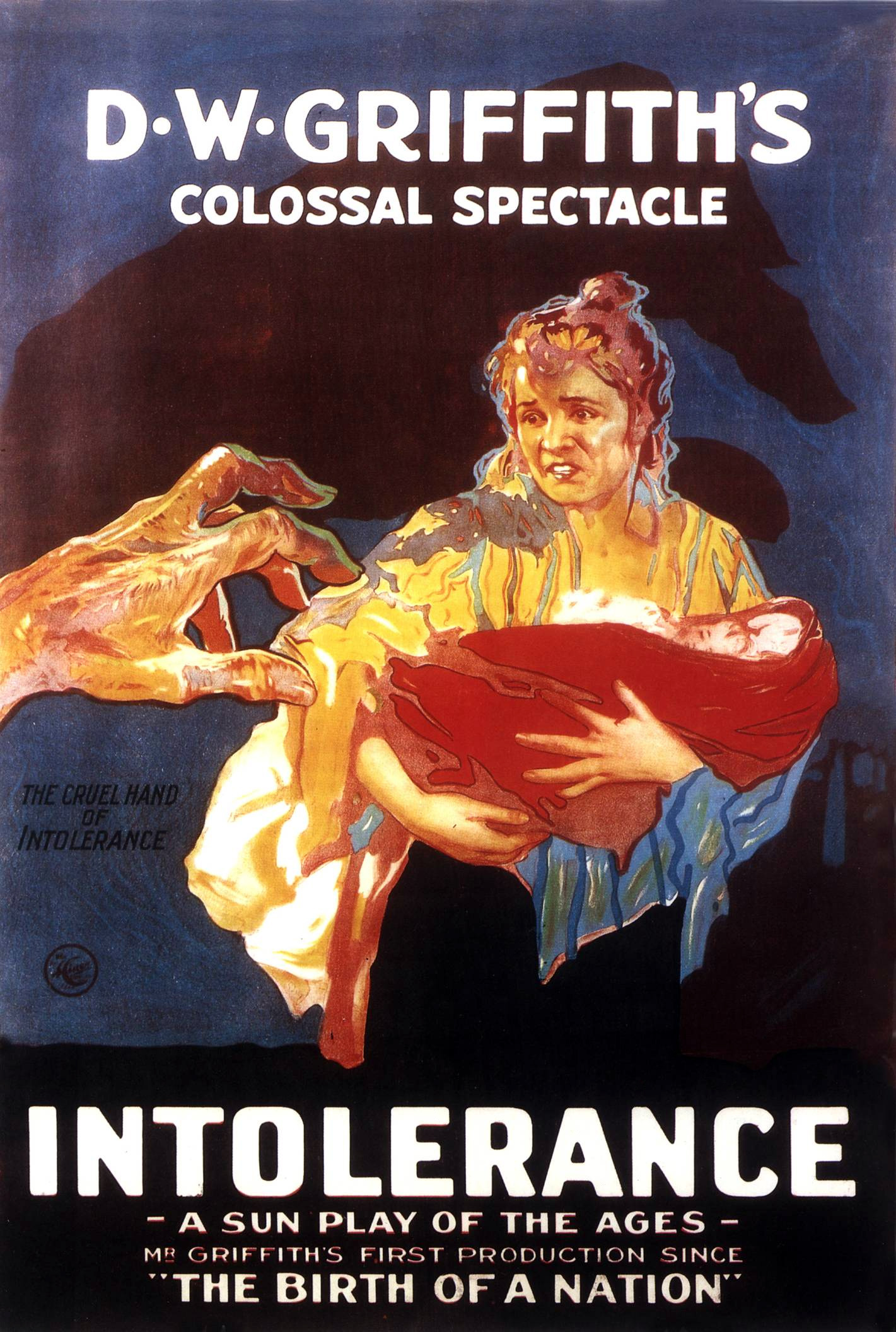
Behind the film
- Year
- 1916
- Director
- D. W. Griffith
- Writers
- D. W. Griffith, Tod Browning, Anita Loos, Frank E. Woods
- Runtime
- 3h 17m
- Genres
- Drama, Art, Silent
- Production
- Triangle Film Corporation
- Country
- United States
- Cast
- Lillian Gish, Mae Marsh, Robert Harron, Mary Alden, Julia Mackley, Walter Long, Lloyd Ingraham, Monte Blue
About the film
Contains story spoilers.
The film starts with a woman rocking a cradle, then opens four stories that share a pattern rather than a cast. In the modern American thread, the Boy and the Dear One begin as young workers in a mill town. Their fragile happiness depends on wages and a home of their own, while the factory owner Arthur Jenkins treats the workers as an expense to manage. His sister Mary funds a reform group with money that comes from their business. The film puts her charitable self-image beside the conditions her family creates, so the damage is done both through the factory and through people who claim to be improving the poor.
When the mill cuts pay, the workers strike and armed guards break the protest with gunfire. The Boy and the Dear One are among the people driven from their homes; they eventually marry, but in the city the Boy turns to a gang for work. The Dear One gives birth to their child and tries to keep the family together while he is in prison. Reformers inspect her life and decide she is an unfit mother, taking the baby away. Their judgment lands like another eviction: they assess her household without addressing why poverty has narrowed her choices. Jenkins’s family has helped create the circumstances, then its foundation punishes the people living in them.
The gang leader, the Musketeer of the Slums, wants the Dear One and resents the Boy’s attempt to leave his criminal orbit. After the Boy is released, the Musketeer is shot by his former lover, the Friendless One, but the timing makes the returning husband look guilty. He is arrested and sentenced to hang. The Dear One searches for evidence while the film cuts between the prison and the other stories, turning the execution clock into a meeting point for separate histories. At the last moment, the Friendless One confesses and the Boy is spared. His rescue gives the modern story a clear resolution, and the authorities restore the child to the Dear One. The verdict cannot undo the strike or the institutions that treated suspicion as proof, but the ending reunites the family after its immediate crisis.
In ancient Babylon, Prince Belshazzar allows the worship of Ishtar alongside the established god Bel. The High Priest sees that religious freedom will weaken his position and secretly works with the Persian king Cyrus to open the city to invasion. The Mountain Girl, a spirited young woman who loves Belshazzar from afar, learns that something is wrong and tries to warn him. She is brave enough to fight when Cyrus’s forces attack, but she cannot prevent the betrayal. The city falls; the Mountain Girl dies, and Belshazzar and the Princess Beloved choose death rather than surrender to the conquerors. The Babylon thread gives the film its broadest spectacle, but the conflict is intimate: a powerful priest turns public faith into a tool for protecting his own authority.
The shorter French and Judean episodes bring the same pattern into a court and a religious dispute. In Paris, Catherine de Medici persuades her son, King Charles IX, to move against the Huguenots. The planned marriage of Brown Eyes and Prosper Latour is caught up in the St. Bartholomew’s Day Massacre. In the Judean story, Jesus’s acts of compassion and his conflict with the Pharisees lead toward his crucifixion. These episodes do not receive as much room as the modern couple or Babylon, but their brevity is part of the film’s method: each returns as another example of authority turning difference into a reason to punish. The cradle image, with Lillian Gish rocking it, bridges the stories without pretending their histories are identical.
Griffith gives each period a different visual register, and the original version used tints to help distinguish the threads. Intertitles orient the audience, while the recurring cradle image signals a shift in time and place. The Babylon passages open out into enormous sets and massed crowds; the modern story stays close to homes, workplaces and the prison. These changes in scale make the structure legible even as the cutting grows more restless. The film does not connect the characters through a shared journey. It asks the audience to notice how each plot repeats a pressure point: someone with authority labels another person dangerous, immoral or unworthy, and the consequences fall on people with less power.
As the endings approach, the editing switches among the execution, Babylon’s defeat and the other threatened lives with shorter, faster passages. That structure asks the viewer to carry several timelines at once. The four plots never join into one event; their connection comes from repeated choices by people who control work, law, belief or government. Griffith began with the contemporary story later known as The Mother and the Law, then expanded it with historical episodes. The result is a silent film whose scale is visible both in its crowd scenes and in how it cuts between private danger and public spectacle. Its final movement gives the Boy a pardon and ends Babylon’s resistance in defeat, leaving contrasting outcomes inside one shared argument about power.