
Behind the film
- Year
- 2013
- Director
- Ethan Coen, Joel Coen
- Writers
- Ethan Coen, Joel Coen
- Runtime
- 1h 45m
- Genres
- Drama, Musical, Comedy drama
- Production
- Paramount Pictures
- Country
- United States, France
- Cast
- Oscar Isaac, Carey Mulligan, Justin Timberlake, John Goodman, Garrett Hedlund, F. Murray Abraham, Ethan Phillips, Adam Driver
About the film
Contains story spoilers, including the ending.
Inside Llewyn Davis follows a musician who can command attention during a song and still have nowhere to sleep afterwards. Oscar Isaac plays Llewyn in the Greenwich Village folk world of 1961, after the death of his musical partner Mike. His solo record brings little money, and friends' apartments provide temporary shelter. An escaped cat becomes another responsibility he cannot comfortably manage. Jean's possible pregnancy makes their already hostile exchanges more difficult. Llewyn travels to Chicago to audition for Bud Grossman, but the performance produces no offer of the solo career he wants. He declines a place in a trio. Back in New York, an attempt to return to the Merchant Marine collapses over his missing licence and its replacement cost. Another night at the Gaslight brings the story back to its opening assault in an alley. Bob Dylan takes the stage inside as Llewyn goes out to face the husband of a singer he heckled. The return to that beating supplies an explanation for the opening without turning the intervening journey into a professional breakthrough.
Joel and Ethan Coen used Dave Van Ronk's The Mayor of MacDougal Street as a guide to the period, then invented a singer to move through it. Llewyn shares a working-class background and part of Van Ronk's repertoire, but the Coens distinguished him from the real musician. Even Isaac's voice and appearance took the character away from the figure they had first imagined. Their starting image was a folk singer being beaten behind a club. Asking what could have led to that attack gave them a way into the story. They also knew they wanted a circle: a short span of time that would return to the same event. The repeated Gaslight performance needed enough familiar dialogue and changed framing to show that the audience had arrived back at the opening night. That design makes the final scene a return to an earlier moment with more knowledge of Llewyn's conduct. The film's use of a real musical world leaves room for an invented life that does not follow Van Ronk's biography.
Isaac prepared by reading Van Ronk's memoir and Dylan's Chronicles, looking at period films and speaking with people who had been in the Village. His audition combined scenes with a performance of 'Hang Me', and he learned additional songs in case they were needed. Playing the guitar required work on Travis picking. The character also needed a physical way of carrying his struggles through streets and rooms between performances. Isaac chose to walk as though Llewyn was going uphill even when travelling downhill. He requested the character's worn shoes before filming so that they could help establish that feeling. On set, he found the Coens relaxed and practical, attentive to the rhythm of their dialogue without dictating each gesture. They did not explain the role through extended discussions of symbolism. Isaac could argue for a movement or action when he felt strongly about it, while the brothers could resist an idea they disliked. He described that exchange as leaving space for his instincts inside the film's particular tone.
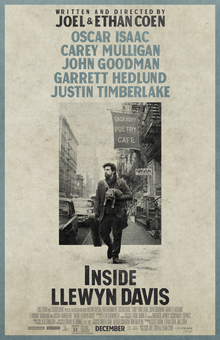
The wintry colour came partly from an image already associated with this musical moment. The Coens named the cover of The Freewheelin' Bob Dylan and photographs from the same session as their main colour reference. They had little period moving footage to consult, though black-and-white photographs existed. Bruno Delbonnel joined them as cinematographer after their earlier short collaboration on Paris je t'aime. The directors joked about calling him Roger, referring to their long partnership with Roger Deakins, but said they quickly settled into working with Delbonnel. Their reference joined a recognisable street image to the fictional singer's cold New York surroundings.
Music producer T Bone Burnett described the actors singing their parts live during filming. He singled out the Grossman audition as a demanding musical scene, with Llewyn choosing a complicated song for the man deciding his prospects. Dylan's closing 'Farewell' also depended on a particular recording. Burnett approached Dylan's publishing representative, Jeff Rosen, about licensing the song and learned that Rosen had found a previously unreleased version. It was clearer than the recording they already had. The appearance of Dylan at the end therefore has its own recorded voice while Isaac's singing carries Llewyn through the film.
Additional editor Katie McQuerrey described a cut shaped by the brothers' preparation. They storyboarded the film, and its first assembly was already within minutes of the intended length. Later work involved trims and refinement rather than removing major scenes. Ethan reviewed takes and marked selections on one computer; Joel assembled scenes on another. The music recordings remained connected to what happened on set. Production mixer Peter Kurland recorded the performances live, and those recordings supplied the finished mix. When editing required separate tracks, the team returned to the multitrack recordings and matched them to the picture. That approach preserved the performed music through the cutting process. The film could hold on Llewyn singing while keeping the sound of that actual take, rather than treating his guitar and voice as a recording to which the photographed performance merely had to conform.