
Behind the film
- Year
- 2011
- Director
- Tarsem Singh
- Writers
- Vlas Parlapanides
- Runtime
- 110 minutes
- Genres
- Fantasy, Adventure, Action, Drama
- Production
- Universal Pictures, Relativity Media, Virgin Produced
- Country
- United States
- Cast
- Henry Cavill, Stephen Dorff, Luke Evans, Isabel Lucas, Kellan Lutz, Freida Pinto, Mickey Rourke, John Hurt
About the film
Contains story spoilers.
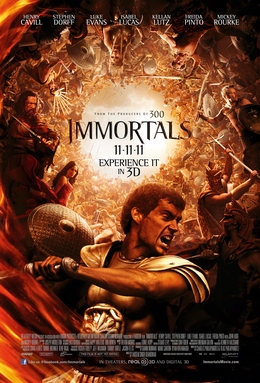
Henry Cavill plays Theseus in Immortals, opposite Mickey Rourke's Hyperion. Zeus has trained Theseus disguised as an old man. Phaedra helps him escape slavery, and Poseidon saves the fugitives with a tidal wave. Returning to bury his mother, Theseus finds the bow and kills the armoured Beast in a labyrinth. Phaedra sleeps with him and loses her visions. Hyperion captures the bow; Ares rescues Theseus, but Zeus kills Ares for interfering. Cassander dismisses Theseus's warning. Hyperion breaches the defences and releases the Titans.
Tarsem described the conflict as two ideas of immortality. Hyperion hopes to survive through his descendants, multiplying his bloodline through conquest and rape. Theseus hopes that great deeds will keep his name alive. The director's explanation places the title within the human struggle as well as the lives of the gods. His approach to the Olympians allowed them to choose youthful bodies without losing the wisdom of their long existence. For Tarsem, Luke Evans could look young and still play a wise Zeus. The same freedom shaped the film's appearance. Speaking about his visual influences, he identified Caravaggio and Fight Club as starting points. He did not want the finished picture to reproduce either reference. Once work began, the needs of Cavill, Evans and the action changed the compositions: a shot that suited an actor might depart from the painting that first suggested the look. He described having to choose between pursuing action and holding to a static tableau. The images developed as the actors and scenes demanded, rather than remaining fixed to the original comparison. Tarsem also said there were few areas in his films where actors could improvise, recalling Rourke's unpredictable physical presence.
Cavill's first encounter with that world came through concept art. He told ComingSoon that the screenplay was still developing when he met Tarsem, whose explanation of the images persuaded him to pursue the role. The screen test asked him to try different approaches to a scene, testing whether he could follow a change in direction as the material evolved. During filming, drawings and scale models could answer his questions about where Theseus stood and what he was looking at. Evans recalled the director keeping the actors from feeling overwhelmed by the sets, extras and effects. His own approach to Zeus began with the character's feelings. He tried to think of a human being whose sorrow, affection and darker side could be understood, even when the character possessed divine powers. Playing Athena's father required him to believe in that relationship with Isabel Lucas. Cavill's preparation also involved six months of training before filming. While working on The Tudors, he exercised before and after the day's acting. Later, he joined the stuntmen in Montreal. He remembered the encouragement within the group: when someone began to struggle, another person could help him return to the work.
Rourke approached Hyperion by looking for reasons behind his cruelty. In his Bullz-Eye interview, he said he resisted playing a villain with only one dimension and wanted to justify why the king behaved as he did. Greenscreen did not change his method; he regarded it as another ordinary part of filmmaking. He remembered Tarsem arriving thoroughly prepared, with costume designer Eiko Ishioka already having spent years on the clothes. That preparation made his own job easier. Rourke also described room for spontaneity: Tarsem might replace a stretch of dialogue with an activity and allow an almost improvised delivery within a structure. In the actor's recollection, the director's clear intentions gave him the freedom to adjust a moment while still knowing what it should achieve.
The environments required similar advance planning. Visual effects supervisor Raymond Gieringer told fxguide that he encouraged building enough practical scenery to contain the action. Wide shots could establish the larger world, while closer work on the built sets could sometimes avoid effects altogether. Before construction, virtual versions let Tarsem walk through an environment and choose camera positions and lenses. During filming, a live composite placed the camera's view against a rough version of the intended background. Poseidon's dive presented a particular problem: a falling figure needed nearby detail to communicate speed and scale. Clouds and rock supplied that reference. Close-ups used the actor with rigging and fans against greenscreen; wider views included a digital double. Scanline developed water with an oily, viscous quality for the wave following his impact. Gieringer said most of the film's stereoscopic presentation came from converting two-dimensional photography, although a few scenes used a 3D rig. That affected individual compositions too. An arrow near Theseus and Hyperion was moved inside the frame so that its projected depth could extend toward the audience. Keeping it clear of the frame's edge helped the intended effect.
The gods battle the Titans as Theseus confronts Hyperion. Mortally wounded, Theseus kills the king in the embrace Phaedra foresaw. Zeus collapses Mount Tartarus and carries Theseus and Athena's body to Olympus. Theseus becomes a legend. Phaedra bears his son Acamas, who receives a warning from the old man and sees Theseus fighting among gods and Titans in the sky.