
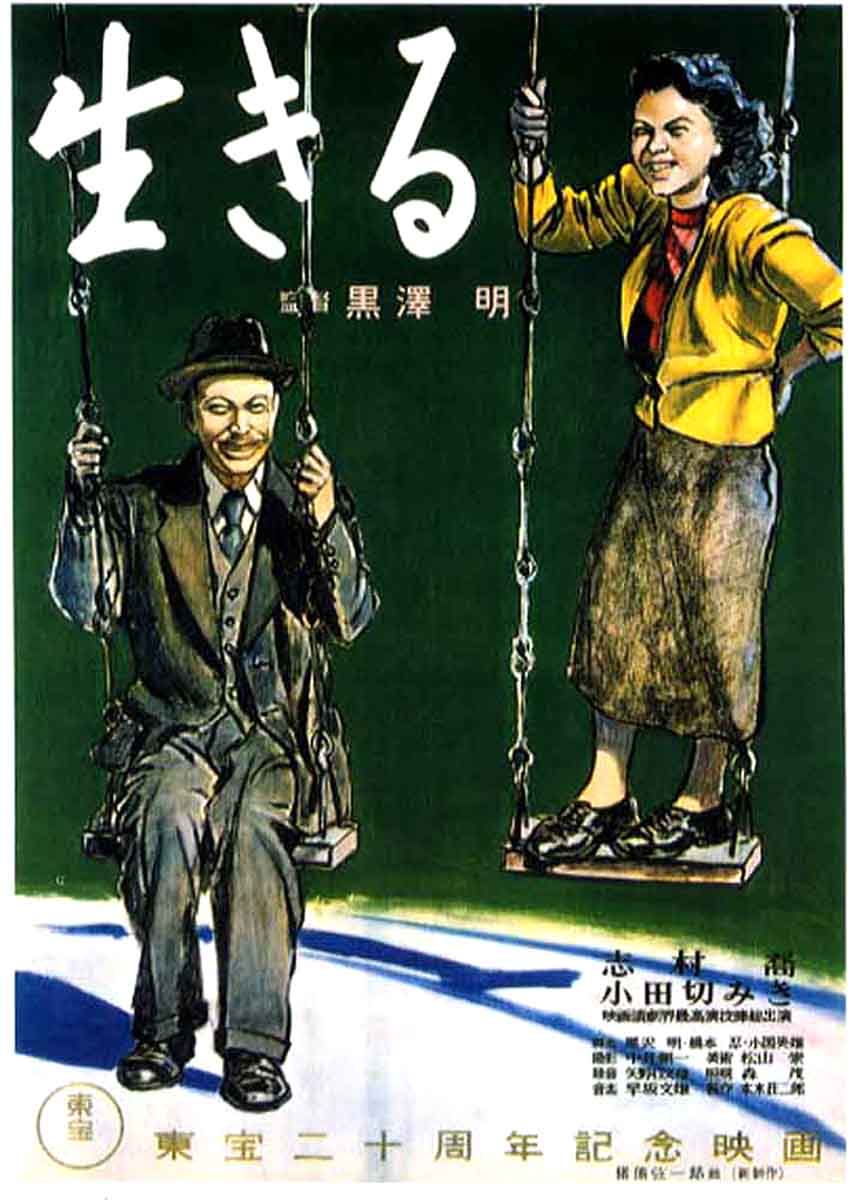
Behind the film
- Year
- 1952
- Director
- Akira Kurosawa
- Writers
- Akira Kurosawa, Shinobu Hashimoto, Hideo Oguni
- Runtime
- 2h 23m
- Genres
- Drama
- Production
- Toho
- Country
- Japan
- Cast
- Takashi Shimura, Minoru Chiaki, Bokuzen Hidari, Kamatari Fujiwara, Makoto Kobori, Nobuo Kaneko, Noriko Honma, Shinichi Himori
About the film
Contains story spoilers.
Ikiru begins by showing us something its central character does not yet understand: an X-ray of the cancer that will kill him. Kanji Watanabe, played by Takashi Shimura, has spent thirty years in Tokyo's municipal bureaucracy, surrounded by documents whose steady movement conceals how little gets done. When local women ask for a foul patch of wasteland to become a children's playground, they are passed between departments until they arrive back where they started. Watanabe belongs to that machinery. He has learned to survive at work by keeping everything moving around him while avoiding decisions that might make him responsible for a result.
The medical diagnosis breaks that routine. Although the doctor offers a reassuring explanation, Watanabe understands that his illness is terminal and that the time available to him is short. At home, he cannot find a way to tell his son Mitsuo. His wife has died, and the family he helped support now seems more interested in his pension and eventual inheritance than in the person sitting nearby. He stops going to the office and takes his savings out into the city. Having devoted so much of his life to being dependable, he has no clear idea what he actually wants to do with the freedom he has suddenly claimed.
A novelist he meets in a bar becomes his guide to a Tokyo he has barely experienced: gambling, crowded streets, drinking and nightclubs. The excursion surrounds him with activity, but he remains an awkward, bewildered presence inside it. In a cabaret, he asks the pianist for an old song, Gondola no Uta, and begins singing. The people who had been dancing and flirting stop to listen. Shimura's low, strained voice changes the atmosphere of the room; the entertainment becomes an encounter with the grief Watanabe cannot otherwise express. The night gives him new sensations, yet it does not supply the sense of purpose he hoped to buy.
His next guide is Toyo, a young colleague who wants his signature on her resignation. Watanabe is drawn to her energy and keeps arranging opportunities to spend time with her, until his need for companionship begins to make her uncomfortable. When he finally explains himself, Toyo has no grand answer to offer. She enjoys her new factory job making toy rabbits because it gives her a connection to the children who will play with them. That ordinary explanation gives Watanabe something he can use. He does not have to become young again or abandon every part of his old life. He can return to the office and make something happen there.
He retrieves the women's playground petition and starts pursuing it himself. Then the film makes an abrupt leap: Watanabe is dead, and his family and colleagues are gathered at his wake. Instead of watching an uninterrupted account of his achievement, we have to reconstruct it through their recollections. Officials compete over who deserves credit for the completed park, while the women's sincere mourning interrupts their self-congratulation. Flashbacks gradually show Watanabe refusing to let the request disappear between departments, enduring resistance and returning to the same task. The man whose working life once consisted of avoiding responsibility has become an inconvenience to everyone relying on that habit.
As the mourners drink, their explanations begin to change. What first looked like an eccentric burst of activity becomes evidence that Watanabe knew he was dying. A policeman remembers seeing him alone on a swing in the finished playground, singing the same old song as snow falls around him. His colleagues promise to follow his example, but the return to work exposes how fragile those promises are. When Kimura tries to object to another instance of bureaucratic indifference, he is silenced and sinks behind the papers on his desk. Later, he looks down at children using the playground. Watanabe's work survives even though the office has largely recovered its old routines.
Kurosawa gives these changes a physical shape. Early scenes crowd Watanabe with files, people and competing demands; the women's circuit through the departments is driven by brisk transitions that make the institutional runaround visible. After his clinic visit, the soundtrack briefly falls silent before traffic noise crashes back in, separating his private shock from a city carrying on around him. The cabaret sequence reverses that relationship, allowing one quiet voice to arrest a noisy room. At the wake, the more formal arrangement of the mourners gives way to drunken arguments and shifting stories, so the same achievement can be claimed, misunderstood and finally acknowledged within one gathering. The two performances of Gondola no Uta hold the personal story together. In the nightclub Watanabe sings from regret; on the swing, the song belongs to a man who has found something to finish. Neither the park nor his colleagues' admiration cures his illness. What changes is how he spends the life still available to him.