
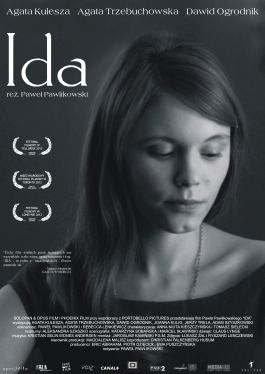
Behind the film
- Year
- 2013
- Director
- Paweł Pawlikowski
- Writers
- Rebecca Lenkiewicz, Paweł Pawlikowski
- Runtime
- 1h 20m
- Genres
- Drama
- Production
- Opus Film
- Country
- Poland, Denmark, France, United Kingdom
- Cast
- Agata Kulesza, Agata Trzebuchowska, Dawid Ogrodnik, Jerzy Trela, Halina Skoczyńska, Joanna Kulig, Mariusz Jakus, Izabela Dąbrowska
About the film
Contains story spoilers.
In 1962, novice Anna is preparing to take her vows at a convent where she has lived since infancy. The mother superior sends her to Łódź to meet Wanda, an aunt she has never known. Wanda is a hard-drinking former state prosecutor, far removed from the disciplined religious life Anna expects. She tells the young woman that her birth name is Ida Lebenstein and that her parents were Jewish and died during the German occupation. Ida asks where they are buried. Wanda cannot answer, so they set out together for the village where the family lived, carrying two different kinds of uncertainty into the trip: Ida has to reconsider the identity she was given, while Wanda must revisit what she left behind.
Wanda tries to make the sheltered novice sample ordinary pleasures before deciding on a lifetime of vows. On the drive, she picks up Lis, a saxophonist playing with a local band, and tries to interest Ida in him. Ida is shy and returns to the hotel, where Wanda has drunk herself unconscious. Later she visits the musicians after their set and talks with Lis, but leaves before the encounter can become a romance. Their stops and pauses let the pair occupy the same journey without becoming close confidantes. Wanda pushes; Ida watches. The film’s quiet exchanges keep the aunt’s teasing from becoming a simple lesson in rebellion, because Ida is still trying to understand why Wanda has lived so differently from her.
The search brings them to the family’s former home, now occupied by Feliks Skiba and his family. His father Szymon had hidden the Lebensteins during the war, but neither man initially gives the women the account they came for. Wanda finally tells Ida that she left her young son Tadzio with the Jewish family when she joined the resistance, believing he would be safe. She assumes he died with Ida’s parents. The missing grave is no longer only a question about Ida’s origins: Wanda is also trying to learn what happened to the child she entrusted to others. They locate Szymon in a hospital, where the old man is near death and speaks kindly of the people he once hid without explaining how they died.
Feliks eventually agrees to take them to the burial place, on the condition that they will make no claim to the house or land. In the woods he digs up the bones and admits that he killed Ida’s parents. Ida survived because she was small enough to pass as Christian, so he sent her to the convent; Tadzio could not pass and was killed with the others. Wanda and Ida carry the remains to the family plot in an abandoned Jewish cemetery in Lublin and rebury them. The act gives Ida a physical connection to the relatives she has never known, while Wanda faces the fact that her own choice to enter the resistance did not save her son. They return to their separate lives with the same history, but without a shared way to bear it.
Back in Łódź, Wanda resumes drinking and casual sex as her grief deepens. Ida returns to the convent, then comes back to Łódź after Wanda dies by jumping from her apartment window. At the funeral she sees Lis again. In Wanda’s flat, Ida takes off her novice’s habit and tries on her aunt’s evening dress and high heels; she smokes, drinks and goes to the band’s performance. Lis teaches her to dance, they kiss and later sleep together. He suggests marriage, children and a familiar future. By morning Ida has dressed in her habit again and leaves without waking him. The film does not show her reaching the convent, but the final image points toward the vows she postponed rather than a settled choice of secular life.
The film’s black-and-white 1.37:1 frame and largely fixed camera keep the characters low beneath open space. Pawlikowski explained that the ratio emerged during lens tests: he tilted the camera up so the actresses’ bodies would not dominate wide shots, and liked how they looked lost in space. He says the composition boxes the characters in and only the final two shots move—the penultimate tracks, while the last is handheld, carrying Ida’s new energy. After Ida returns to the convent, a six-scene, nearly wordless passage follows her doubts through small actions: she smells a leaf, stifles a laugh, watches a flame and looks upward. The camera stays fixed through a few carefully chosen cuts; the sequence’s first scene begins with close views of Ida’s hands and face making a garland, then widens to the other novices, keeping her apart. At the opening of the film, Ida paints faded colors back onto a wooden Christ, a quiet task that echoes the later sequence. The form lets her uncertainty register through posture, looks and small acts instead of explanatory dialogue.