
Behind the film
- Year
- 2017
- Director
- Craig Gillespie
- Writers
- Steven Rogers
- Runtime
- 1h 59m
- Genres
- Black comedy, Drama, Biographical
- Country
- United States, France
- Cast
- Margot Robbie, Sebastian Stan, Julianne Nicholson, Bobby Cannavale, Allison Janney, Bojana Novaković, Caitlin Carver, Paul Walter Hauser
About the film
Contains story spoilers.
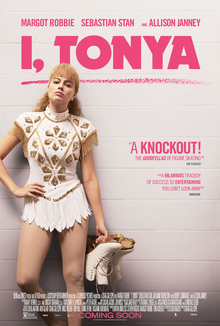
I, Tonya tells the story of figure skater Tonya Harding through recollections that do not agree. Margot Robbie plays Tonya, who is introduced as a four-year-old taken to the rink by her mother, LaVona Golden, played by Allison Janney. LaVona pushes her into lessons and keeps her there with sharp criticism and violence. Tonya’s talent is evident early, but the film places it beside the cost of being raised to treat pain as part of training. Her father eventually leaves, and Tonya grows into a skater whose energy and jumps impress coaches while her homemade costumes, music and manner mark her as an outsider in a sport that prizes polish.
Tonya’s relationship with coach Diane Rawlinson gives her a route into competition, but the film keeps returning to how little support surrounds her. She starts dating Jeff Gillooly as a teenager and marries him; Sebastian Stan plays a young man who first offers warmth, then becomes controlling and violent. Tonya leaves him, but later turns back to Jeff when she needs help preparing for the next Olympic cycle. The film shows her landing the triple Axel, then cuts against that achievement with judges who seem to weigh her class and appearance alongside her performance. She is told that she does not fit the wholesome image they want for the United States team.
After placing fourth at the 1992 Winter Olympics, Tonya steps away from skating and takes a waitress job. Diane persuades her to train again for the 1994 Games, but her return brings the old conflict over presentation back with it. Tonya confronts a judge about her scores and hears that skating is not judged on jumps alone. LaVona offers little comfort when Tonya asks for help, so she reaches out to Jeff. Around them, Jeff’s friend Shawn Eckardt boasts about connections and expertise that are mostly fantasy. The movie gives him a place in the gathering plan around a death threat against Tonya, which he later turns into a scheme to threaten Nancy Kerrigan. The film cuts among these characters’ explanations, letting their self-interest and vanity become part of the account.
The attack on Kerrigan is the story’s turning point, and the film deliberately refuses a neutral, documentary voice. Kerrigan is struck in the leg after practice in Detroit; the attackers are caught, and the FBI traces the plot through Eckardt and Jeff. Tonya learns what Jeff and Shawn have done, gives information to the FBI and tries to separate herself from them, but Jeff sees her interview transcript and confronts her at home. The movie presents competing claims about how much Tonya knew beforehand, and makes the limits of memory and self-protection part of its form. That uncertainty belongs to the film’s dramatised retelling: in real life, Jeff admitted to his role, Tonya pleaded guilty to conspiring to hinder prosecution, and she received a lifetime ban from competitive skating.
The story’s finish is not another chance on the ice. Tonya competes at the Olympics while the charges wait, but she places eighth as Kerrigan wins silver. At the hearing, Tonya begs the judge to send her to jail instead of taking away skating, the work around which her life has been organised. The ban stands. That choice gives the ending a specific sting: punishment removes the activity that helped Tonya endure the earlier parts of her life. A later glimpse of her as a boxer shows her trying another public arena, still fighting before an audience that has come to see conflict. The film’s last image does not suggest that she has repaired the past; it leaves her performing for people who know her mainly through the scandal.
Screenwriter Steven Rogers built the film around interviews with Tonya and Jeff, whose recollections of their life together sharply diverged. The movie lets them address the camera, then interrupts their versions with arguments, flashbacks and fourth-wall breaks. LaVona and Shawn also give their own accounts, and the voices do not line up into a settled timeline. Craig Gillespie said he was drawn to the script’s unusual structure and its shifts between comedy and violence. He and Robbie chose not to soften the abuse that shaped Tonya’s defensiveness, while keeping the film’s jokes tied to the characters’ self-importance, crude schemes and media performance. The quick cuts make the interviews feel like another contest over who gets to define her.
The skating scenes connect that form to Tonya’s physical work. Robbie trained for months, while doubles and visual effects carried the footage beyond what she could safely perform. The film uses the triple Axel as more than a medal-winning trick: it marks a rare moment when Tonya’s technical skill is visible in a sport that, as the movie depicts it, also judges her clothes, music and background. Its mockumentary style can make a scene feel like a boast, an accusation or a memory at once. That instability is why the film’s account of the Kerrigan attack should be read as a crafted version of conflicting testimonies, rather than as a final historical finding about every person’s prior knowledge.