
Behind the film
- Year
- 2007
- Director
- Edgar Wright
- Writers
- Edgar Wright, Simon Pegg
- Genres
- Crime, Action, Buddy, Parody
- Production
- StudioCanal, Working Title Films, Big Talk Studios
- Country
- United Kingdom, France
- Cast
- Nick Frost, Simon Pegg, Jim Broadbent, Timothy Dalton, Martin Freeman, Bill Nighy, Paddy Considine, Rafe Spall
About the film
Contains story spoilers, including the ending.
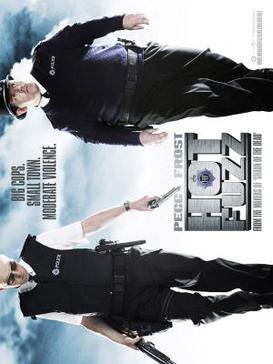
Hot Fuzz takes the energy of an American action comedy into a seemingly sleepy English village. Simon Pegg plays London officer Nicholas Angel, with Nick Frost as his new colleague Danny Butterman and Jim Broadbent as Inspector Frank Butterman. Directed by Edgar Wright and written by Wright and Pegg, the 2007 film puts its police partnership at the centre of the change in scale. A place that appears suited to quiet routines becomes the setting for the kind of armed confrontation usually associated with a much larger city. Angel brings professional seriousness to his new posting; the comic setting gives that seriousness plenty of resistance.
Angel's transfer comes because his success makes his London colleagues look bad. In Sandford, he first arrests Danny for drunk driving, then discovers that the man is both a fellow officer and the inspector's son. Danny's enthusiasm for action films seems far removed from Angel's exacting approach to police work, but they gradually become friends. Their evenings watching DVDs sit alongside an investigation that the rest of the station would rather dismiss. Two amateur actors die in an apparent car crash, a wealthy resident is killed in an explosion, and a journalist dies beneath falling church masonry. Angel suspects a connection involving property development and supermarket manager Simon Skinner. When florist Leslie Tiller is killed, the possibility of harmless coincidence becomes harder for him to accept. The investigation gives Danny a reason to take his work more seriously while forcing Angel to rely on someone whose interests initially seemed childish.
The Neighbourhood Watch Alliance's explanation is much pettier than Angel's theory. Its members kill people who threaten Sandford's chances in the Village of the Year competition. Their complaints include bad acting, an irritating laugh and a house they dislike. Frank leads the group, linking his obsession with winning to his wife's suicide after an earlier defeat. Danny helps Angel escape, but struggles to confront his father. When Angel returns, Danny finally refuses Frank's orders, and the other officers join them against the conspiracy. After the arrests, Angel declines an invitation to return to London: he has found a reason to stay. A final attack wounds Danny, yet the closing scene brings the partners back together on duty, with Danny now a sergeant. Their friendship survives the collapse of the authority Danny once trusted. Angel's new home becomes a place he can serve alongside people who have finally chosen to do the job.
Wright described Hot Fuzz as a tribute to cop and action cinema, with a deliberately British beginning that grows more American as it proceeds. That intention also shaped the preparation. He and Pegg wrote for Frost knowing how particular lines would sound in their friend's voice. Frost saw the script early, and rehearsals allowed performers to contribute ideas before filming. Wright said useful improvisations were written into the screenplay, leaving a tightly settled plan for the shoot. The combination of comedy, thriller plotting and action made unrestricted invention on set difficult. The director's account connects the film's precision to that rehearsal process: a line has to belong to the character while still fitting the surrounding story. He also recalled filming the town-square shootout with spectators just outside the frame. The large action sequence was staged within an ordinary working location, with schoolchildren and older residents watching the apparently peaceful town become a battlefield.
The village's smaller police incidents came from a different kind of preparation. Wright said that neither he nor Pegg had been an officer, so they interviewed police rather than relying entirely on favourite films. One interviewee had moved from east London to the countryside and could describe the difficulties of adapting. Wright identified the escaped swan, the practice of buying cakes as a punishment and the use of a local officer as a translator as details drawn from real anecdotes. These incidents give Angel's new surroundings their own demands before the murder inquiry takes over. The research also supplied experiences outside the writers' personal lives. Wright described the buddy relationship as two different people completing each other, placing the friendship underneath the references. His interest in a wide frame served both purposes: it could accommodate action while keeping Pegg and Frost together in a two-shot. The pair's presence in the same image mattered to the comedy as much as the larger spectacle.
Pegg said the writers watched about 138 cop films while preparing Hot Fuzz. They already liked the genre, but wanted its dialogue, familiar exchanges and escalating explosions to become a language they could use fluently. He described the central joke as moving that language from American city streets into country lanes and pubs. The characters can inhabit an action film while still belonging to Sandford. Pegg's account also leaves room for a much smaller discovery during filming: the station's swear box. Most of the prohibited words are partly hidden by asterisks, while the worst is written out. He recalled that detail being invented on the day. It is an office joke about an attempt at decorum that defeats itself, far from the scale of the shootouts. Both kinds of comedy grow from people treating their immediate surroundings as normal, whether they are collecting fines for bad language or bringing action-film tactics into a village dispute.