
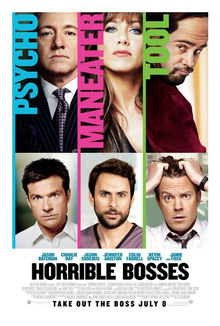
Behind the film
- Year
- 2011
- Director
- Seth Gordon
- Writers
- John Francis Daley, Michael Markowitz, Jonathan Goldstein
- Runtime
- 1h 38m
- Genres
- Comedy
- Production
- New Line Cinema
- Country
- United States
- Cast
- Jason Bateman, Charlie Day, Jason Sudeikis, Jennifer Aniston, Colin Farrell, Kevin Spacey, Jamie Foxx, Donald Sutherland
About the film
Contains story spoilers.
Nick Hendricks arrives early at the financial firm where he has spent years pursuing a promotion. Dave Harken turns that ambition into a leash: Nick works late and tolerates humiliation because Harken keeps suggesting the job is nearly his, then claims the position for himself. Jason Bateman plays Nick as controlled and dutiful, a man whose frustration first appears as a private calculation of what he has earned. The film makes this grievance legible through routine office hierarchy rather than a grand corporate conspiracy. Harken can make a small reprimand feel consequential because Nick has invested so much time in believing that obedience will be rewarded.
Kurt Buckman has a very different problem. He likes his job as second-in-command at Pellitt Chemicals and respects its owner, Jack, but Jack's death puts the business in the hands of his son Bobby. Colin Farrell's transformation into the balding, cocaine-using heir makes Bobby visually unlike the polished executive Kurt might have expected to replace Jack. He threatens to sell the company and treats employees as expendable, turning a workplace Kurt valued into a source of uncertainty. Jason Sudeikis gives Kurt an easygoing manner that contrasts with Nick's contained resentment, so each friend enters the revenge plot from a distinct emotional position.
Dale Arbus is a dental assistant engaged to Stacy, yet his daily work is dominated by Dr. Julia Harris, whose sexual advances become coercive. She threatens his engagement with compromising photographs, using the prospect of Stacy seeing them to pressure him into sex. Jennifer Aniston plays Julia with a breezy confidence that sharpens the imbalance: she treats the office as a place where her authority and desire override Dale's refusal. Charlie Day's anxious, high-energy performance makes his discomfort visible. His friends initially regard the attention as something to envy, leaving Dale to explain why a boss's persistent advances are a threat to the life he wants.
Seth Gordon introduces the three workplaces through the employees' voiceovers, letting each man describe the pressure he faces before the friends share a plan. The three men compare stories in a bar, where their complaints become a drunken thought experiment about killing their bosses. They are not professional criminals and have no practical knowledge of murder, but quitting seems to each of them to mean surrendering something important: Nick's long-awaited advancement, Kurt's livelihood, or Dale's ability to keep working without further intimidation. Their decision turns the film from workplace comedy into a dark farce. The audience knows how extreme the proposal is; the friends treat it as a solution they can discuss over drinks, which lets bravado and panic coexist in the same conversation.
An Internet search for a hired killer first brings the friends a man who has understood their request as a sexual service. They next approach Dean “Motherfucker” Jones, played by Jamie Foxx, who offers to act as a murder consultant. For $5,000, his advice is to exchange targets, borrowing the logic of Strangers on a Train. Separating each killer from his own employer seems to remove an obvious motive. The proposal gives their conversation a criminal vocabulary, although none of them has acquired the patience, nerve or competence needed to carry it out.
Reconnaissance immediately exposes that gap. Nick and Kurt search Harken's house while Dale keeps watch outside. Harken confronts Dale about litter from his peanut-butter sandwich, then suffers an allergic reaction. Dale uses Harken's EpiPen to save him; from inside the house, Nick and Kurt mistake the repeated jabs for a stabbing and flee. The comedy depends on the same action meaning rescue to one friend and murder to the others. Worse, Kurt leaves Bobby's stolen phone in Harken's bedroom. What looks like another careless detail becomes the link between two employers who otherwise belong to separate parts of the friends' lives.
Harken finds the phone and concludes that Bobby is sleeping with his wife, Rhonda. He drives to Bobby's home and shoots him, with Nick secretly witnessing the killing. Nick's flight attracts a traffic camera, putting him under suspicion rather than allowing him to report the crime from a safe distance. Jones recommends recording Harken's confession. At Harken's surprise birthday party, Nick and Dale do get him to admit the murder, but Kurt has the recorder and is elsewhere having sex with Rhonda. Their attempt to produce evidence has failed at precisely the moment they need it, and Harken now knows they can expose him.
Harken pursues them by car and repeatedly crashes into their vehicle. The collisions alert its navigation service; operator Gregory disables the car, allowing Harken to catch them. Harken then shoots himself in the leg to make the friends appear responsible for the violence. When the police arrive, the navigation service's recording exposes his confession and defeats the frame-up. The outcomes preserve the three separate workplace stories. Nick becomes company president under a new CEO whose own behaviour supplies a final unsettling joke. Kurt stays at the chemical company under a promoted colleague. Dale, assisted by Jones, obtains compromising footage of Julia and blackmails her into stopping the harassment. Their escape comes through a mixture of accidental evidence and coercion, giving the revenge fantasy its victory without turning these men into accomplished killers.