
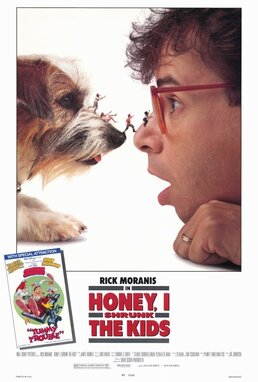
Behind the film
- Year
- 1989
- Director
- Joe Johnston
- Writers
- Ed Naha, Tom Schulman
- Genres
- Science fiction comedy, Science fiction, Comedy
- Production
- Walt Disney Pictures, Silver Screen Partners III
- Country
- United States
- Cast
- Rick Moranis, Matt Frewer, Marcia Strassman, Kristine Sutherland, Thomas Wilson Brown, Amy O'Neill, Jared Rushton, Robert Oliveri
About the film
Contains story spoilers.
A baseball through Wayne Szalinski's attic window activates his shrinking machine, reducing Amy, Nick and their neighbours Ron and Little Russ to a quarter-inch tall. Wayne accidentally sweeps them into the rubbish. Their journey home crosses grass, a bee flight and flooding sprinklers. A discarded cookie feeds them, and a baby ant carries them before dying while protecting Ron from a scorpion. They survive a lawnmower and ride the dog Quark indoors. Nick falls into Wayne's cereal; Quark stops Wayne eating him. Nick signals that the baseball activated the machine, and Wayne reverses the process. All four return to normal. Wayne and Diane reconcile, Big Russ tells his son he is proud of him, and the families share an enlarged Thanksgiving turkey. Amy and Little Russ's new romance continues across the table.
That journey began with Brian Yuzna imagining adventures at grass level. In his SYFY interview, he recalled a backyard barbecue with Stuart Gordon in late 1985, when they wanted to make a film their own children could watch. Yuzna remembered pretending as a child that he was small enough to ride insects. Together they developed the inventor, the baseball accident and the children being thrown out with the rubbish. Ed Naha joined the script's development. Keeping the adventure close to home was a deliberate choice: Yuzna resisted a studio suggestion that the children should reach a shopping mall. Other proposed scenes also disappeared. A dogcatcher taking Quark would have required the children to work inside a lock to escape; an elaborate sewing-kit slingshot gave way to the simpler cereal-bowl idea. Neither sequence belongs to the finished film. An early ending with the children riding an enlarged ant into a scientific society was abandoned too. Yuzna defended the eventual ant's death as the story's necessary moment of sadness.
The shrinking premise was already in place when Tom Schulman arrived to rewrite the screenplay. Speaking to Alex Ferrari for Indie Film Hustle, he described being recruited shortly before production in Mexico, with a demand to turn what he considered a drama into a comedy. Rick Moranis's response to the new script would determine whether filming went ahead. Schulman resisted pressure to start putting words down immediately and insisted on taking several days to think first, despite repeated calls from Jeffrey Katzenberg. He credited the earlier team with the central idea. His account also describes a disagreement once filming began. Staying in the United States, he watched the returning dailies with studio executives. A child's line that he had not written prompted an objection, although Schulman liked it. The studio telephoned Joe Johnston to forbid improvisation. Schulman recalled Johnston ending the call rather than agreeing, after which the executives decided to let him continue. The comedy's wording remained a subject of negotiation even after that urgent rewrite.
Johnston's route to the director's chair involved a much smaller film than the one he was about to make. In his doubleFEATURE interview with Steven Feinberg, he recalled Thomas Smith urging him to bring a directing reel to Disney. Johnston had only a nine-minute black-and-white student film from the University of Southern California, made without synchronous sound. He took it to a meeting with Jeffrey Katzenberg, along with notes on how the Honey, I Shrunk the Kids screenplay could improve. Smith called afterwards with the offer. Johnston remembered questioning whether the studio could really hire him on that sample. Katzenberg's answer, in Johnston's recollection, was that they wanted to establish that he knew where to place a camera.
The familiar neighbourhood and the children's enlarged surroundings were built at Churubusco Studios in Mexico City. Disney's production account describes 48 sets, with a San Diego house serving as the model for the Szalinski home. Smith demonstrated the scale effects with tests of children riding an ant and running up a candy wrapper. The breakfast scene used inner tubes textured as cereal rings floating in 16,000 gallons of artificial milk. The huge oatmeal cookie combined polyurethane foam with real cream filling that the cast could eat. These were objects the children could stand beside, climb over or handle.
The ant needed both physical movement and a readable personality. Miniatures technician Peter Anthony Zamora explained that its antennae were designed to communicate emotion. The latex-foam model, covered with horsehair, took five months to complete and needed seven to twelve operators. David Allen also used stop-motion animation for shots combining the moving ant with its riders. Moranis filmed separately from the children, and credited Johnston with explaining how their scenes would come together. Oversized construction and separately photographed performances therefore had to describe the same space.
Matt Frewer, who plays Big Russ, encountered that space after joining the cast late. In his Moviefone interview, he remembered receiving the version of the script they would shoot and promptly travelling to Mexico. Walking out of his door into the recreated neighbourhood could ease homesickness: a friend's house was nearby. The oversized sets felt to him like an enormous playground, while Johnston kept talking the actors through what the finished images would look like. Frewer connected the story's appeal to a child's curiosity about an ordinary backyard. The imagined expedition needed no distant jungle; the setting already outside the house supplied its discoveries.