
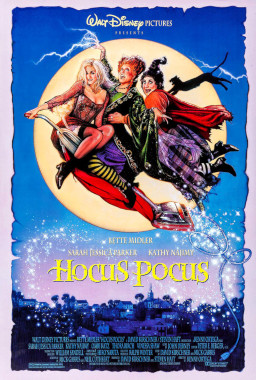
Behind the film
- Year
- 1993
- Director
- Kenny Ortega
- Writers
- Mick Garris, Neil Cuthbert
- Runtime
- 96 minutes
- Genres
- Comedy horror, Horror, Fantasy, Comedy
- Production
- Walt Disney Pictures, David Kirschner Productions, Steven Haft Productions
- Country
- United States
- Cast
- Bette Midler, Sarah Jessica Parker, Kathy Najimy, Omri Katz, Thora Birch, Vinessa Shaw, Jason Marsden, Sean Murray
About the film
Contains story spoilers.
In 1693, the Sanderson sisters kill Emily Binx and curse her brother Thackery into an immortal cat before being hanged. Three centuries later, Max's candle-lighting releases them. He, Dani and Allison escape with Binx and the spellbook. The witches need children's life force before sunrise. They raise Billy Butcherson and enchant the parents into dancing all night. A school kiln fails to destroy them. Opening the book exposes the children; Dani and Binx are abducted. Max and Allison fake dawn with headlights, rescue them and spill the potion. Billy becomes their ally. Max drinks the remaining potion to save Dani, offering himself instead. Winifred falls onto hallowed cemetery ground and turns to stone; dawn destroys all three witches. Binx's cat body dies, freeing his human spirit to reunite with Emily. The parents leave the dance, but the spellbook's eye opens again.
The sisters' movements were worked out before the cameras rolled. Bette Midler, Sarah Jessica Parker and Kathy Najimy had six weeks of rehearsal, with choreographer Peggy Holmes helping each develop her own way of moving and flying. Winifred leads aggressively, Sarah is eager to get airborne, and Mary treats flight cautiously enough to signal with her hand. Najimy wanted Mary to be recognisable from her shadow alone. A curled pumpkin stem made by the art department gave her the idea for the twisting purple hairstyle, while an extended nose suited Mary's ability to sniff out children. Midler's Winifred drew on Cruella De Vil and the Queen of Hearts. Parker tried different voices before finding Sarah's shortly before shooting began. The flying also placed demands on their clothes: special costume versions concealed the harnesses used to suspend the actresses from the stage ceiling. Costume designer Mary Vogt imagined Sarah in fluid clothes influenced by early twentieth-century dancers. Mary wore earthy colours and belt rings that suggested places to hang an herbalist's ingredients.
Vogt chose green and purple to work with Winifred's red hair. The marks on her robe were deliberately changed with extra lines so that they would not reproduce recognisable symbols. Arthur Rackham's storybook illustrations and Goya's Los Caprichos informed the costumes, bringing fairy-tale references together with more unsettling imagery. Vogt thought of Sarah as a witch princess. Dani needed her own place among these larger figures: her costume was brightly coloured to keep her visible, with a homemade appearance that suggested her mother had put it together.
Billy's battered body had to let Doug Jones move freely. Tony Gardner and Margaret Prentice applied a single thin foam-latex piece across his face and neck so the wrinkles could move together. The mouth stitches could be disconnected between shots, letting Jones talk and eat. Gloves extended his fingers with solid acrylic cups and could be replaced when his physical performance damaged them. A suit beneath the torn clothes supplied exposed zombie arms and legs. After a makeup test, the team left Jones's eyes without contact lenses to preserve their expression. Losing his head required another performer. Karyn Malchus wore a built-up torso proportioned to Jones, with a false neck above her own head. Magnets joined the stump to Billy's latex-and-polyfoam head, and she looked through the lace collar. For his emergence from the grave, a pneumatic mechanism beneath a raised part of the stage pushed his coffin through a breakaway lid and soil. Binx also had several physical forms: an animatronic cat, floppy doubles, posable stand-ins and inflatable versions. The animatronic's fangs were shortened after tests made them seem too threatening.
Some effects joined separately photographed pieces into a single event. Buena Vista's digital team built a six-layer composite for a house explosion, combining live-action footage of the house with an exploding miniature of its upper floors and roof. Puppet witches were filmed against bluescreen, while a matte painting supplied the moon and clouds, which were given digital movement. The cemetery had its own physical weight: six inches of dirt covered the set, and real elm and birch trees were brought from the East Coast. Effects rigged into the scenery added to the art department's costs.
The costume-ball number grew out of Ortega's decision to interrupt the chase with a song, something producer David Kirschner initially opposed. Marc Shaiman shaped the arrangement around the groove of a Midler concert opener, giving it an orchestral feel. Najimy and Parker's backing parts drew on his work with Midler's Harlettes. Jones recalled that Midler sang forcefully even while matching a recorded vocal, keeping the effort of singing in her performance. Vogt had spent much of her costume budget on the witches, so Max and Dani's mother's Madonna outfit used plastic funnels for its cone bra. Party extras wore stock costumes from Treasure Island, The Sword and the Rose, The Island at the Top of the World and Tron, alongside red outfits from Gypsy. Billy nearly had a stage moment too. In a sequence cut for time, Jones performed loose-limbed kicks, a floor split and kisses to the crowd before rejoining the pursuit. His brief enjoyment of an audience belongs to the deleted scene.
John Debney took over the score after James Horner left by mutual agreement when delays in locking the film conflicted with other commitments. Debney recalled a tight writing deadline and some all-night work, helped by orchestrators Brad Dechter, Don Davis and Frank Bennett. Ortega, Kirschner and Ralph Winter supported hiring him, and Horner also put in a recommendation. The songs have separate credits: Shaiman produced and arranged Jay Hawkins's I Put a Spell on You, while James Horner composed Sarah's Theme with lyrics by Brock Walsh.