
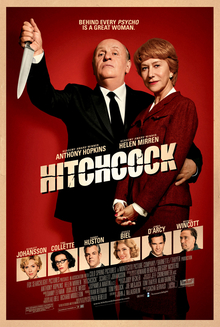
Behind the film
- Year
- 2012
- Director
- Sacha Gervasi
- Writers
- John J. McLaughlin
- Runtime
- 98 minutes
- Genres
- Biographical, Comedy drama, Drama
- Production
- Searchlight Pictures, The Montecito Picture Company
- Country
- United States
- Cast
- Anthony Hopkins, Helen Mirren, Scarlett Johansson, Toni Collette, Danny Huston, Jessica Biel, Michael Wincott, James D'Arcy
About the film
Contains story spoilers.
After North by Northwest, the film's Hitchcock wants another challenge and chooses Robert Bloch's Psycho. Studio resistance leaves him financing it himself. Censorship disputes and his treatment of actresses strain his marriage. Alma works on a screenplay with Whitfield Cook at a beach house; Hitchcock suspects an affair, which she angrily denies. When he falls ill, she steps into the production. His first cut disappoints executives, while Alma discovers Cook with another woman. The couple reconcile and reshape Psycho together, including the decision to use Bernard Herrmann's strings in the shower scene. At the premiere, Hitchcock waits outside the auditorium and gestures in time with the audience's screams. He publicly thanks Alma, and they reaffirm their partnership. A final address to the audience ends with a raven landing on his shoulder, pointing towards The Birds.
Hitchcock is a dramatization based on Stephen Rebello's nonfiction book Alfred Hitchcock and the Making of Psycho. Rebello told The Film Stage that his account had depended heavily on interviews with people around the earlier production. He felt he had given Alma too little space because he assumed readers already understood her importance, and wanted the adaptation to correct that emphasis. Screenwriter John McLaughlin wrote the first several drafts and established the structure. Rebello credited him with the Hitchcock Presents-style opening and the imagined conversations with Ed Gein. Those exchanges give the film's Hitchcock someone to address in private; they are a dramatic invention, rather than meetings between the two men. Rebello also recalled a set visit from Psycho script supervisor Marshall Schlom, whose response encouraged the filmmakers. The adaptation therefore combines testimony about making Psycho with invented scenes of a marriage under pressure.
For the 2012 dramatization, Gervasi worked with Hopkins and Mirren on a compact shooting schedule. Gervasi told Interview that Hitchcock was shot in thirty-five days, after a week of rehearsal. A table read with Anthony Hopkins and Helen Mirren gave him an early sense of how the central performances would work. The producers had considered him after seeing Anvil: The Story of Anvil, but he still had to pitch for the directing job. His connection was to a filmmaker putting his own money at risk to reach an audience, something he had done with Anvil. He also saw a creative partnership at the centre of both projects. That interest shaped his pitch for a story in which Alma is a collaborator as well as a wife.
Production designer Judy Becker separated the domestic rooms, studio offices, Psycho sets and imagined Gein scenes through their colours and furnishings. She and researcher Alex Linde consulted the Academy Library, decorating magazines and behind-the-scenes photographs. They found no colour photographs of the Psycho sets and lacked access to Universal's Hitchcock archives. Becker instead photographed paint samples in black and white to match the grey values of the original stills. Norman's parlour could therefore have bright blue walls and red upholstery while keeping the tonal relationships of Psycho. The home used muted neutrals with coral, yellow and turquoise, with stronger colours around Alma's pool and Cook's beach house. Red accents connected these settings. Becker deliberately chose a Tudor-style home to suggest English roots, departing from the Hitchcocks' more contemporary Bel Air house. She enlarged the kitchen and bathroom by about thirty-five percent for movement. In the kitchen, the refrigerator stood at the far end, while Alma's workstation, dining table and garden window allowed arguments and solitary meals to play across the room. Pale yellow counters softened its otherwise clinical finishes. Bird motifs and a recurring shovel linked domestic spaces to the imagined nightmares.
Hopkins's appearance also changed during preparation. Makeup artist Howard Berger told Fast Company that he developed six versions, beginning with a close likeness that was too heavy. Camera tests more than six weeks before shooting brought criticism from the producers, leaving time to adjust the appliances before the first day. Berger reduced the nose and ears and removed dentures that had changed Hopkins's jawline. A strong line at the centre of the brow interfered with the actor's performance and was dropped. The last lip appliance went during the final test on the night before production; Hopkins supplied the pout himself. Berger described the result as a portrait combining the performer and the subject. Gervasi explained to Slackerwood that he wanted the audience to recognise Hopkins interpreting Hitchcock, rather than have the actor disappear under an impersonation. He also described the screenplay's reversal of status: an established director becomes an underdog who must prove himself again by risking his own money on Psycho.
Gervasi borrowed specific camera ideas from Hitchcock's films for this domestic story. He told CinemaNerdz that eight visual references were scattered through the picture. The fast movement over a theatre marquee, through rain towards umbrellas, refers to Foreign Correspondent. When Hitchcock phones home and Alma answers expecting Cook, the camera moves towards the back of his head with the telephone cord coiled around his neck, echoing Dial M for Murder. Gervasi said he placed these quotations where they helped the scene, while leaving viewers familiar with the earlier films something to recognise. Danny Elfman's involvement began with a visit to the set, where he watched the monitor and then asked to return the next day. Despite an already crowded schedule, he insisted on finding time to compose the score for Hitchcock. That is the music for Gervasi's film, distinct from Herrmann's Psycho score within its story.