
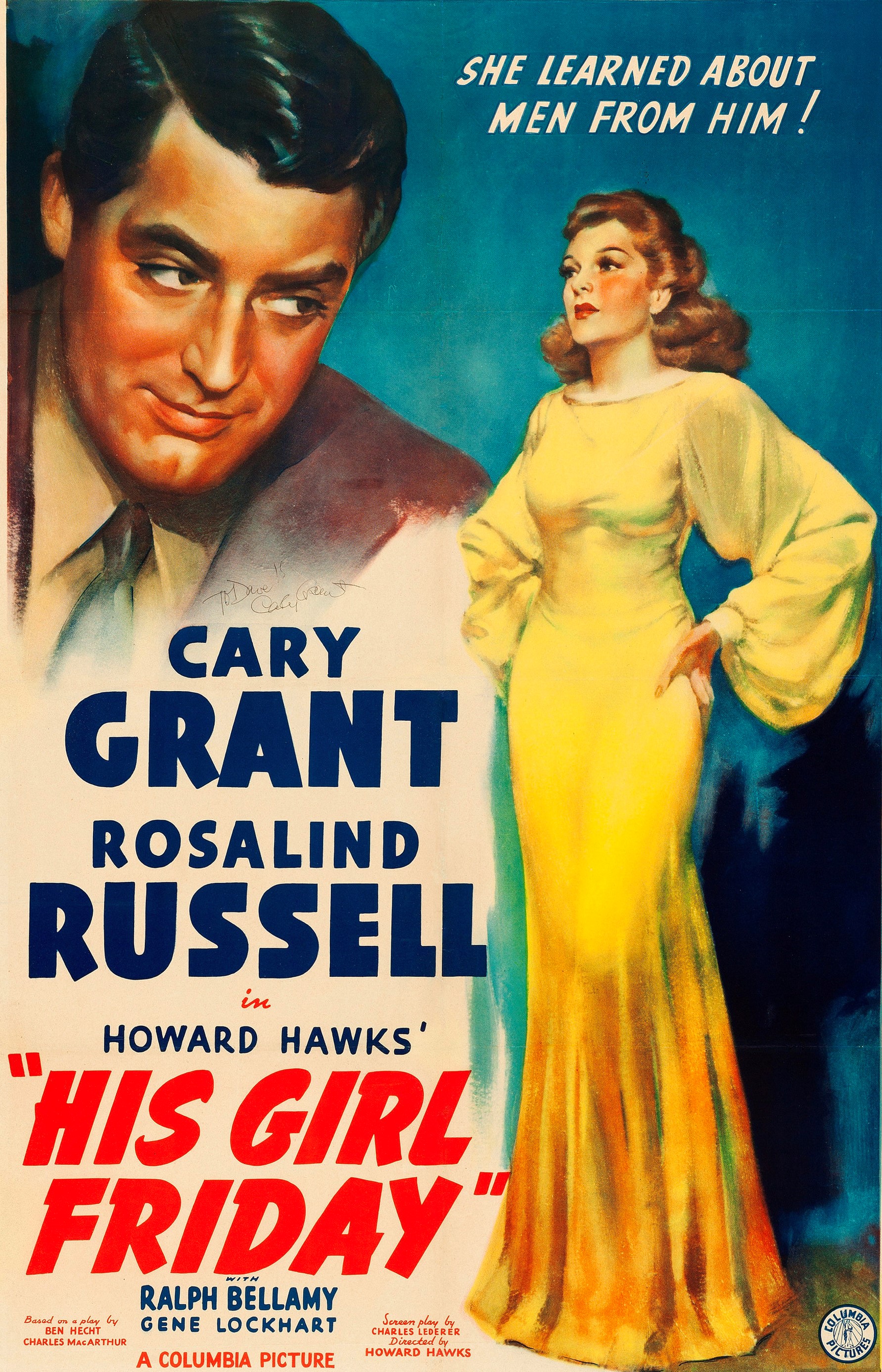
Behind the film
- Year
- 1940
- Director
- Howard Hawks
- Writers
- Charles Lederer, Charles MacArthur, Ben Hecht
- Genres
- Comedy of remarriage, Comedy drama, Drama, Romantic comedy
- Production
- Columbia Pictures
- Country
- United States
- Cast
- Cary Grant, Rosalind Russell, Ralph Bellamy, Gene Lockhart, Porter Hall, Ernest Truex, Cliff Edwards, John Qualen
About the film
Contains story spoilers, including the ending.
His Girl Friday follows a reporter trying to leave a profession and a husband who keep finding ways to draw her back. Rosalind Russell plays Hildy Johnson opposite Cary Grant as Walter Burns in Howard Hawks's 1940 comedy. Hildy intends to marry Bruce Baldwin, played by Ralph Bellamy, and settle in Albany. Walter knows that a story can hold her attention longer than an argument about their divorce. He asks her to interview Earl Williams before his execution for killing a policeman. She agrees on a practical condition: Walter must buy insurance from Bruce, providing a commission for the couple's new life. Hildy has already learned to guard against Walter's pickpocket associate, giving Bruce instructions for hiding the insurance payment in his hat rather than leaving it easily accessible. Yet he also has Bruce framed for theft, forcing Hildy to bail him out. She quits again, only for Williams's escape to pull her back into reporting. Walter can interfere with the departure, but Hildy's own appetite for the work makes his interference effective.
Williams reaches the press room and hides in a roll-top desk. Hildy and Molly Malone conceal him when the other reporters arrive. Molly, who has shown him kindness, jumps from the window to draw their attention away. Walter orders an associate to kidnap Bruce's mother and plans to move the desk to his newspaper. Hildy keeps typing while Bruce tries to get her to leave. Behind the pursuit, the mayor and sheriff are protecting their electoral prospects: they have tried to suppress a reprieve sent by the governor. The sheriff discovers Williams and arrests Hildy and Walter, but messenger Joe Pettibone arrives with the reprieve and forces their release. The reprieve also exposes the officials' willingness to let a man die for political advantage. Walter says Hildy can go. Her distress at that permission makes clear that she still wants him. Bruce telephones from jail, arrested over counterfeit money supplied through Walter's scheme. Walter and Hildy will marry again, with a honeymoon in Albany covering a strike. Even their second attempt at marriage begins as another assignment, with the newspaper taking precedence over the quiet home Bruce had offered her.
The press room gives Hildy both a place among her colleagues and reasons to resent the business. The reporters have already made Molly into material for their stories before listening to her account. Their interest in Williams's escape brings further questions, although their earlier treatment gives her little reason to trust them. Hildy's talent operates inside that same scramble for a saleable story. Walter's pursuit of the scoop and his pursuit of Hildy become difficult to separate. She can meet him in the argument and do the reporting he needs, but his tricks keep imposing costs on Bruce and his mother. Her return to Walter does not produce a reformed editor. The Albany assignment puts the old pattern into their future marriage, after the execution story has shown how much she still wants to work beside him.
The speed of those exchanges took preparation. Hawks encouraged actors to add lines and overlap one another, while Russell privately paid a writer to supply jokes. Grant realised what she was doing and began asking what she had brought that day. The sound crew had to keep pace with the performers using several microphones, switching between them on cue rather than leaving all of them open. Some scenes needed as many as thirty-five changes. The restaurant sequence took four days instead of its scheduled two. What sounds spontaneous therefore depended on carefully coordinating speech, movement and recording. Russell's private additions gave her more ammunition in the exchanges, while the microphones had to catch the words before the next speaker cut in. Overlapping speech also allowed Charles Lederer's unusually long screenplay to pass quickly on screen. Hildy and Walter's verbal competition establishes their professional equality alongside their attraction. The same pace lets each challenge the other without waiting for a polite invitation to answer.
Hawks explained that the overlap was written into the dialogue. Extra words at the start and end of a sentence could be covered by another actor's speech while its essential meaning remained audible. He wanted the conversation to move faster than in other pictures, and felt interruptions sounded closer to the way people actually talked. That intention required space for one person to begin before another had finished. Hawks also recalled testing The Front Page with a woman reading the reporter's part while he read the editor. He decided that the exchange worked better that way. Making Hildy a woman changed the relationship available to the adaptation: the contest over keeping a reporter could also become an argument between former spouses. The overlapping voices let that professional struggle and their renewed courtship happen in the same breath.