
Behind the film
- Year
- 2016
- Director
- Theodore Melfi
- Writers
- Theodore Melfi, Allison Schroeder, Margot Lee Shetterly
- Runtime
- 2h 7m
- Genres
- Biographical, Drama
- Production
- 20th Century Studios, Chernin Entertainment, Donna Gigliotti
- Country
- United States
- Cast
- Taraji P. Henson, Octavia Spencer, Janelle Monáe, Kevin Costner, Kirsten Dunst, Jim Parsons, Glen Powell, Mahershala Ali
About the film
Contains story spoilers.
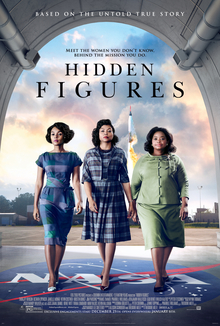
Hidden Figures follows three Black women whose work at NASA’s Langley Research Center places them inside the American space race while its daily routines still exclude them. Katherine Johnson, Dorothy Vaughan and Mary Jackson are friends and colleagues in Hampton, Virginia, where the West Area Computers perform calculations for engineers. The film opens with the three of them stranded beside their car on the way to work, then shows a white police officer questioning them before eventually escorting them to Langley. That small roadside episode introduces the setting’s contradiction: the women’s mathematical skill is urgently needed, but their race and gender shape how they are treated before they even enter the building.
Katherine is transferred from the West Area to the Space Task Group, where she must check calculations for the Mercury program. The move brings her closer to the launch decisions, but her new colleagues do not readily treat her as an equal. She works under Al Harrison and faces resistance from head engineer Paul Stafford, who keeps her away from important briefings and removes her name from reports. The office is also segregated in practical ways: Katherine must cross the campus to use a bathroom assigned to Black employees, leaving her desk for long stretches and making it harder to keep up with work in the group. Her calculations can be indispensable while her presence is treated as an inconvenience. That tension shapes both her working day and the mission’s growing pressure.
Dorothy Vaughan is already doing the work of a supervisor, directing the West Area Computers, but she has not been given the title or pay. When NASA installs an IBM computer, she recognizes that it could make the women’s manual calculations seem unnecessary. She finds a book on FORTRAN, teaches herself to program, and learns enough to prepare the other women for the machine. The computer initially frustrates the engineers, who cannot get it to produce reliable results. Dorothy’s practical knowledge makes her useful to the new unit, and she takes her colleagues with her rather than allowing the change to leave them behind. Her story tracks how technical work is reassigned as the center shifts from hand calculations to electronic processing.
Mary Jackson wants to move from computing into engineering, a job that requires courses offered at a whites-only high school. Engineer Karl Zielinski encourages her to pursue the change, while the coursework remains barred to her because of segregation. Mary studies the rules and petitions a local judge for permission to attend the classes at night. The judge grants her request, allowing her to qualify for the engineering program. The courtroom episode turns a bureaucratic barrier into a visible confrontation, while Mary’s persistence keeps the scene grounded in the specific credential she needs. Her path differs from Katherine’s mission calculations and Dorothy’s programming work, but all three depend on getting their ability recognized inside institutions designed to limit it.
Katherine’s personal life is also unsettled. She is raising three daughters after the death of her first husband and is cautious when Colonel Jim Johnson begins courting her. At work, the Mercury mission gives her a chance to contribute directly to the launch, but the calculations move quickly and the newer electronic computer is not yet trusted. Astronaut John Glenn asks that Katherine verify its numbers before he flies. She works through the orbital figures and confirms the trajectory needed for the mission. The film makes the arithmetic legible as a human responsibility: a number has to be checked against a real flight plan, and the people relying on it are waiting for a dependable answer.
As the launch approaches, Katherine’s contributions become harder for the Space Task Group to ignore. Harrison removes the sign restricting access to the women’s bathroom, a dramatic moment the film uses to represent a broader shift in the office. Dorothy’s programming group is absorbed into the IBM operation, and Mary continues toward engineering. The film brings their separate workplace battles together around Glenn’s orbital flight. Katherine’s verification helps clear the calculations for launch, and the mission succeeds in carrying Glenn into orbit and returning him safely. The resolution gives the women public recognition for work that had long been treated as background support, though each has had to push through a different door to reach that point.
The film is based on real mathematicians, but compresses events and stages some encounters for a feature narrative. It brings three careers into one tightly connected stretch of the space race: Johnson’s trajectory calculations, Vaughan’s programming transition, and Jackson’s move into engineering. Each woman’s work reaches a different kind of obstacle, from being kept away from technical discussions to protecting a computing team through a change in technology or securing the coursework required for a new role. Theodore Melfi’s adaptation links these strands to the deadline of John Glenn’s flight, so their separate workplace decisions feed into one public mission. The story’s daily turning points are decisions about who may enter a room, use a skill, or claim credit for finished work.