
Behind the film
- Year
- 1987
- Director
- Clive Barker
- Writers
- Clive Barker
- Genres
- Horror, Body horror
- Country
- United Kingdom, United States
- Cast
- Ashley Laurence, Andrew Robinson, Sean Chapman, Doug Bradley, Grace Kirby, Oliver Smith, Simon Bamford, Clare Higgins
About the film
Contains story spoilers, including the ending.
Hellraiser begins with Frank Cotton looking for a new experience and finding one he cannot control. He buys a puzzle box, opens it in an upstairs room and summons the Cenobites. Hooked chains tear his body apart. Later his brother Larry moves into the house with his wife Julia, who once had an affair with Frank. A mundane injury changes the house again: Larry cuts his hand, and blood reaches Frank's remains beneath the floorboards. Frank returns in an incomplete body and persuades Julia to bring him victims so that he can rebuild it. Her desire to recover their relationship becomes an arrangement in which strangers are led upstairs to die. Larry does not understand what is happening above him. His daughter Kirsty's suspicion eventually brings her into the room where Julia has been keeping Frank's return hidden.
Kirsty escapes from Frank with the box, but opening it in hospital brings the Cenobites to her. She offers to lead them to the man who escaped them in exchange for her freedom. Returning to the house, she discovers that Frank has killed Larry and is wearing his skin. Julia is fatally wounded during Frank's attempt to reach Kirsty. The Cenobites reclaim Frank and tear him apart, then turn their attention back to the woman who brought them there. Kirsty uses the puzzle to send them away and escapes with Steve. Trying to burn the box does not destroy it. A vagrant retrieves it from the fire and changes into a winged skeletal creature. The final return to the merchant puts the object back into circulation. Kirsty gets out of the house, but the invitation that first tempted Frank is waiting for someone else.
Clive Barker described the project during production as a love story shaped by perversity. Desire is the reason Julia helps Frank, and seeking pleasure is what brought him to the box in the first place. The Cenobites' interventions enter a family already divided by secrecy and betrayal. Barker and producer Christopher Figg had developed the project around a small domestic situation, with The Hellbound Heart taking the idea into prose before the feature reached the screen. In a contemporary interview, Barker explained that the adaptation expanded a minor character from the novella into a more conventional heroine. Kirsty gives the audience someone who can discover the house's secret and act against it. His declared visual aim was to place forbidden imagery inside carefully made pictures, while delivering the monsters promised by the story. The ordinary rooms and the impossible bodies therefore belong to the same film.
Barker prepared storyboards for the first Hellraiser, largely keeping them for himself except where major effects required them. Looking back in a conversation with filmmaker David Bruckner, he described bringing theatre experience to a form of directing he was still learning. He placed particular weight on the actors and on how a written line changed when someone performed it. Doug Bradley's delivery as the leader of the Cenobites was one example he remembered with pride. Another memory concerned the first audience screening and its response to Larry injuring his hand on the nail. The filmmakers had tried several ways of achieving that small effect. Barker was surprised that an ordinary wound drew such a strong response in a film full of elaborate bodily destruction. It also has a precise story function: that blood is what allows Frank to return.
The resurrection changed during production. An additional effects shoot after principal photography replaced an earlier version that had disappointed the filmmakers. Effects trainee Stuart Conran remembered working on layered wax pieces that could be melted and filmed in reverse for Frank's emergence. He also recalled a skeletal animatronic puppet being rejected after a camera test in favour of prosthetic makeup for Frank's early condition. Conran assisted with moulds, painted foam latex and puppeteering before receiving small effects of his own, including inserts of hooks entering flesh. He credited the Cenobite designs chiefly to Barker, with Bob Keen and the effects crew developing the other work. For Conran, the lighting and editing were part of making those physical constructions convincing. An effect needed the right view and duration as well as an object the team could build. His recollections place the frightening finished images after a series of experiments and replacements.
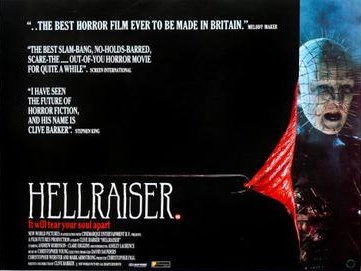
Keen described the Cenobites' appearance as developing through conversations with Barker. Chains, shafts of light and the visual arrangements around them grew from their exchange of ideas. The figure later known as Pinhead became simpler as they worked: an early quill-like approach gave way to a grid drawn on the head, then to pins or nails placed within that pattern. Keen also gave Bradley a substantial share of the character's identity. The face could be constructed by the effects department, but the bearing belonged to the performer inside it. Keen thought of the character as having the authority of a general, an image that fits the calm presentation of such an altered body. His account describes a design finding its final shape through drawing, makeup and performance. The threat does not require the figure to rush at Kirsty; his presence can make an encounter feel like being called to answer.