
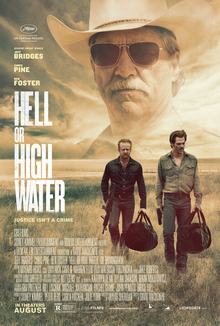
Behind the film
- Year
- 2016
- Director
- David Mackenzie
- Writers
- Taylor Sheridan
- Runtime
- 1h 42m
- Genres
- Heist, Crime, Drama, Contemporary western
- Production
- Starz Entertainment
- Country
- United States
- Cast
- Chris Pine, Jeff Bridges, Ben Foster, Gil Birmingham, Dale Dickey, Buck Taylor, Katy Mixon, Kevin Rankin
About the film
Contains story spoilers, including the ending.
Hell or High Water follows two pairs of men moving towards the same confrontation. Toby and Tanner Howard are brothers trying to save family land; Marcus Hamilton and Alberto Parker are the Texas Rangers pursuing their robberies. David Mackenzie directs Taylor Sheridan's screenplay, with Chris Pine and Ben Foster as the brothers and Jeff Bridges and Gil Birmingham as the lawmen. The production's account places family loyalty alongside the financial pressures changing the West. These men have ties to a landscape that can no longer guarantee the lives they expected from it. The banks are both robbery targets and part of the economic system threatening the ranch. Mackenzie was drawn to the moral difficulty of people committing crimes for reasons that can be understood. That gives the pursuit a problem beyond catching thieves: its hoped-for rescue is already being purchased through harm to other people.
The brothers carry that burden differently. Toby is a divorced father concerned with what his children will inherit, and his apparent calm conceals worry. Tanner, an ex-convict, is much less predictable. Even an insult from a bank employee can provoke his pride during a robbery. Across the pursuit, Marcus brings an abrasive manner to his work with Alberto, whose Comanche heritage becomes a target of his racist teasing. His questioning of a frightened clerk also reveals a gentler, more patient way of getting information. The same investigator can be cruel to his partner and considerate with a witness.
The plan depends on turning stolen cash into a legitimate payment. The brothers' mother has died, leaving a reverse mortgage on the ranch, where oil has been discovered. They rob Texas Midlands branches and convert the money through casino gambling, obtaining a cheque payable to the bank. Their final target is crowded, and an exchange of gunfire kills a guard and an armed customer. Toby is wounded during the escape. Tanner separates from him to draw the pursuit away, then kills Alberto from a ridge. Marcus gets behind Tanner and shoots him dead. Toby reaches the casino and pays off the debt in time, placing the ranch in trust for his sons. Later, the retired Marcus visits him there, still certain of his involvement. Toby explains his determination to break the family's poverty; Marcus holds him responsible for Alberto's death. The arrival of Toby's family interrupts the confrontation. Their parting invitation to meet again leaves the conflict alive rather than providing an arrest or a final gunfight.
Mackenzie deliberately leaves that last encounter unsettled. In his Silver Screen Riot interview, he said a tightly closed moral conclusion would undermine the questions the film raises. Knowing the men's reasons is different from settling what they deserve. The film gradually supplies information that changes how their earlier behaviour can be understood, asking for those judgments to remain provisional. The director also discussed the difficulty of portraying gunfire and racial tensions without glorifying or excusing them. Even the quieter comic scenes complicate who seems powerful. At the T-Bone diner, an uncompromising waitress leaves the two Rangers looking distinctly nonplussed. Mackenzie confirmed that she was an experienced actress, rather than a local simply appearing as herself. Her command of the encounter briefly cuts the lawmen down to size, giving the people they pass on the road their own presence and authority.
The wide landscapes were photographed in New Mexico after a scouting trip through the Texas communities behind Sheridan's writing. Giles Nuttgens described those visits as a way to absorb the harshness and economic decline before recreating the setting elsewhere. The opening robbery uses a developing shot around the town to establish its emptiness and the brothers' intention to strike before crowds arrive. A diner stakeout makes the bank outside more visible than Marcus inside, because the destination of his attention matters more than an evenly exposed face. Nuttgens also used the wide frame to make Tanner seem small against the ranch landscape. One moment of brotherly wrestling arose when lightning halted the normal lighting work. The crew filmed Pine and Foster contemplating their surroundings at dusk; the actors began fooling around, and that unplanned behaviour became the scene. The environment could shape both the picture and the performance.
Time with the characters was something Mackenzie and editor Jake Roberts actively protected. Their conversations and silences had to give each pair space without stopping the pursuit's forward movement. The production schedule produced another useful difference between them. Pine's availability required the brothers' material to be filmed first and in sequence, before Bridges and Birmingham arrived. Mackenzie said that progression let each scene feed intuitively into the next, while the later Ranger material could be approached at a less hurried pace. The final encounter was especially concentrated: Pine and Bridges overlapped for only one day. Real banks, diners and casinos also gave the actors environments with their own atmosphere. Mackenzie described relying on how a location and performers felt on the day, while recognising that stunts required planning. The result's pauses and sudden accelerations have a practical foundation in how these two halves were made.