
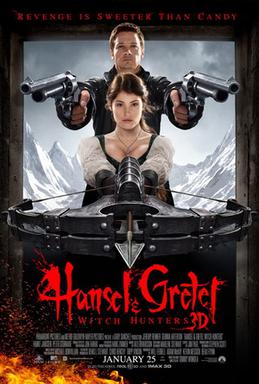
Behind the film
- Year
- 2013
- Director
- Tommy Wirkola
- Writers
- Tommy Wirkola
- Runtime
- 1h 28m
- Genres
- Action, Fantasy, Comedy horror, Comedy drama
- Production
- Metro-Goldwyn-Mayer, Paramount Pictures, MTV Films
- Country
- Germany, United States
- Cast
- Jeremy Renner, Gemma Arterton, Famke Janssen, Peter Stormare, Thomas Mann, Zoë Bell, Derek Mears, Ingrid Bolsø Berdal
About the film
Contains story spoilers, including the ending.
Hansel & Gretel: Witch Hunters follows the fairy-tale siblings into an adult career built on their childhood escape. Armed with guns and a crossbow, they accept a contract to find children abducted around Augsburg. They first stop Sheriff Berringer from executing Mina as a witch. The investigation reveals a coming Blood Moon, when Muriel's coven intends to sacrifice twelve children and gain protection from fire. Hansel becomes separated from Gretel during a raid on the town; Mina later finds and heals him. Edward, a troll working for the witches, saves Gretel from Berringer's men. He explains that trolls serve witches, a statement that points toward Gretel's family history. The siblings' search leads them to their childhood home, where Muriel reveals that their mother, Adrianna, was a powerful white witch and that Gretel's heart is the missing ingredient in the ritual.
Muriel had wanted a white witch's heart at the previous Blood Moon. Unable to defeat Adrianna directly, she exposed her to the townspeople and targeted Gretel instead. The siblings' father hid the children in the forest to protect them; the mob killed both parents. In the present, Muriel wounds Hansel and takes Gretel away. Mina reveals that she too is a white witch, heals Hansel and uses Adrianna's grimoire to bless his weapons. With the young admirer Ben, they attack the witches' gathering and rescue the children. Edward frees Gretel, defying Muriel, who throws him over a cliff. Gretel revives him. The pursuit returns to the decaying gingerbread house, where Muriel kills Mina. Hansel and Gretel fight Muriel together and finally decapitate her with a shovel. They collect the reward and continue hunting, now accompanied by Ben and Edward. Their work has changed through the discovery that witchcraft runs in their own family and that the category of witch includes allies as well as the enemies they have spent years killing.
Writer-director Tommy Wirkola conceived the film as a continuation of a familiar story: what might happen to children who survived abandonment and killed the witch who tried to eat them? Producer Kevin Messick encountered his earlier film Dead Snow at Sundance, where the audience's noisy response to its combination of horror and comedy attracted him. Wirkola brought several ideas to their meeting, saving Hansel and Gretel for last and accompanying it with early artwork. Messick said they sold the project to Paramount within a week; two years later they were building Augsburg in Germany. The European location mattered to Wirkola, who wanted the surrounding world to resist an Americanised appearance. He deliberately gave the two leads American accents to make them sound like outsiders and somewhat more modern than the people around them. The supporting cast drew on German and Scandinavian performers, including established Norwegian actors in small parts. Pihla Viitala, who plays Mina, came to their attention through a tape in a German casting office. Messick linked that local talent pool both to the economics of shooting there and to the fairy-tale setting's European atmosphere.
Creature design gave Wirkola another way to make the fantasy tangible. Edward was performed by Derek Mears in an animatronic troll suit, despite doubts about whether animatronics would work convincingly. Wirkola pointed to Guillermo del Toro's Hellboy as the kind of physical creature presence he wanted, and used the same effects company. Keeping an actual performer in the scene was part of his effort to give witches and trolls a material footing. The witches themselves were designed around animal references: Muriel's was a wolf. Those associations helped determine their appearance and sound, moving away from a single conventional witch design. Wirkola also described a tonal limit on each ingredient. Too much humour would turn the film into a spoof; excessive gore could pull the audience out of the action. Post-production brought an unfamiliar American studio process of testing and responding to many opinions, supported by producers who understood the intended film. A release delay later gave him the chance to shoot an ending scene that had previously been removed from the script, rather than merely holding the completed picture back.
Gemma Arterton approached Gretel as someone whose hard exterior protects a damaged, vulnerable person. She saw Gretel as the more cerebral sibling, with Hansel supplying more of the outward humour and physical force, while stressing that Gretel also has a sense of humour. The brother-and-sister relationship depended on the rapport she found with Jeremy Renner from their first meeting. Arterton described Wirkola as attentive to the actors and collaborative from the first day, even amid the demands of a large fantasy production. Her own physical workload was greater than on her earlier action films, making the stunt work a particular challenge. The sets also supplied something concrete to play against: she recalled the gingerbread-house exterior standing in a German forest. She credited Wirkola's insistence on practical effects with helping the fantastical world feel present around the performers. During the delay before release, she and Renner returned for additional character moments, including material filmed in the California desert that had not been possible in Germany.