
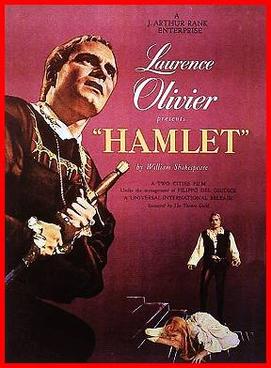
Behind the film
- Year
- 1948
- Director
- Laurence Olivier
- Writers
- Laurence Olivier
- Runtime
- 2h 30m
- Genres
- Drama
- Production
- Two Cities Films
- Country
- United Kingdom
- Cast
- Basil Sydney, Eileen Herlie, Jean Simmons, Stanley Holloway, Laurence Olivier, Peter Cushing, Anthony Quayle, Felix Aylmer
About the film
Contains story spoilers.
Olivier’s Hamlet opens with the prince’s body being carried through Elsinore, then returns to the watch before the tragedy. The castle is already unsettled: Hamlet’s father has died, and Gertrude has married his brother Claudius within a month. Hamlet stays apart from the celebration. Horatio and the sentries bring him to the battlements, where the Ghost identifies Claudius as the murderer and explains that poison poured into the sleeping king’s ear killed him. Hamlet now has an accusation from the dead king, but he must decide whether to trust it and how to act without making the court’s suspicion stronger.
The family around him gives that problem a personal edge. Claudius is both the new king and Hamlet’s uncle, while Gertrude’s quick remarriage keeps the old king’s place in the family painfully visible. Polonius, the royal adviser, assumes Hamlet’s strange behaviour comes from his daughter Ophelia. She has been told to keep away from the prince, and Hamlet’s bitter rejection of her at the nunnery meeting leaves little room for the two to repair their relationship. Olivier’s cut-down version gives the court fewer political side stories, so Hamlet’s grief, anger and unease with his mother stay close to the centre of the story.
Hamlet hires a travelling company to perform a play that echoes the murder described by the Ghost. He changes the action so Claudius will see a king killed by poison in the ear, then watches the audience as closely as the actors. Claudius calls for lights and leaves before the performance is over. Hamlet takes that response as proof that the Ghost told the truth. The scene lets him test the charge in public without naming it aloud, while the camera moves through the room to register the reactions of people watching one another. The performance gives Hamlet evidence; it does not tell him what to do with it.
Soon afterwards, Hamlet finds Claudius alone with a chance to kill him, but stops when he sees the king at prayer. He worries that killing Claudius then would send the murderer to heaven, while his father’s spirit remains condemned. The delay is followed by a confrontation with Gertrude, where Polonius hides behind a curtain to listen. Hamlet hears a movement, thinks Claudius is there, and stabs through the hiding place. When he sees Polonius, the mistake cannot be undone. The Ghost appears again as Hamlet argues with his mother; Gertrude cannot see it and reads her son’s words as further evidence that he has lost his reason.
The film makes Hamlet’s bond with Gertrude unusually intimate. He kisses her during the bedroom confrontation, and Olivier’s staging gives their argument a disturbing closeness as he presses her about Claudius and his father. Hamlet is sent away to England, where Claudius expects him to be killed. At sea, pirates attack the ship and Hamlet returns to Denmark. The film has removed Rosencrantz and Guildenstern, who carry the execution order in Shakespeare’s play, and it also removes the Fortinbras story. Those cuts keep the route back to Elsinore compact, but they leave the audience with fewer witnesses to the political machinery around Hamlet.
While Hamlet is away, Ophelia’s grief and isolation deepen after her father’s death and Hamlet’s rejection. She becomes disoriented and drowns; the film gives the water sequence a physical, lingering presence rather than treating it as news delivered by another character. Laertes returns furious and wants revenge for Polonius and Ophelia. Claudius steers that anger into a fencing match, arranging for Laertes to use a poisoned blade and keeping poisoned wine ready if the first plan fails. Hamlet accepts the challenge, though he has a bad feeling about it. Their meeting turns court ceremony into a trap neither man can leave cleanly.
At the duel, Hamlet wins the first exchanges and Gertrude drinks from the poisoned cup. Laertes wounds Hamlet with the poisoned blade; the fighters exchange weapons, and Hamlet wounds Laertes with the same blade. Gertrude warns Hamlet about the poisoned wine before dying. As he dies, Laertes admits that Claudius planned the killing. Hamlet attacks the king, stabs and slashes him, and then dies from the poison. Horatio remains to mourn him and tell what happened. Instead of bringing in Fortinbras to claim the throne, Olivier ends with the Danish court carrying Hamlet’s body away in a military funeral.
Olivier and editor Helga Cranston built the film around long passages of verse. Cranston remembered that many cuts were planned ahead and timed to movement, action or the rhythm of a line, letting the actors’ speech carry a scene without leaving the film static. The crew tested the Ghost’s appearance and moving fog on the soundstage; one abandoned idea used a negative image. Those experiments match the film’s larger visual approach. Light, deep focus and the winding castle corridors make hidden motives visible in the frame, while Hamlet’s reflections and pauses leave his next move uncertain. Elsinore feels like a place built to watch its own inhabitants.