
Behind the film
- Year
- 2007
- Director
- Ben Affleck
- Writers
- Ben Affleck, Aaron Stockard
- Runtime
- 1h 54m
- Genres
- Crime, Neo-noir, Mystery, Drama
- Production
- Miramax, The Ladd Company
- Country
- United States
- Cast
- Casey Affleck, Michelle Monaghan, Morgan Freeman, Ed Harris, Amy Ryan, John Ashton, Robert Wahlberg, Amy Madigan
About the film
Contains story spoilers, including the ending.
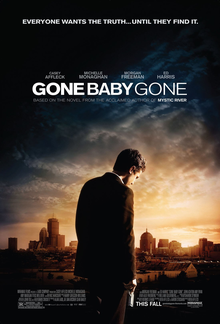
Gone Baby Gone puts private investigators Patrick Kenzie and Angie Gennaro into a case their usual work has not prepared them to solve. Amanda McCready's family wants their knowledge of the neighbourhood and their distance from the police. Casey Affleck and Michelle Monaghan play partners whose personal relationship is also bound to their professional work. The missing child's mother, Helene, makes the search difficult to separate from questions about the life Amanda had at home.
A failed exchange at a quarry leaves Amanda presumed drowned. Patrick later discovers that the explanation conceals an arranged disappearance involving people he trusted. Amanda is alive with retired police captain Jack Doyle and his wife. Doyle argues that she can have a better life with them. Angie wants Patrick to leave the child there, while Patrick insists on returning her to Helene. He informs the police, Doyle is arrested, and Amanda goes home. Angie leaves Patrick because of his decision. In the final visit to Helene's apartment, Patrick offers to babysit while she goes out. Amanda corrects the name of the doll her mother has been calling Mirabelle: it is Annabelle. Patrick has kept his promise to bring the girl back, but the quiet evening gives him no assurance about what follows. His presence beside Amanda leaves the consequence of his choice in an ordinary room, after the investigation and its arrests have ended. The reunion solves the disappearance while exposing the limits of what a solved case can do for the child.
Ben Affleck and Aaron Stockard adapted Dennis Lehane's novel, which offered a familiar Boston world and a demanding structure. Affleck had expected an existing plot to let him concentrate on dialogue and character, the parts of writing in which he felt more confident. Instead, he found that fitting its turns into a feature required careful preparation for the later revelations. Removing material threatened the links that made other events understandable. He also wanted to keep the dialogue, atmosphere and shades of character that had attracted him to the book. His plan for his own involvement changed along the way. He initially considered acting in an adaptation made by another director, then became increasingly invested in directing it himself. Acting and directing together felt too daunting. The work of shaping the screenplay therefore also changed his place in the production. He moved from imagining himself inside Patrick's story to directing the people who would give it its screen form.
The younger Patrick gave Casey Affleck a character with less settled experience of moral uncertainty. Ben Affleck explained that moving him towards thirty meant the case could change the direction of his life. Casey's preparation also took him away from the glamorous private investigator of familiar thrillers. He described real investigators spending much of their time gathering and passing information at a desk, with fieldwork that was ordinary and poorly paid. Monaghan valued Angie as an independent woman doing unusual work and sharing an equal partnership. Amy Ryan approached Helene through compassion for someone lacking education, childcare and a reliable social structure. She did not excuse Helene's choices, but looked for the circumstances in which those choices developed. The actors' accounts connect the case to work and family conditions that existed before Amanda disappeared. Patrick and Angie enter it as a team, while Helene brings a history that cannot be reduced to her televised appeal for her daughter.
Affleck wanted the people around the case to feel like inhabitants of Boston rather than standard movie faces. While filming local residents, he sometimes waited for them to become bored with the camera or drew attention towards himself so they would stop watching it. The intention was to reduce their awareness of being photographed. He also described the book's difficult characters and unresolved moral questions as reasons to adapt it. Beneath the kidnapping, he saw cycles of poverty, abuse and neglect passing between generations. Amanda's home could provoke concern for her even before the audience knew where she had been taken. That attention to the circumstances surrounding the child connects the neighbourhood filming with the ending's difficult choice. The search takes place among people already struggling to hold their lives together.
John Toll photographed the film on 35mm in Boston, with Modern VideoFilm handling dailies and the later digital finishing. Affleck and Toll spent much of the colour-correction sessions with colourist Skip Kimbal, deciding the final look and different moods for scenes, including flashbacks. The finishing also addressed the television images through which the search reaches the public. Artist Roger Berger described adding news footage to blank television screens and integrating effects material into the picture. The process joined the photographed rooms and streets to the broadcasts seen within them. Modern's account describes Affleck closely involved in the dailies and working with Toll on a specific look. The apparent immediacy of the neighbourhood scenes coexisted with deliberate choices about their colour and about the images visible on screens inside the story.
Directing the disturbing material remained uncomfortable for Affleck and members of the crew. Discussing the discovery of a child's abuse, he said the scene continued to upset them as they worked. Becoming a father had sharpened his response to stories about children. The locations could also bring uneasy encounters. Affleck recalled entering Boston bars in the morning and inviting the people already drinking there to remain for filming. Some locations were hostile, and he described police interrupting visits to neighbourhoods where drugs were being sold. His wish to give the audience access to those places involved dealing with people who had not assembled to welcome a film crew.