
Behind the film
- Year
- 2019
- Director
- M. Night Shyamalan
- Writers
- M. Night Shyamalan
- Runtime
- 2h 8m
- Genres
- Science fiction, Superhero, Science fiction horror, Science fiction action
- Production
- Blinding Edge Pictures, Blumhouse Productions, Universal Pictures
- Country
- United States
- Cast
- Bruce Willis, Samuel L. Jackson, James McAvoy, Anya Taylor-Joy, Spencer Treat Clark, Charlayne Woodard, Sarah Paulson, Luke Kirby
About the film
Contains story spoilers, including the ending.
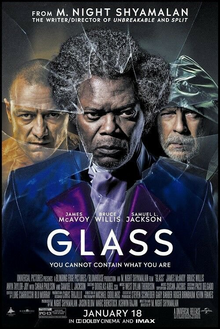
Glass brings the central characters of Unbreakable and Split into the same 2019 story. M. Night Shyamalan directs Bruce Willis as David Dunn, Samuel L. Jackson as Elijah Price and James McAvoy as Kevin Wendell Crumb. Shyamalan said the original Unbreakable outline already contained a triangle connecting these men: David and Kevin would fight, allowing Elijah to pursue his belief that comic books reflected a hidden reality. That arrangement gives the crossover a purpose beyond putting familiar faces together. Elijah wants a demonstration that will prove his theory, and the other men's confrontation is the event he believes can supply it. The earlier films approached that world from different characters before Glass brought their competing ideas into one institution.
Dr. Ellie Staple confines David and Kevin at Raven Hill, where Elijah is already a patient. She offers ordinary explanations for their apparent powers, while Elijah secretly prepares an escape and a public confrontation. The fight remains outside the hospital rather than reaching the skyscraper he describes. After learning Elijah caused the train wreck that killed his father, the Beast mortally wounds him. Casey brings Kevin's original identity forward, but a sniper shoots him. Officers drown David in a flooded pothole. Staple belongs to an organisation that suppresses superhumans, and she tries to erase the security recordings. Elijah has already sent the footage to a private website. His mother, Joseph Dunn and Casey receive copies and release them publicly. All three men die, but the surviving witnesses can still expose what happened and defeat the effort to keep their existence secret.
Shyamalan described the hospital conversations as the film's equivalent of action sequences. Sarah Paulson's Staple needed to challenge the other performers through argument, with the intelligence to hold the room while questioning what their characters believed. His directions addressed each character's motives rather than treating anger or intensity as useful in themselves. Jackson described Elijah as quietly studying the outside world while maintaining his own agenda, already aware of David and Kevin when they arrive. McAvoy faced a different kind of expansion from Split. Shyamalan said all twenty-four identities were developed and filmed, with twenty appearing in Glass. The work involved more than introducing names: each identity needed a manner of speaking and a relationship to the others. McAvoy described the Beast as having an increasingly developed worldview, expecting those who had suffered to rally behind him and discovering that his expectation was not automatically fulfilled.
The film also uses older material as memories. Shyamalan returned to scenes made for Unbreakable that had been removed from that film, giving Elijah a childhood memory connected to his need to believe he was extraordinary. A memory involving young Joseph addresses his continuing faith in his father. Bringing back those performances allowed the story to reach into the characters' pasts without recreating the younger actors. Shyamalan explained that each selection belonged to the question being asked at that point in Glass. He also described the difficulty of balancing the ensemble: Kevin brings several distinct major identities into a story that must still make room for David, Elijah, their families and Staple. The film's distribution of attention grew from that crowded set of relationships rather than a single hero's uninterrupted journey.
Colour gives the men identities that the hospital tries to drain away. Shyamalan associated David's green with protecting life, Kevin's ochre or mustard with the Beast's spiritual mission, and Elijah's purple with his view of himself as royalty. The ordinary world begins from a comparatively monochrome base, allowing stronger colours to accompany the characters' awareness of themselves. Staple's surroundings use pale blues, greys and whites. Shyamalan described the pink therapy room as a place where the stronger colours fade toward white, matching its effort to make extraordinary beliefs seem ordinary. His approach to spectacle followed a similarly restricted scale. He preferred directing physical action on the set and did not want to compete with superhero films through enormous digital cityscapes. The story can invoke the grand confrontation Elijah imagines while remaining among the buildings and people close to him.
The former Allentown State Hospital supplied the production with a location early enough to influence the script. Shyamalan explored its rooms and corridors, then revised scenes to use spaces that appealed to him. A striking pink day room could not be filmed as intended, so its appearance was recreated on another floor for the group sessions. Production designer Chris Trujillo used the old institution's architecture as a starting point while the characters' holding rooms served particular story functions. David's room contains a system that can spray water, Kevin's uses flashing lights to trigger changes of identity, and Elijah's padded room protects his fragile bones. Those arrangements make each room a different physical constraint. The hospital can present a common institutional face while treating each man's body as a separate problem to control.
Editor Luke Ciarrocchi described one problem that could not be solved simply by shortening a scene. A high, wide shot through an office window showed several characters arriving together in a car park. Screening audiences found the coincidence implausible, but removing the scene would leave a later gathering unexplained. Different entrances, exits and dialogue versions failed to settle it. Ciarrocchi and Shyamalan eventually discussed what the scene actually needed, then removed the dialogue and used ambient room sound. From that distant viewpoint, unheard conversation became natural, and the gathering could retain its mystery without explaining every arrival. Ciarrocchi also recalled reducing a long assembly in gradual passes rather than making one drastic cut. His example shows how the film's information could change through sound and timing even when the image itself remained a single continuous shot.