
Behind the film
- Year
- 1956
- Director
- George Stevens
- Writers
- Fred Guiol, Edna Ferber
- Runtime
- 3h 16m
- Genres
- Drama, Western
- Production
- Warner Bros. Entertainment, Warner Bros. Pictures
- Country
- United States
- Cast
- Elizabeth Taylor, Rock Hudson, James Dean, Carroll Baker, Jane Withers, Mercedes McCambridge, Dennis Hopper, Sal Mineo
About the film
Contains story spoilers.
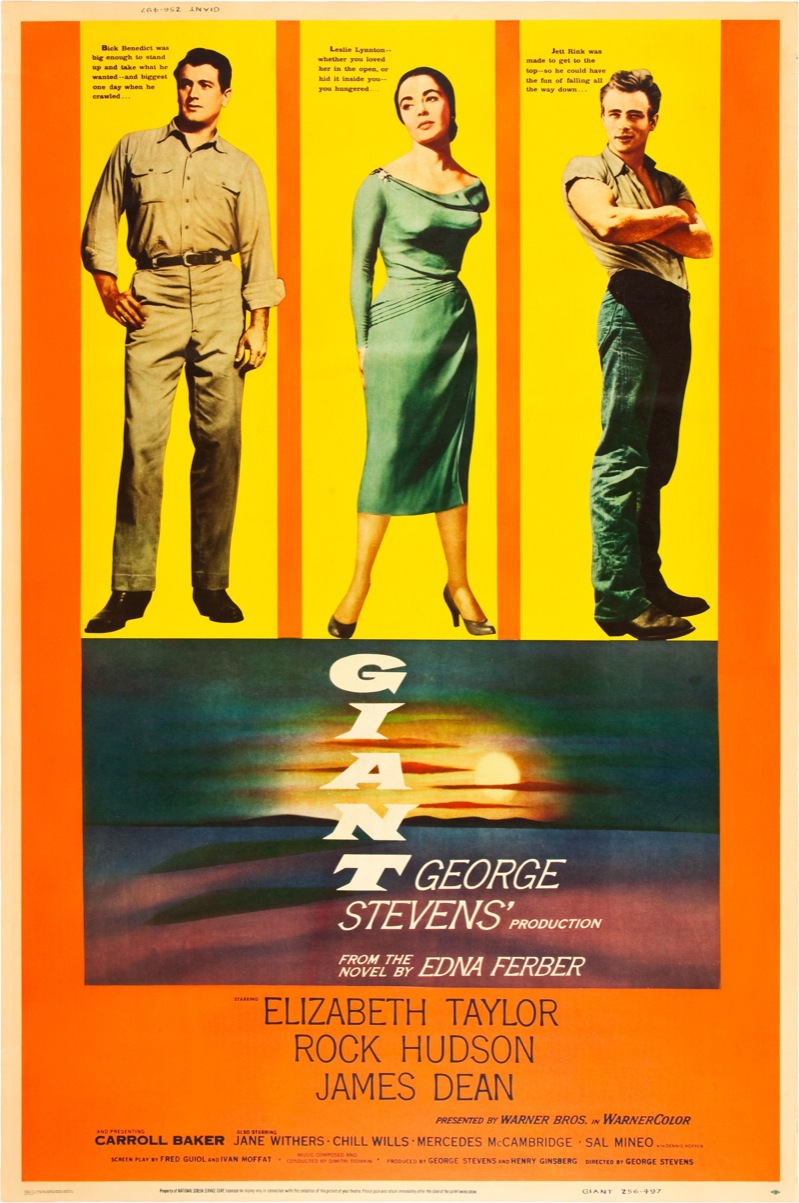
George Stevens’s Giant follows the Benedict family across several decades, beginning when rancher Jordan “Bick” Benedict travels from Texas to Maryland to buy a horse. He falls for Leslie Lynnton, whose independent manner and interest in politics set her apart from the life Bick expects to bring her into. They marry and return to Reata, the huge cattle ranch he runs with his sister Luz. Leslie arrives in a world where the family’s wealth depends on Mexican American workers, yet Bick treats them as a separate class. She greets their driver Angel Obregón warmly and soon asks to see the village where the workers live. The difference between Leslie’s curiosity and Bick’s dismissive habits shapes the marriage from the start.
At Reata, Luz sees Leslie as a rival for control of the household, while Jett Rink, a poor ranch hand, is drawn to Leslie and resents Bick. Leslie notices the conditions in the workers’ village when she meets Angel’s sick wife and newborn son, Angel III. Luz dies after a fall from a horse, and Leslie presses the family doctor to treat the baby despite Bick’s objections. Luz has left Jett a small piece of land; when Bick offers him money to keep it in the family, Jett refuses and calls the plot Little Reata. The choice gives him a place of his own, and when he strikes oil there, it changes the balance between the two men. Reata’s cattle wealth and the oil beneath the surrounding land begin pulling the family toward different futures.
Leslie and Bick have twins, Judy and Jordan, then a younger daughter named Luz. Bick assumes his son will inherit the ranch and tries to make him ride a pony, though the frightened boy would rather play with a doctor’s kit. Angel III, the child Leslie helped, handles the horse confidently. This small family occasion makes Bick confront a future he cannot simply order into existence. Leslie continues to campaign for better treatment of the workers, including help from a Mexican American physician, and disputes Bick’s control over both the ranch and their children. Their arguments widen when she challenges the men’s political talk and refuses to accept that she should stay quiet. Eventually she takes the children to Maryland for a long visit. Bick arrives at her sister’s wedding and asks her to return, accepting that she will not become less outspoken.
While the Benedict children grow up, Jett’s oil strike turns him into a millionaire and he builds a company and public image around his new power. Bick resents the success on land he considers part of Reata and forces Jett to change the company name. The war and postwar years bring oil money to the region, but prosperity does not erase the division between white Texans and Mexican Americans. Jordan chooses medicine rather than the ranch and secretly marries Juana, a nurse who is Mexican American. Bick is furious when he hears the news, yet after Angel III dies in military service, he offers the grieving family a Texas flag from his own collection. The gesture does not undo his earlier prejudice, but it shows that his relationship with the Obregón family has changed as the next generation makes its own choices.
Years later, Jett’s airport and hotel opening brings the families together for a celebration. Their younger daughter Luz, named for Bick’s sister, has become infatuated with Jett, but Jett is drunk and still obsessed with Leslie. At the hotel, staff refuse to serve Juana because of Jett’s order against doing business with Mexican Americans. Jordan smashes a mirror in protest and later confronts Jett at the banquet. Bick joins the fight, though Jett is too drunk to defend himself, and the family leaves the party in disgust. On the drive home they stop at a roadside café. The owner lets the Benedicts stay because of their status but tries to throw out an older Mexican couple. Bick challenges him and is beaten, an outcome that matters to Leslie because he has finally taken a public stand against the exclusion she has opposed for years.
Back at Reata, Bick calls himself a failure, but Leslie tells him that the diner fight showed her what kind of man he could be. Their closing moment is quieter than the public brawl: they sit with their two grandsons, one white and one brown, and Bick jokes that people will have to accept how the boys look. The film ends on their faces, with the family’s future no longer tied to one heir or a single way of life. The ranch house and open Texas land give the story an epic scale, while the central changes happen at a dinner table, a workers’ village, a hotel salon and a roadside café. Reata’s shift from cattle to oil runs alongside the family’s slow movement toward a wider idea of belonging.