
Behind the film
- Year
- 2008
- Director
- Peter Segal
- Writers
- Tom Astle, Matt Ember
- Runtime
- 1h 50m
- Genres
- Spy, Action
- Production
- Village Roadshow Pictures
- Country
- United States
- Cast
- Steve Carell, Anne Hathaway, Dwayne Johnson, Alan Arkin, Terence Stamp, Terry Crews, David Koechner, James Caan
About the film
Contains story spoilers.
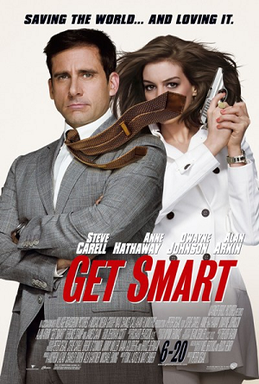
Peter Segal’s Get Smart reworks the 1960s spy comedy as an origin story for Maxwell Smart. Steve Carell plays Max as a pedantic but sharp CONTROL analyst who wants to become a field agent. Though he aces the tests, the Chief keeps him at headquarters for his analytical skill. The film opens by sending him through CONTROL’s long sequence of locked doors and a phone booth, then reveals the agency still operating below the city. Its museum preserves familiar tools from the earlier series, including the shoe phone and Cone of Silence, as relics that remain in active use.
Max’s promotion comes when KAOS attacks CONTROL and compromises the identities of its agents. With much of the field force exposed, the Chief makes Max Agent 86 and pairs him with Agent 99, a capable operative whose recent plastic surgery has left her identity unknown to KAOS. She is wary of Max’s clumsiness, while he is excited to be out of the analyst’s chair. They follow stolen nuclear material to Russia. On the flight, Max is mistaken for a threat; a dart fired from his Swiss Army knife hits the plane’s eject button, and 99 parachutes after him.
The trail runs through bomb maker Ladislas Krstic’s party to a Moscow bakery concealing a weapons factory. There Max meets KAOS leader Siegfried and his lieutenant Shtarker. The factory is destroyed, but its weapons are already gone; Agent 23’s inspection leaves Max under suspicion rather than celebrated. A warning from KAOS heavy Dalip redirects him to Los Angeles, where the President is due to attend a concert. Radiation detected on 23 finally exposes the admired agent as the traitor. Max’s analytical habits, which seemed ill suited to fieldwork, now matter to identifying the real threat.
The deception also changes the partnership. Agent 99 begins as the experienced guide to a man who has only just left his desk, yet experience does not make the agency immune to being misled. Agent 23 has the credentials Max wants; his betrayal makes reputation an unreliable measure of competence. Max and 99 have to combine practical ability with his attention to apparently trivial details. The film keeps the spy assignment recognizable even when their exchanges are comic: stolen nuclear material, concealed identities and a danger to civilians remain the reasons for their journey.
Agent 23 takes 99 hostage, leading to a chase and a fatal collision with a train. Max then interrupts the concert before the musical trigger can set off the bomb. The immediate danger is resolved through the same collision of urgent action and awkward intervention that has followed his promotion. He does not become an elegant, unflappable agent once the plot reaches its largest scale; the awkward man the agency underestimated is still the one who must act. Max and 99’s relationship also develops beyond the reluctant professional pairing with which they began.
The older series supplies a recognizable collection of objects and comic positions. The shoe phone and Cone of Silence turn communication, normally a spy’s essential advantage, into something cumbersome and conspicuous. Bill Murray appears as Agent 13, whose assignment leaves him stationed inside a tree. Max’s lengthy reports make his attention to detail an office frustration before it becomes useful elsewhere. These details establish a particular kind of intelligence service, one whose machinery and bureaucracy can be as inconvenient as its enemies. The film carries that institutional absurdity into a much larger action setting.
Segal and Carell approached that expansion by agreeing that the villains should be a credible danger rather than another set of comedians. Their model was a spy thriller with comic behavior inside it, and Segal described the desired footing as a comedic Bourne Identity. Carell also chose to develop his own Max rather than imitate Don Adams. Improvisation was part of that process, but Segal expected it to return to the story instead of becoming a detachable routine. Hathaway brought improvised material to her first audition with Carell, and some of it survived into the film. Segal and the writers also prepared alternative jokes so that a scene could be adjusted after a preview without abandoning its purpose. That method helps explain the mixture on screen: an action scene continues to advance the assignment while a line, a reaction or an uncooperative device changes its rhythm.
The adaptation’s origin-story structure gave Segal room to introduce both the agency and the relationship instead of assuming the audience already knew them. He discussed that choice with Mel Brooks, who supported the idea of showing how Max becomes Agent 86 and meets 99. At the same time, Segal wanted returning viewers to recognize the world they had followed on television. Three of the original series’ cars appear, alongside the gadgets and familiar phrases, and original Siegfried actor Bernie Kopell has a cameo. Segal described placing small references throughout the film, including ones that would be easy to overlook on a first viewing. Those continuities coexist with a contemporary setting and a different starting point for Max. The resulting film can introduce CONTROL through a new recruit’s ambitions while letting older viewers recognize how much of its peculiar equipment and sense of ceremony has survived.