
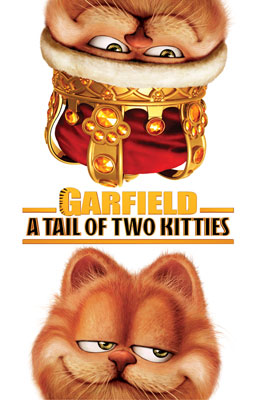
Behind the film
- Year
- 2006
- Director
- Tim Hill
- Writers
- Joel Cohen
- Genres
- Comedy, Children's, Live-action/animated
- Production
- Davis Entertainment, 20th Century Studios
- Country
- United States
- Cast
- Breckin Meyer, Jennifer Love Hewitt, Billy Connolly, Tim Curry, Ian Abercrombie, Roger Rees, Bob Hoskins, Greg Ellis
About the film
Contains story spoilers, including the ending.
Jon Arbuckle's planned proposal to Liz Wilson takes him to London in this 2006 sequel, directed by Tim Hill. Garfield objects to the engagement, then escapes a kennel with Odie and hides in Jon's luggage. Their adventure begins when the pets leave the hotel and get lost. Meanwhile, Lady Eleanor Carlyle has left her castle to Prince XII, an orange cat almost identical to Garfield. Her nephew, Lord Dargis, can inherit only after Prince dies, so he throws the cat into a river inside a picnic basket. Jon finds the bedraggled Prince and takes him for Garfield; Smithee, the castle's butler, makes the opposite mistake. Bill Murray again voices Garfield, with Breckin Meyer returning as Jon and Jennifer Love Hewitt as Liz. Tim Curry supplies Prince's voice, and Billy Connolly plays Dargis. Garfield's new address comes with servants, elaborate meals and animals who expect him to behave like their ruler.
Winston the bulldog persuades the castle animals to protect the impostor: Dargis wants a resort that would destroy their home. Garfield teaches them to make lasagna, while Prince discovers life as an ordinary pet. Both eventually want to return home. Once reunited, they work against Dargis together. The solicitors see both cats, exposing the deception, but Dargis threatens them with a blunderbuss and takes Liz hostage. Jon and the animals overcome him, and Smithee calls the authorities. Dargis is arrested. Garfield also changes his mind about Jon's engagement, helping him propose to Liz, who accepts.
The proposal mattered before filming began. In a Radio Free interview, Meyer said it was the centre of the story that the filmmakers wanted to keep when Hewitt's television schedule forced changes. An early script had the human characters going to London for the whole adventure. The revision had Jon follow Liz there. Meyer recalled a week of filming in London without Hewitt, followed by work on newly built castle interiors. Hewitt confirmed that she never filmed in London. Her availability also shaped the working week: Meyer said she joined the film on Sundays after spending weekdays on Ghost Whisperer. He welcomed having more human performers to react to, including Connolly and Ian Abercrombie as Smithee, after scenes spent acting opposite a stand-in sack for Garfield. The sequel's larger animal cast meant more imaginary partners as well as more live ones.
Animation supervisor Chris Bailey gave the two orange cats different ways of moving. In Animation World Network's production report, he described Garfield's wider paws, swaying hips and lower head, while Prince moved with his toes closer together and his nose higher. Their resemblance drove the mistaken identity story, but their posture could keep their personalities apart. Bailey also described Prince discovering Garfield's habits: after eating lasagna, the royal cat studies his swollen stomach and prods it as though he cannot quite believe it belongs to him. Rainmaker handled talking faces on filmed animals alongside Rhythm & Hues' fully animated cats. Supervisor Charlene Eberle found Winston especially demanding. His folds, panting and changing appearance from different angles complicated the work of matching a digital face to the real bulldog. Her team adjusted the face, wrinkles and lighting shot by shot so the added expressions would sit against the photographed animal.
Betsy Paterson, Rhythm & Hues' visual-effects supervisor, explained the fur work in a separate Computer Graphics World interview. Garfield had 3.3 million hairs, controlled through guide hairs and painted maps specifying such things as length, density and clumping. Most movement followed physical rules; contact with other objects required the guides to move the fur appropriately. Mud and lasagna sauce brought another problem. The artists first groomed and textured the fur to look wet or dirty, then attached individually modelled pieces that could react to gravity and fall away. Lighting also needed care because Garfield's orange coat responded strongly to coloured illumination. Paterson said the environmental lighting was toned down to keep the orange bright enough for the director. When the cats sat on beds or couches, their bodies needed to press into the soft surfaces. Matching shadows helped make those digital bodies appear to carry weight.
American Humane's animal-action report describes the kitchen crowd as separate performances filmed against green screens. Trainers used cues and edible rewards. Birds were released at intervals, and each animal's food was fake or suitable for its species. The attack on Dargis used similar precautions. The mousetrap's spring was removed before the rabbit nudged it. Odie grabbed fabric attached to the actor's jacket. The ferret's journey up a trouser leg used a trainer's altered costume, with an exit at the knee and a bandage protecting the shin. The final-credit pool party also separated animals that appear together. American Humane records that different species were filmed separately in the water. Pigs had a carpeted ramp and stairs into the spa. Trainers accompanied the cows into the pool while staying out of view. The ferret's diving-board splash began with a short jump onto furniture pads on dry land, against a green screen.