
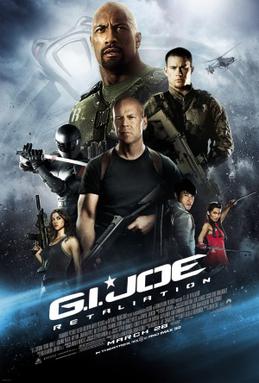
Behind the film
- Year
- 2013
- Director
- Jon M. Chu
- Writers
- Rhett Reese, Paul Wernick
- Genres
- Action, Thriller, Science fiction, Ninja
- Production
- Metro-Goldwyn-Mayer, Hasbro, Skydance Media
- Country
- United States
- Cast
- Dwayne Johnson, Bruce Willis, D. J. Cotrona, Lee Byung-hun, Adrianne Palicki, Ray Park, Jonathan Pryce, Ray Stevenson
About the film
Contains story spoilers, including the ending.
G.I. Joe: Retaliation turns the team's official position into its greatest vulnerability. In Jon M. Chu's 2013 sequel, Duke leads a mission to secure nuclear weapons in Pakistan, then loses most of his unit in an attack on their encampment. The orders come from the office that should protect them. Zartan has replaced the American president, while the real president remains a prisoner, and the impostor can make Cobra's attack appear to be a legitimate military operation. Dwayne Johnson's Roadblock, Adrianne Palicki's Lady Jaye and D.J. Cotrona's Flint survive to investigate. Their immediate problem is therefore larger than finding an enemy base: the enemy controls the public account of who they are. Channing Tatum's Duke dies in the assault, moving leadership and the work of retaliation to the remaining members.
The survivors' return to America develops alongside a separate conflict between Snake Eyes and Storm Shadow. The ninja rivalry concerns an old killing and the loyalties formed around it, while Roadblock's group needs to expose a contemporary impostor. Both strands make deception an obstacle that physical strength alone cannot remove. Bruce Willis plays General Joseph Colton, an older figure who supplies weapons and assistance when the surviving Joes can no longer rely on their organisation. The screenplay by Rhett Reese and Paul Wernick moves between that improvised counterattack and Cobra's increasingly expansive threats. Its military world includes both heavy conventional firepower and machines with unexpected destructive functions. The combination gives the film several kinds of combat: close fighting, gun battles and attacks whose danger lies in what a piece of equipment can transform into.
The two investigations converge through Storm Shadow's discovery that Zartan killed the Hard Master and framed him. He joins Snake Eyes and Jinx against Cobra. At a summit, the false president provokes the nuclear powers into launching their missiles, then destroys his own arsenal in flight, prompting the others to do likewise. Their disarmament leaves them exposed to Project Zeus, Cobra's orbital weapons, demonstrated through the destruction of central London. Storm Shadow kills Zartan, and Colton and Lady Jaye free the real president. Roadblock defeats Firefly and destroys the orbital weapons, but Cobra Commander escapes. The restored president honours the Joes and their dead. Storm Shadow departs after taking his revenge, while Cobra Commander's survival leaves the larger struggle unfinished. Restoring the team's name closes the immediate betrayal without eliminating the organisation behind it.
The attack on the encampment combines practical destruction with effects that extend its scale. Two versions of the camp were constructed at a Louisiana gravel pit, allowing the production to keep one intact while another was damaged. Method Studios added helicopters, projectiles, tracer fire and additional explosions. The photographed blasts provided timing and lighting references for the computer generated attack, helping its separate elements occupy the same night. A different kind of construction makes Zartan's disguise visible. Digital Domain created a fully digital head for the moment when he cuts his skin and nanomites repair it. Models based on Arnold Vosloo and Jonathan Pryce allowed the image to change between the concealed man and his borrowed appearance. That effect gives the political deception a physical mechanism: the president's face is something Cobra can manufacture and maintain.
The mountain fight had an equally constructed geography. At the Michoud Assembly Facility in Louisiana, the production built a snowy monastery exterior, its interior and an artificial rock wall. Stunt performers working on that wall supplied acrobatics for a sequence also drawing on footage of performers using ziplines on a real mountain. These were separate pieces of a single screen location, with indoor sets providing access to bodies, ropes and combat movements that would be difficult to photograph together on an actual cliff. The same location report describes a second unit filming Roadblock and Flint pursuing Firefly beside a grassy beach, standing in for South Carolina. The production could therefore organise very different environments around the action's requirements, from the enclosed monastery to the open ground of the final pursuit. The monastery's full scale sets also gave the performers a physical environment before the finished mountain landscape was assembled around them.
ILM's work on the cliff sequence connected the photographed performers to a digital mountain through small visual cues. Reflections on polished and wet rock, contact shadows and patches of sunlight added depth to footage taken largely in shadow. Slight camera movement made the viewpoint feel suspended near the fighters. When an otherwise usable stunt needed a stronger kick or sword movement, digital limbs could replace parts of the performer. The avalanche was built from an ice overhang divided into pieces, with animation and simulations breaking it apart before layers of particles supplied the spreading snow. London required a different destructive rule. The ground was treated as a shell that could fracture, with the moving plates driving the buildings' collapse. Helicopter photography established camera and lighting, but the extent of the damage ultimately required a digital city.